

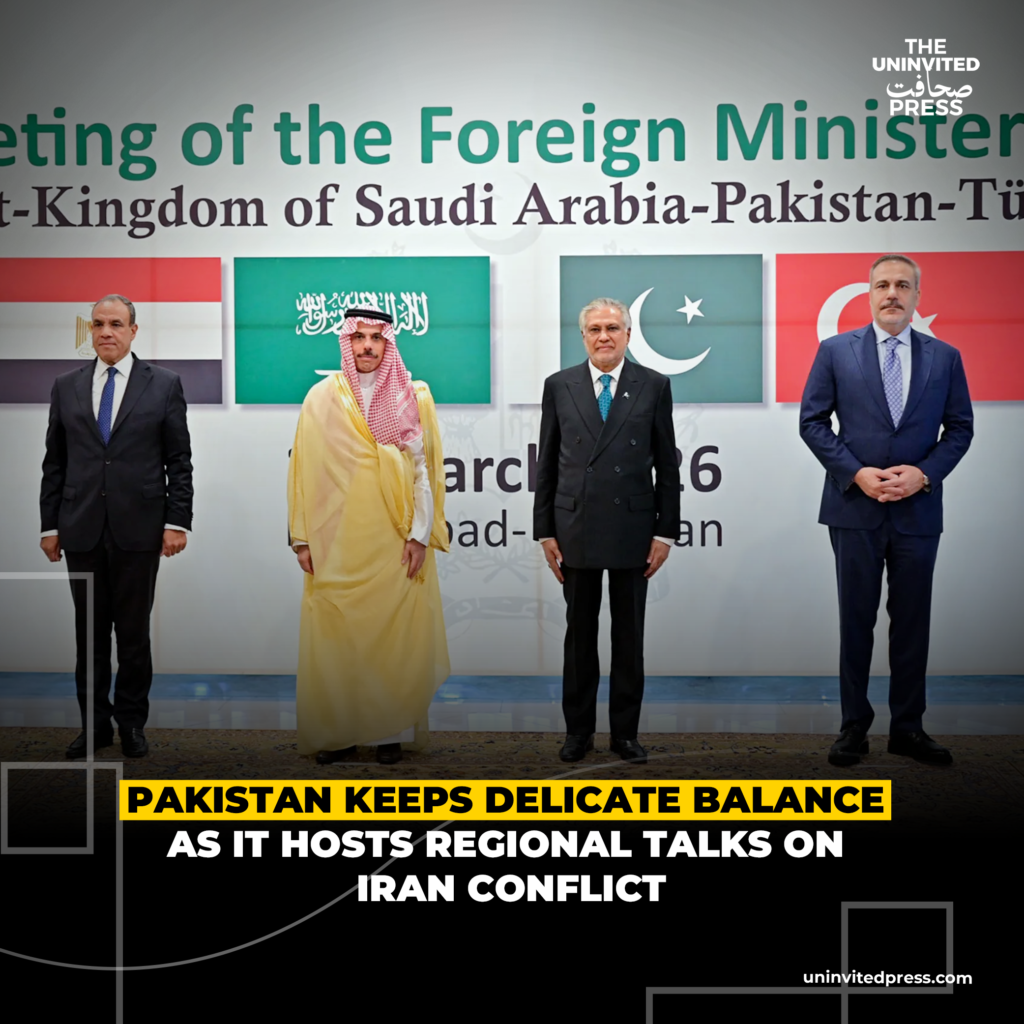
Foreign ministers from Saudi Arabia, Egypt and Türkiye meet in Islamabad to push for de-escalation, while Pakistan offers to host US-Iran negotiations amid fears of wider conflict.
Pakistan has positioned itself at the centre of diplomatic efforts to end the month-long US-Israeli war on Iran, hosting a high-level meeting of foreign ministers from Saudi Arabia, Egypt and Türkiye as the conflict risks further escalation.
The two-day consultations, which began on Sunday in the Pakistani capital, brought together Pakistani Foreign Minister Mohammad Ishaq Dar with Saudi Arabia’s Prince Faisal bin Farhan, Egypt’s Badr Abdelatty and Türkiye’s Hakan Fidan. The ministers discussed ways to achieve an “early and permanent end” to the war, including possible pathways for direct or indirect US-Iran talks.
Pakistan’s Foreign Ministry described the gathering as part of broader efforts to de-escalate tensions in the region. Following the meeting, Ishaq Dar stated that Pakistan is ready to host “meaningful” talks between Washington and Tehran, building on its role as a messenger relaying messages between the two sides.
Pakistan’s Delicate Diplomatic Balancing in Iran Conflict:
Pakistan’s mediation role reflects a careful navigation of competing interests. As a neighbour sharing a long border with Iran, Islamabad maintains cultural and religious ties with Tehran, including a significant Shia population at home. At the same time, Pakistan has close defence and economic relations with Saudi Arabia, including a mutual defence pact that could be invoked in case of aggression against the kingdom.
Analysts describe Pakistan’s position as a “very delicate balancing act.” While condemning strikes on Iran and civilian casualties, Pakistani officials have avoided directly naming the United States in their criticism, instead focusing on calls for restraint and dialogue. Islamabad has also expressed readiness to defend Saudi interests if needed, without taking steps that would provoke direct confrontation with Iran.
The talks come as the conflict enters its second month, with reports of US military build-up, including additional Marines in the region, and Iranian warnings against any ground incursion. Discussions in Islamabad reportedly touched on proposals to reopen the Strait of Hormuz to shipping, a critical chokepoint for global oil supplies that has seen disruptions amid the fighting.
Pakistan’s Mediation Efforts Face Diplomatic and Strategic Limits:
Pakistan has been shuttling messages between Washington and Tehran, with officials confirming that a reported 15-point US proposal is under deliberation in Iran. Pakistani Prime Minister Shehbaz Sharif recently held extended talks with Iranian President Masoud Pezeshkian, underscoring Islamabad’s efforts to keep channels open.
Regional powers involved in the Islamabad meeting have expressed support for diplomatic initiatives, though differences remain over the terms of any potential ceasefire or agreement. Iran has shown deep mistrust of US intentions, citing reports of possible American ground operations and demands that include ending uranium enrichment and curbing support for regional allies.
Critics and observers note that while Pakistan’s role as a facilitator is welcomed by some, its own internal economic and security challenges, along with the risk of being drawn into the conflict, limit how far it can push for breakthroughs.
Humanitarian concerns are also rising, with calls for protection of civilians and an end to actions that could further destabilise the broader Middle East, including spillover effects on Gulf states and global energy markets.
As the foreign ministers’ meeting continues into Monday, attention remains on whether the gathering can produce concrete proposals to bridge the gap between the US and Iran. For Pakistan, success in hosting these talks could enhance its diplomatic stature as a middle power, but failure risks exposing the limits of its influence in a conflict driven by major powers.