

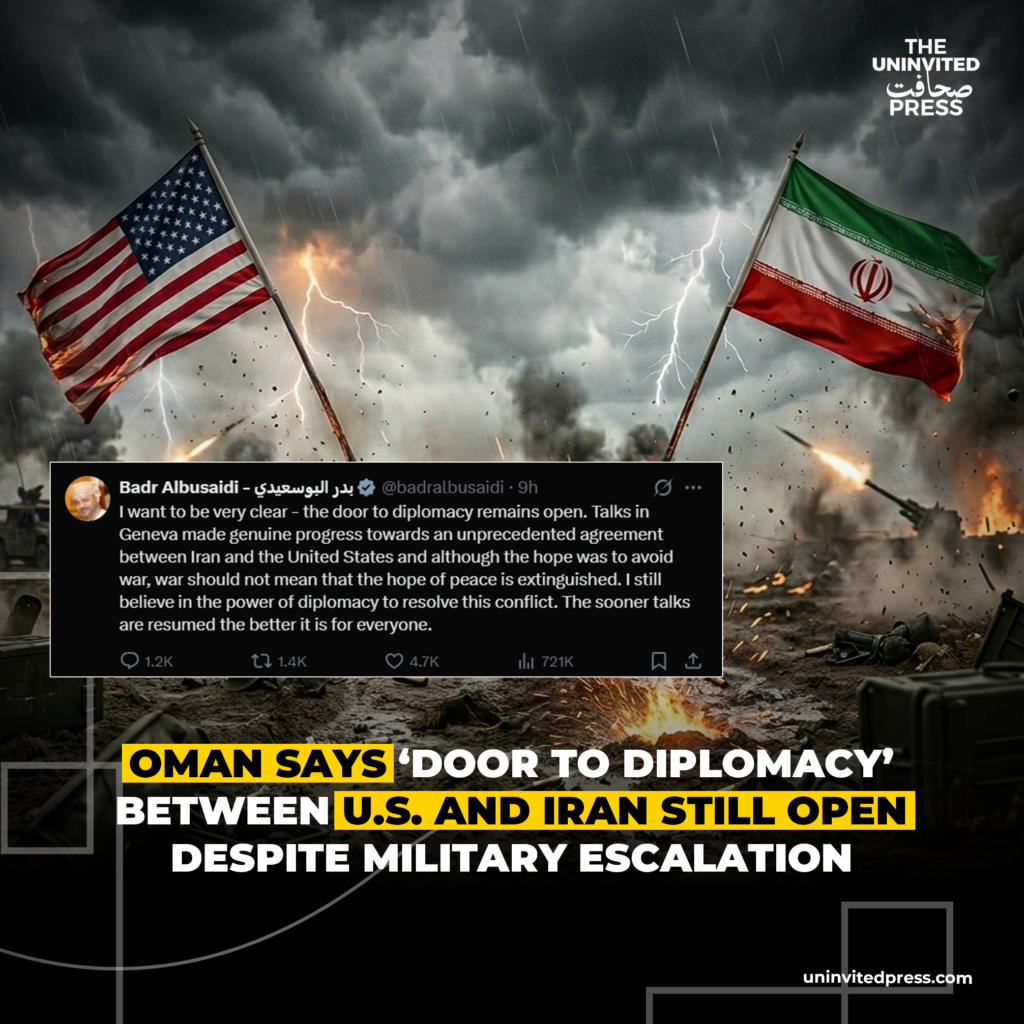
Oman’s foreign minister urges Washington and Tehran to return to talks despite U.S.-Israeli strikes and regional military tensions, saying diplomacy still offers a path to peace.
Oman Signals Diplomacy Still Possible Amid Rising Regional Tensions:
Oman’s Foreign Minister Badr bin Hamad al-Busaidi said on March 2, 2026 that the “door to diplomacy remains open” between the United States and Iran, even as military strikes and retaliatory actions escalate across the Middle East. His remarks underscore Muscat’s mediating role and a continued push for negotiations despite mounting conflict.
Oman Urges U.S.-Iran Talks to Resume:
In a post on X (formerly Twitter), Oman’s foreign minister made it clear that diplomatic engagement between the United States and Iran has not been abandoned, despite recent hostilities in the region. “I want to be very clear-the door to diplomacy remains open,” Al-Busaidi wrote, emphasizing progress made in earlier negotiations held in Geneva.
Al-Busaidi noted that talks between U.S. and Iranian delegations had achieved “genuine progress towards an unprecedented agreement,” although a formal deal had yet to be reached. He added that while efforts had hoped to prevent conflict, the outbreak of violence should not extinguish hopes for a peaceful resolution.
The foreign minister reaffirmed his belief that diplomacy could still play a crucial role in resolving tensions and urged both sides to resume discussions at the earliest opportunity, framing dialogue as beneficial for all parties involved.
Oman has long served as a neutral facilitator between Tehran and Washington, especially in talks aimed at curbing Iran’s nuclear ambitions and easing broader geopolitical frictions. The Sultanate’s role as a mediator has included hosting indirect negotiations and encouraging steps toward de-escalation.
Amid Strikes and Retaliation, Diplomacy Struggles to Hold Ground:
Tensions between the United States and Iran have surged following joint U.S.–Israeli strikes on Iranian targets in late February 2026, which included an attack on Tehran that killed Iran’s Supreme Leader. Iran has since retaliated with missile and drone strikes across the Middle East, targeting U.S. bases and allied installations.
Even amid this escalation, back-channel and indirect talks have continued. Delegations from both nations met in Geneva in late February to negotiate possible diplomatic pathways, addressing contentious issues including nuclear enrichment and sanctions relief. While no conclusive agreement has been announced, both sides described the discussions as substantive and constructive.
Oman has historically acted as a mediator between the two countries, hosting negotiations and maintaining relations with both Tehran and Washington. Its continued diplomatic engagement aims to prevent the current military flare-up from spiraling into a wider regional war.
Diplomacy’s persistence contrasts with sharp military activity across the region, including attacks in Gulf cities and shifting security dynamics among U.S. allies. Oman’s statement serves as a reminder that, even amid intense military confrontation, avenues for negotiation and de-escalation remain open.