

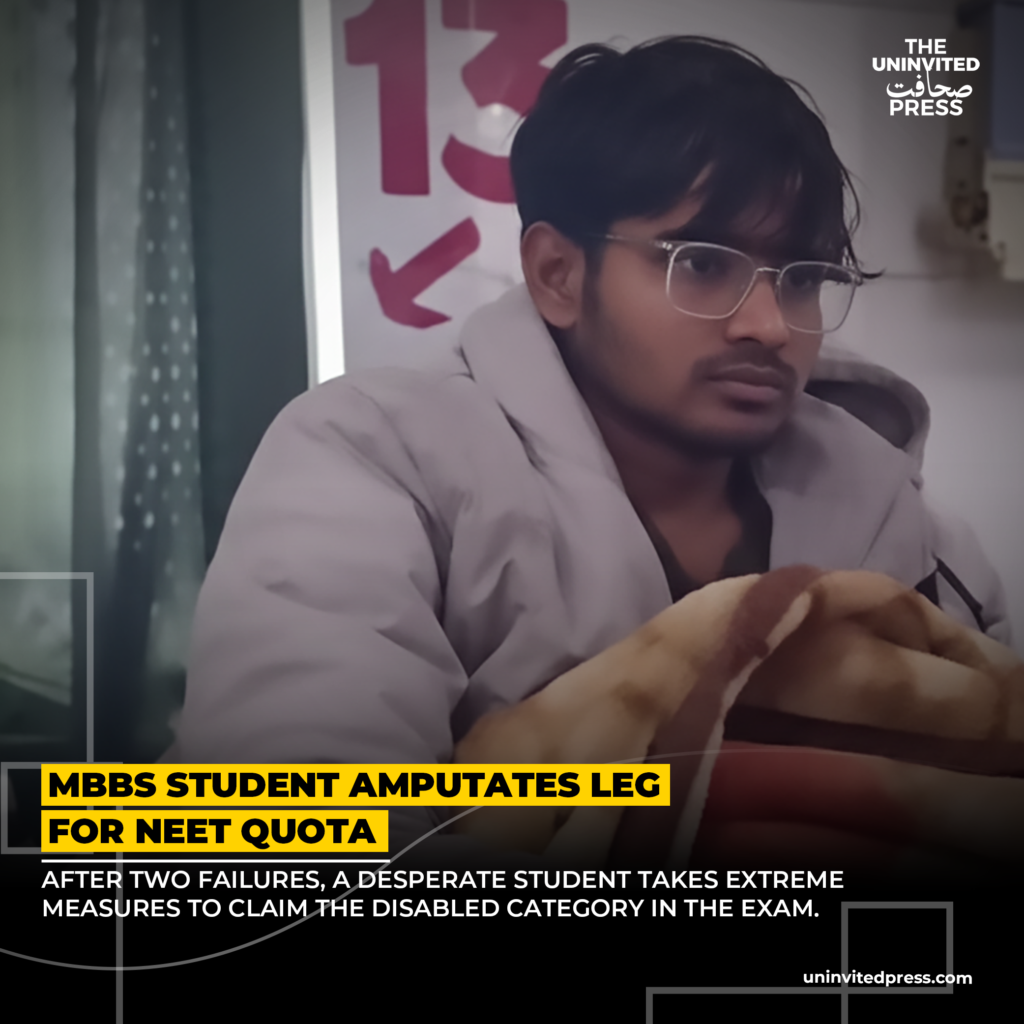
Uttar Pradesh youth’s shocking self-inflicted injury exposes extreme pressure of India’s medical entrance exam system.
Cut by Competition: NEET Pressure Drives Aspirant to a Shocking Extreme:
A 24-year-old NEET aspirant from Jaunpur, Uttar Pradesh, allegedly amputated part of his own left foot in a bid to qualify for the Persons with Disabilities (PwD) quota in medical college admissions after failing the exam twice. Police investigations revealed the injury was self-inflicted, with the student now under treatment and facing potential charges. This extreme act highlights the crushing desperation fueled by fierce competition for limited MBBS seats in India, where NEET failures can derail lifelong dreams and spark nationwide debate on exam reforms and mental health support.
A Trail of Desperation: Police Uncover Self-Inflicted Injury Behind PwD Quota Bid:
The incident came to light when Suraj Bhaskar, a 24-year-old from Khalilpur village in Jaunpur, reported to police that unknown assailants had attacked him and severed part of his left foot. Officers from Line Bazaar police station launched an investigation, but discrepancies quickly emerged: no witnesses, no motive, and the wound’s nature suggested deliberate action.
During questioning and home searches, police discovered a diary containing entries like “I will become an MBBS doctor in 2026” and references to securing admission “at any cost.” Digital evidence and medical knowledge from his D-Pharma background indicated he had self-amputated using tools and techniques to create a qualifying disability (locomotor impairment ≥40% for PwD quota).
The National Testing Agency (NTA) allocates 5% PwD reservation in NEET for MBBS/BDS seats under the Rights of Persons with Disabilities Act, 2016. Suraj, having failed NEET twice, allegedly saw this as his last path to a government medical college seat amid cut-throat competition-over 2.4 million candidates vie for roughly 100,000 seats annually.
Police confirmed the injury was self-inflicted and are treating the case as attempted fraud of government quota benefits. Suraj remains hospitalized for treatment, with no immediate charges filed as of late January 2026.
Mental Health Crisis in Competitive Education:
The case has reignited debate over the extreme stress faced by students preparing for high-stakes entrance exams in India. Mental health experts warn that relentless competition, social pressure, fear of failure, and lack of counseling support can push vulnerable students toward irreversible decisions.
Psychiatrists and educators alike are calling for expanded mental health services, early intervention programs, and reforms to reduce the all-or-nothing nature of medical entrance testing.
When Competition Crosses a Line: Rethinking Quotas, Care, and Student Well-Being:
While disability quotas are meant to ensure equity and inclusion, experts argue that the incident highlights the need for clearer awareness, stronger safeguards, and better communication about eligibility criteria. Policymakers are being urged to review whether the current system adequately balances fairness with compassion.
This incident stands as a sobering reminder of the human cost behind academic competition. Beyond rules and rankings, educators stress the need to prioritize student well-being, realistic career counseling, and dignity over desperation.
As investigations continue, the case is likely to influence future discussions on exam reforms, mental health policy, and ethical boundaries in education.
How NEET Pressure, Quota Rules, and Trust Deficits Collide?
NEET-UG, introduced in 2013, serves as the single entrance exam for MBBS/BDS across India, replacing multiple state exams to ensure uniformity. However, intense competition-often 20-25 lakh applicants for 1 lakh seats-has led to widespread stress, coaching center dependency, and reported suicides (over 20 in Kota alone in 2025).The PwD quota reserves 5% seats for benchmark disabilities, including specified locomotor impairments, aiming for inclusion. While intended to support genuinely disabled candidates, the category has faced misuse allegations, prompting stricter verification by medical boards.
This case echoes past controversies: In 2018-2020, Supreme Court rulings tightened PwD guidelines after fraud claims. The 2024-2025 NEET paper leak scandal further eroded trust, sparking protests and demands for reforms like multiple attempts or alternative pathways.
The incident exposes systemic failures-extreme pressure, inadequate mental health support, and quota vulnerabilities-fueling calls to address coaching culture, counseling, and exam fairness.