

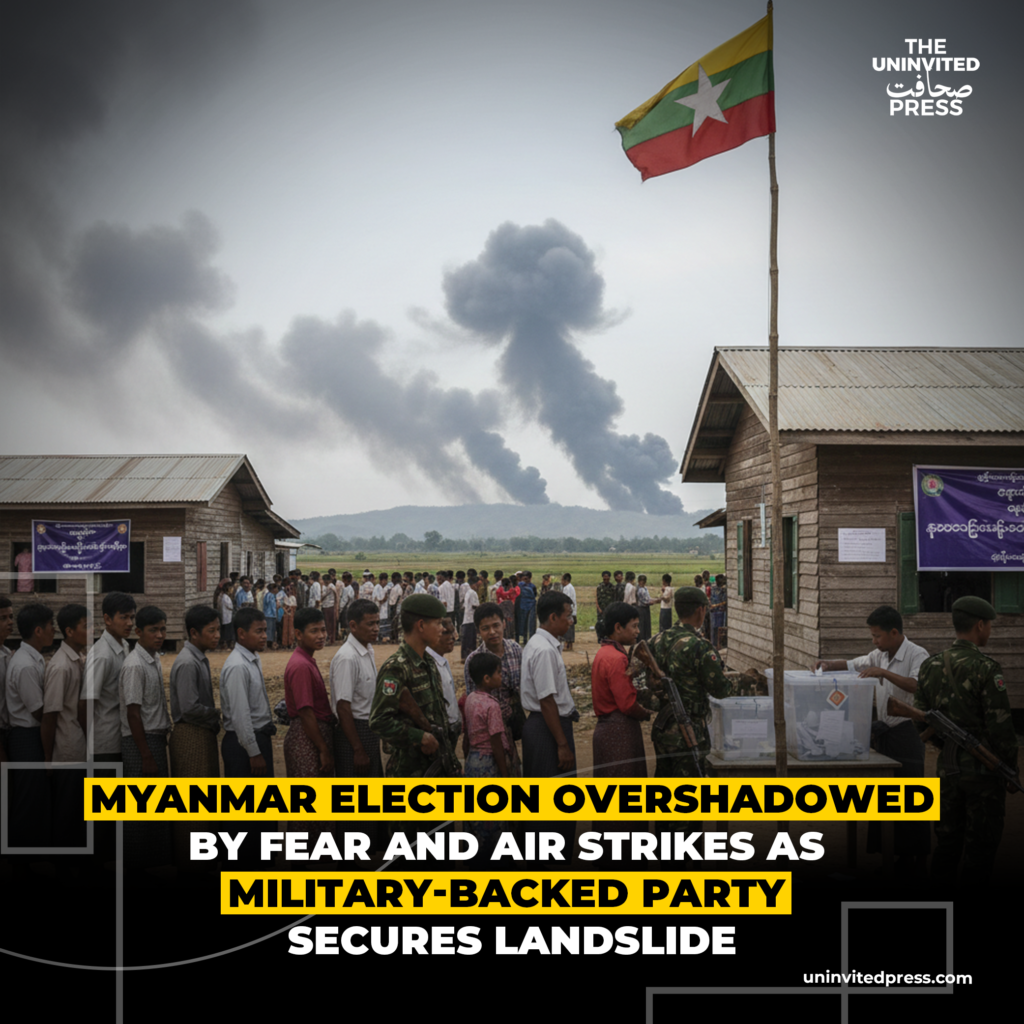
Myanmar’s junta-backed USDP secures landslide in sham 2025-26 election amid air strikes killing 170 civilians, entrenching military rule post-2021 coup.
Myanmar Junta Claims Landslide Amid Air Strikes, Humanitarian Crisis:
Myanmar’s military junta declared a sweeping victory for its proxy Union Solidarity and Development Party (USDP) on January 30, 2026, following a controversial three-phase general election marred by violence and exclusion. With the USDP securing over 80 percent of contested seats amid ongoing civil war, the results cement the regime’s grip five years after the 2021 coup that ousted Aung San Suu Kyi’s government. As air strikes killed at least 170 civilians during the voting window, critics decry the process as a facade to legitimize rule-by-force, leaving millions disenfranchised and deepening a humanitarian crisis that has displaced over 3 million people.
Three Phases, One Outcome: Junta's Proxy Party Claims Overwhelming Victory:
Myanmar’s Union Election Commission (UEC) released final tallies on January 30, 2026, confirming the USDP’s dominance in the staggered polls. In the Pyithu Hluttaw, the lower house with 440 seats (330 elected, 110 reserved for military), the USDP claimed 232 elected seats. For the Amyotha Hluttaw, the upper house with 224 seats (168 elected, 56 military), the party secured 108 elected seats. Combined with the constitutionally mandated 25 percent military bloc, pro-junta forces control about 86 percent of parliament.
The election unfolded in phases to manage security amid civil strife. Phase one on December 28, 2025, covered 102 townships, with USDP taking 89 of 102 lower house seats. Phase two on January 11, 2026, spanned 100 townships, yielding 86 lower house seats for USDP. The final phase on January 25, 2026, in 63 townships, added 57 lower house seats to their tally. Minor ethnic parties, like the Shan Nationalities Democratic Party (7 seats) and Mon Unity Party (5 seats), picked up scraps, while independents and smaller groups claimed the rest.
Voting proceeded under heavy military presence, with reports of coercion in places like Karenni State. An armed group attacked polling stations in Loikaw, but junta forces maintained control in selected areas. By February 1, 2026-marking the coup’s fifth anniversary-the results stood unchallenged domestically, though resistance groups vowed continued opposition.
Poverty Doubled, Millions Displaced: The Human Cost of the Junta's Power Grab:
This election stems from the February 1, 2021, coup, when the military seized power, alleging fraud in the 2020 vote where Aung San Suu Kyi’s NLD won overwhelmingly. The junta, under Min Aung Hlaing, extended a state of emergency seven times, delaying polls initially promised for 2023. A 2024 census gathered data on opponents, while January 2023 electoral reforms shifted to proportional representation, requiring parties to re-register with hefty fees and membership thresholds-effectively dissolving 40 groups, including the NLD.
The vote excluded 121 constituencies and entire townships in resistance-held areas, disenfranchising millions, including Rohingya minorities. Amid a civil war that has killed thousands and displaced 3.6 million, the junta aimed to project legitimacy under the 2008 Constitution, which already reserves 25 percent of seats for the military. USDP, led by Khin Yi since 2022, fielded active generals and drew from junta ranks, having won only 33 seats in 2020.
The outcome entrenches a “civilian” facade for military rule, potentially prolonging conflict and repression in a nation where poverty has doubled since the coup, affecting half the population. It highlights the junta’s desperation amid territorial losses to ethnic armed groups and the People’s Defense Force.