

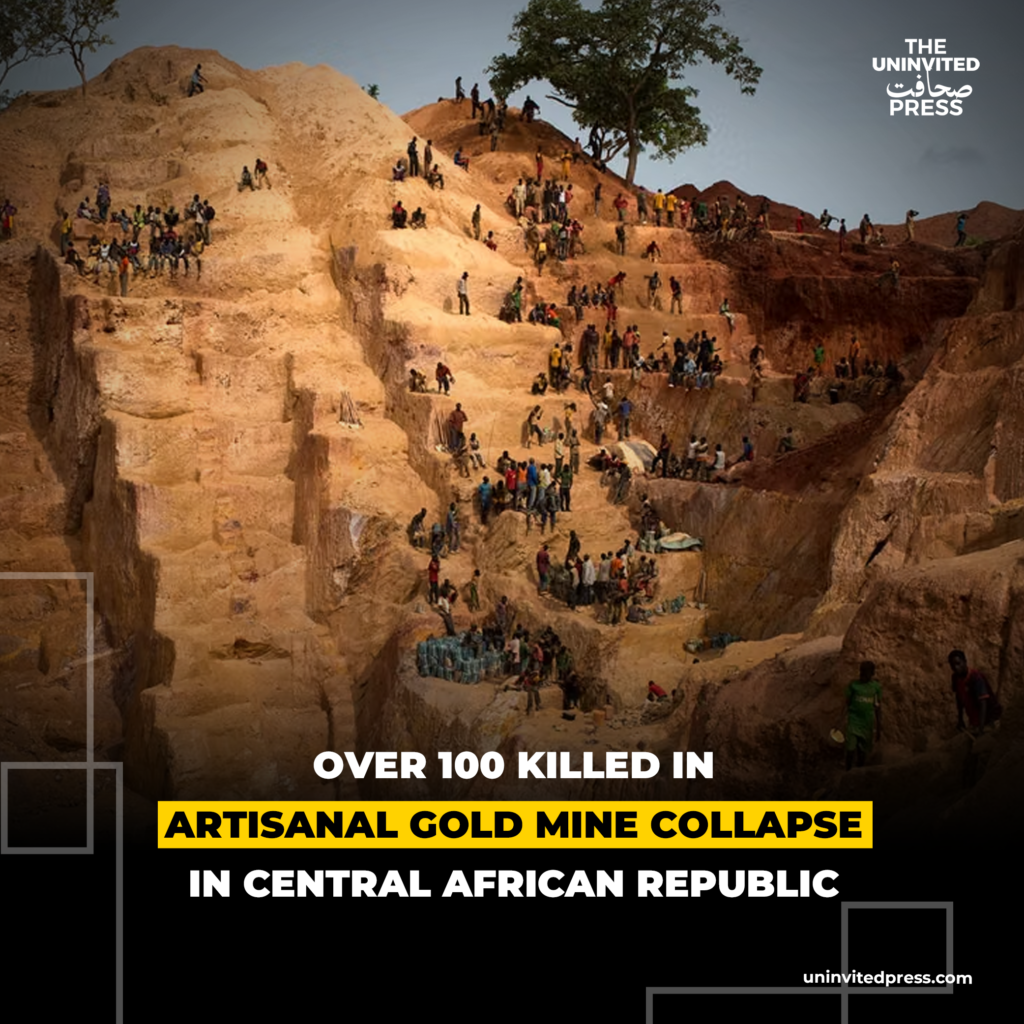
Landslide at informal mining site near Cameroon border leaves dozens still missing as rescue efforts continue and investigation is launched.
More than 100 people have been killed after an artisanal gold mine collapsed in a landslide in the western Central African Republic, local officials, a Red Cross volunteer and mining association representatives said, in one of the deadliest recent accidents in the country’s largely unregulated small-scale mining sector.
Over 100 Killed in Central African Republic Gold Mine Collapse:
The disaster struck in the village of Zamboye (also referred to as Zamboï), in Nana-Mambéré prefecture, roughly 50 kilometres (31 miles) from the town of Baboua and close to the border with Cameroon. Hundreds of miners, many of them young men and women from both countries, were working at the large open-pit site when part of the ground gave way, burying people under earth and debris.
Videos circulating on social media appear to show a slope collapsing onto a crowd as others scramble to safety. A miner at the site, Cedric Mbango, described the scene as “catastrophic.” “The ground completely collapsed and buried people. As I speak to you, other people are still buried. Rescue attempts are under way,” he told Media.
Gervais Ganagoroh, a local Red Cross volunteer involved in relief efforts, told the AP that more than 100 bodies had been recovered. Bertrand Be Yangué, a member of the Zamboye youth council, confirmed the death toll exceeded 100 and was likely to rise, with several people still missing and feared dead, and others seriously injured. A Cameroonian border town mayor, Adamou Abdon of Garoua-Boulaï, told the BBC that 107 bodies had been removed from the rubble. Officials cautioned that a precise formal toll remained difficult to establish while search operations continued.
The public prosecutor in Baboua said several underground tunnels in which miners were operating had collapsed, triggering the landslide. An investigation has been opened to determine the cause and who was running the site. Survivors were taken to hospital in Baboua. Cameroonian authorities said they were prepared to receive and treat injured people crossing the border and were working with Central African counterparts to repatriate the bodies of Cameroonian victims; at least three to five Cameroonian nationals were confirmed among the dead.
Deadly Risks of Informal Gold Mining Exposed:
Artisanal and small-scale gold mining provides a vital livelihood for thousands across the Central African Republic and neighbouring countries, but the sector is plagued by weak regulation, minimal safety standards and frequent accidents. Pits are often left unsealed, tunnels are poorly supported, and heavy rains can further destabilise the ground. Similar collapses have occurred repeatedly in the region, including at Be-Mbari earlier in 2026 and at other sites in previous months, claiming dozens of lives each time.
Government spokesman Evariste Ngamana expressed sympathy for the victims’ families and said authorities were “working hard to provide relief and assistance.” Opposition voices in both countries have criticised the persistent dangers faced by informal miners. Rescue teams, including locals and Red Cross volunteers, continued searching the site on Wednesday, using available machinery amid concerns that further disturbance of the unstable ground could endanger anyone still trapped.
The tragedy underscores the human cost of informal mining in one of the world’s poorest and most fragile states, where mineral wealth coexists with chronic insecurity, limited state presence in remote areas, and few alternative sources of income for communities living near the border. As recovery efforts proceed and the investigation begins, the full scale of the loss-and any measures that might prevent the next such disaster-remain under scrutiny.