

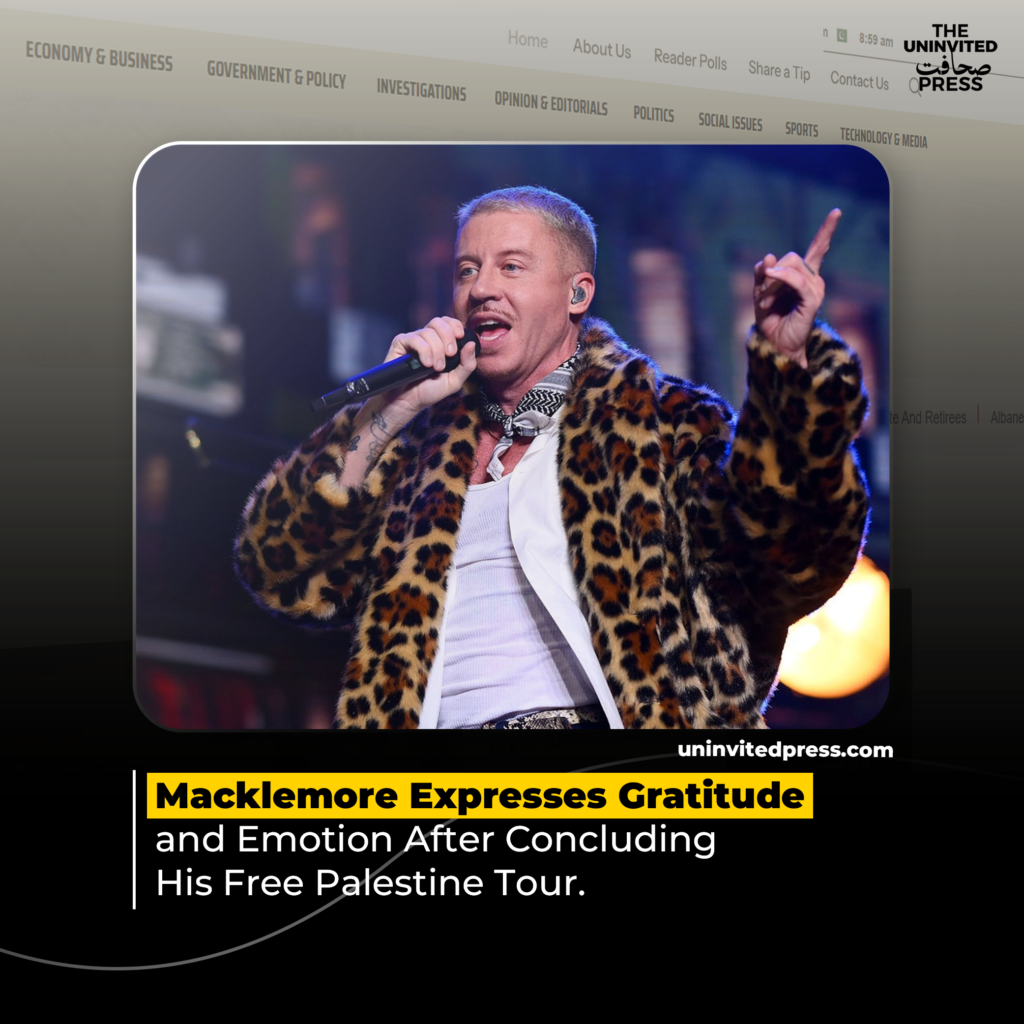
US rapper describes sold-out European shows as his ‘favourite thing’ amid ongoing calls for solidarity with Gaza.
American rapper Macklemore has described himself as “overwhelmed with gratitude and awe” after completing his three-date Free Palestine Tour, calling the series of benefit concerts the “favourite thing I’ve ever been a part of.”
The tour, which sold out in Dublin, Paris and London, was organised after Macklemore was removed from the remaining dates of Ed Sheeran’s US Loop tour in September. The decision followed onstage remarks in which he called for a “Free Palestine” during performances at MetLife Stadium in New Jersey.
Macklemore’s Free Palestine Tour Raises Funds for Gaza Relief:
Macklemore, whose real name is Benjamin Haggerty, launched the benefit shows in late October. All proceeds were directed to organisations supporting Palestinian communities through humanitarian relief, medical care, education and advocacy.
The opening night at Dublin’s 3Arena on 26 October featured guests including Irish singer Hozier, Belfast group Kneecap and the folk band Beoga, which had withdrawn from Sheeran’s tour in solidarity. Subsequent dates in Paris and London drew similarly large crowds and high-profile participants. The final show, at London’s OVO Arena Wembley on 30 October, was attended by more than 12,500 people and included appearances by Paloma Faith, climate activist Greta Thunberg and others.
Audiences waved Palestinian flags and joined chants of “Free Palestine.” Macklemore told the London crowd it had been “more uncomfortable for me to stay silent than to say something,” adding that speaking out was “human” rather than courageous. “Those children in Gaza are our children. There is no separation,” he said.
Macklemore Reaffirms Support for Palestinian Freedom:
In a subsequent Instagram post reflecting on the tour, Macklemore wrote that advocating for Palestinian life and freedom remains controversial and can carry a cost. He described the gatherings as a reaffirmation that collective action can produce something profound.
“The crowd is just as much a part of that as the artists. We all are,” he said. “After five of the most intense weeks… it felt like we could all finally exhale. There is so much work to do. The march is long. But this felt like a beautiful step toward rekindling something in all of our hearts.”
The concerts form part of a broader pattern of artists using their platforms to address the humanitarian crisis in Gaza, where large-scale casualties and displacement have continued despite a ceasefire agreement. Macklemore has framed the shows as an expression of shared humanity rather than division, a message that resonated with capacity crowds across the three European cities.