

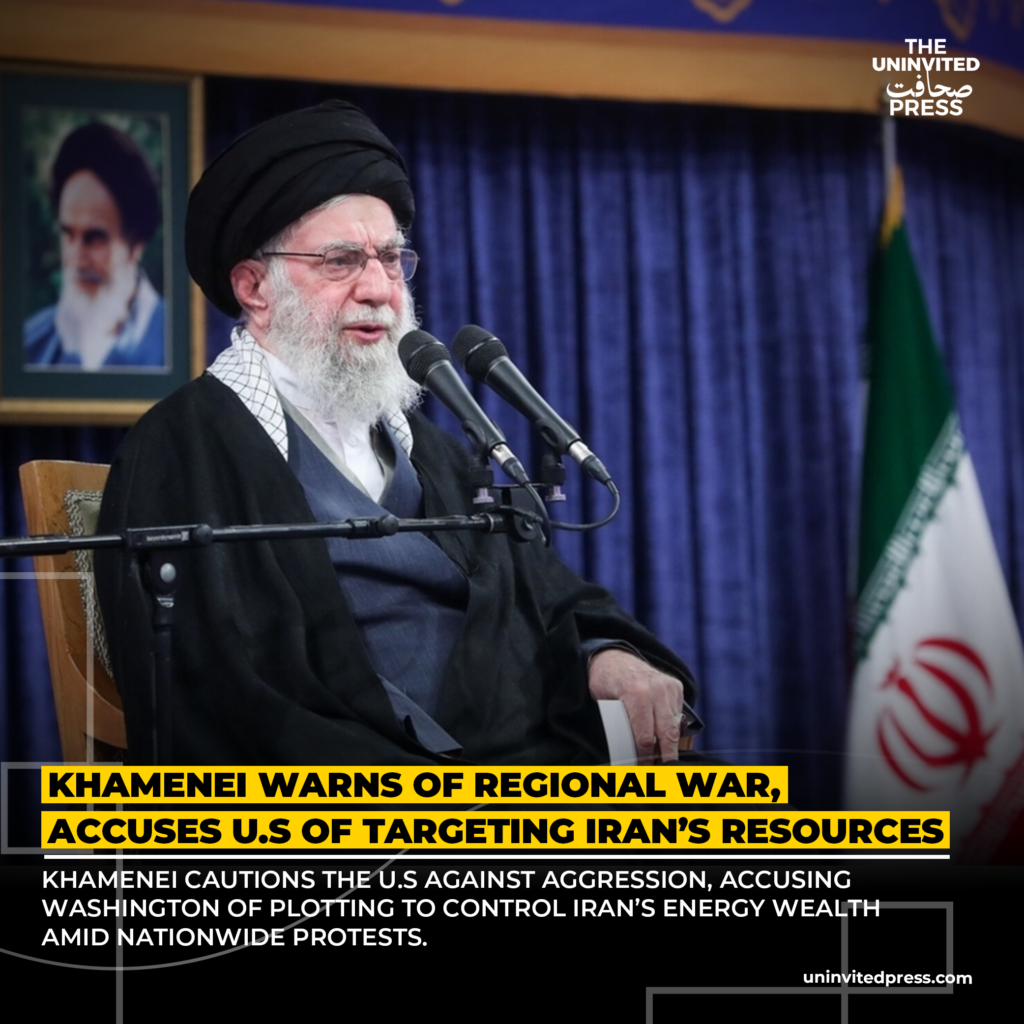
Iran’s Supreme Leader Khamenei warns of regional war if US attacks, accusing Washington of plotting to control Iran’s energy wealth amid deadly protests. Diplomatic talks loom as tensions escalate in Tehran.
Khamenei's Warning as Trump Positions Warships Amid Iran's Deadly Crackdown:
Iran’s Supreme Leader Ayatollah Ali Khamenei delivered a blistering warning on February 1, 2026, stating that any U.S. military strike would trigger a full-scale regional war. Speaking in Tehran, he accused the United States of harboring ambitions to control Iran’s vast oil, gas, and mineral resources, framing the escalating standoff as a battle for sovereignty. This comes as nationwide protests against economic hardship and government repression enter their second month, with President Donald Trump deploying warships to the region and threatening intervention. The stakes couldn’t be higher: a misstep could engulf the Middle East in conflict, disrupting global energy markets and displacing millions.
Defending Sovereignty or Bluffing? Khamenei's Resource Claims and Regional War Pledge Amid U.S. Buildup:
On February 1, 2026, during a meeting in Tehran marking the approach of the 47th anniversary of the Islamic Revolution, Khamenei addressed a gathering of officials and citizens. State media broadcast his remarks, where he declared, “The Americans must be aware that if they wage a war this time, it will be a regional war.” He emphasized that Iran would not initiate conflict but would respond forcefully to any aggression, stating, “We are not the initiators and do not want to attack any country, but the Iranian nation will strike a strong blow against anyone who attacks and harasses them.”
Khamenei directly tied U.S. motives to Iran’s natural resources, saying, “Iran possesses numerous attractions: Its oil, gas, rich minerals, and geographic location are attractive. The US wants to seize control of this country just as they controlled it before.” He referenced the pre-1979 era under the Shah, when the U.S. held significant influence over Iran’s economy and politics. This narrative aligns with longstanding Iranian rhetoric portraying American actions as imperialistic.
Trump ordered the USS Abraham Lincoln carrier group and associated warships to the Arabian Sea in response to Iran’s violent suppression of protests, which have resulted in hundreds of deaths according to human rights groups. Iranian authorities have imposed internet blackouts and arrested thousands, but reports of clashes continue to emerge.
Trump, responding to Khamenei’s warning on February 1, dismissed it casually: “Of course he is going to say that.” Speaking to reporters at Mar-a-Lago, he added, “We have the biggest, most powerful ships in the world over there, very close, a couple of days, and hopefully we’ll make a deal. If we don’t make a deal, then we’ll find out whether or not he was right.” This mix of optimism and veiled threat underscores the precarious balance between diplomacy and potential military action.
Legacy of 1979 to 2026: Why Khamenei's Warning Echoes a Regime on the Edge?
Iran’s current crisis has deep roots. The protests erupted on December 28, 2025, sparked by a sharp devaluation of the Iranian rial, which hit a record low of around 1.4 million to the U.S. dollar. This economic tailspin stems from a combination of factors: international sanctions reimposed after the U.S. withdrew from the 2015 nuclear deal Joint Comprehensive Plan Of Action (JCPOA) in 2018, exacerbated by “snapback” measures in late 2025; domestic mismanagement; and shortages of water, energy, and basic goods amid soaring inflation rates exceeding 50%.
What began as strikes by shopkeepers in Tehran’s Grand Bazaar quickly escalated into nationwide demonstrations across all 31 provinces, demanding not just economic relief but the overthrow of the Islamic Republic. Chants evolved from complaints about rising prices to calls for regime change, echoing the 2022 “Woman, Life, Freedom” protests triggered by the death of Mahsa Amini in custody. Human rights organizations, including Amnesty International, report that security forces have used live ammunition, leading to at least 500 confirmed deaths and thousands injured or detained.
Historically, U.S.-Iran relations have been fraught since the 1979 revolution, marked by events like the Iran-Iraq War, the nuclear standoff, and proxy conflicts in Syria, Yemen, and Iraq. The 2015 JCPOA briefly eased tensions by curbing Iran’s nuclear program in exchange for sanctions relief, but Trump’s “maximum pressure” campaign unraveled it. Recent escalations include U.S. strikes on Iranian nuclear facilities in June 2025 during a 12-day conflict with Israel, further straining Iran’s economy and fueling public discontent.
At 86, Khamenei remains the ultimate authority in Iran, overseeing a system where the elected president, Masoud Pezeshkian, handles day-to-day affairs but defers to the Supreme Leader on security matters. Analysts note that the regime fears a U.S. strike could reignite protests, potentially leading to its collapse, as internal reports suggest public anger has reached a breaking point.