

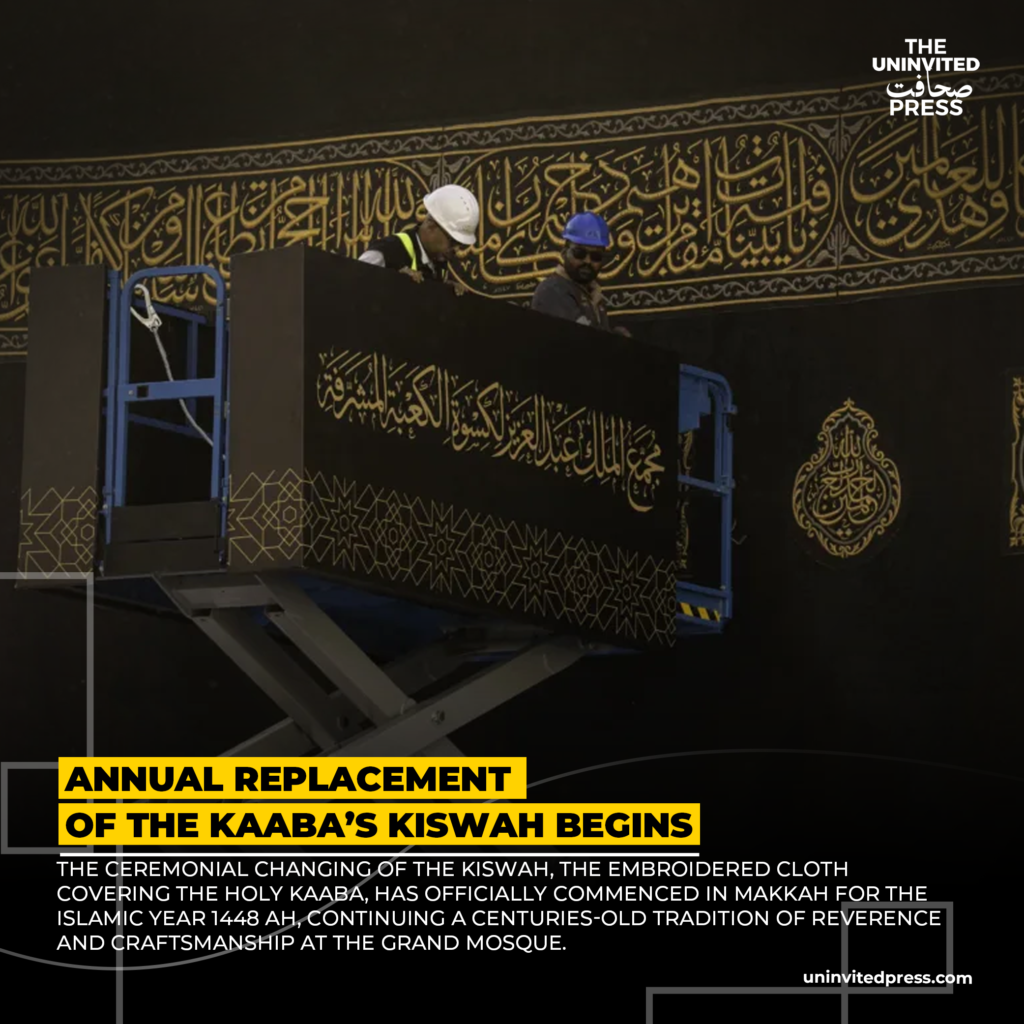
Workers in Makkah have begun the meticulous and highly respected annual process of replacing the embroidered black Kiswah that covers the Kaaba, Islam’s holiest site, marking a significant religious tradition observed at the start of the new Hijri year.
The annual ceremonial replacement of the Kiswah, the black embroidered cloth that drapes the Kaaba, has officially begun at the Grand Mosque in Makkah, marking the start of the Islamic year 1448 AH.
The centuries-old tradition, carried out with deep reverence, involves removing the old Kiswah and installing a new one, crafted from premium black silk and embroidered with gold threads featuring Quranic verses. The process typically unfolds at night, beginning after the Asr prayer with preparations such as installing base rings and removing the door curtain, followed by unstitching the old covering and fitting the new one around midnight.
A legacy of skill and devotion:
The new Kiswah is produced at the King Abdulaziz Complex for the Holy Kaaba Kiswah in Makkah. Weighing approximately 1,415 kilograms and made from about 850 kg of pure silk, it represents the pinnacle of traditional Saudi craftsmanship. The cloth is replaced every year to maintain its condition and honour the sanctity of the Kaaba, towards which more than 1.8 billion Muslims worldwide direct their prayers.
Officials from the General Presidency for the Affairs of the Grand Mosque and the Prophet’s Mosque oversee the operation, which draws significant attention from pilgrims and Muslims globally, especially as it coincides with the beginning of Muharram.
Spiritual significance:
The Kaaba, known as the House of God (Bayt Allah), lies at the heart of the Grand Mosque and serves as the focal point of the Hajj pilgrimage. The Kiswah not only protects the structure but also symbolises purity, renewal, and the continuous devotion of the Muslim ummah.
This year’s replacement comes as millions prepare to mark the new Hijri year with reflection and prayer. The old Kiswah will be carefully removed, cut into pieces, and often distributed as honoured gifts to dignitaries, museums, and Islamic institutions.
The ceremony underscores Saudi Arabia’s role as custodian of Islam’s two holiest sites and its commitment to preserving traditions that date back over a millennium, while blending them with modern precision and organisation.