

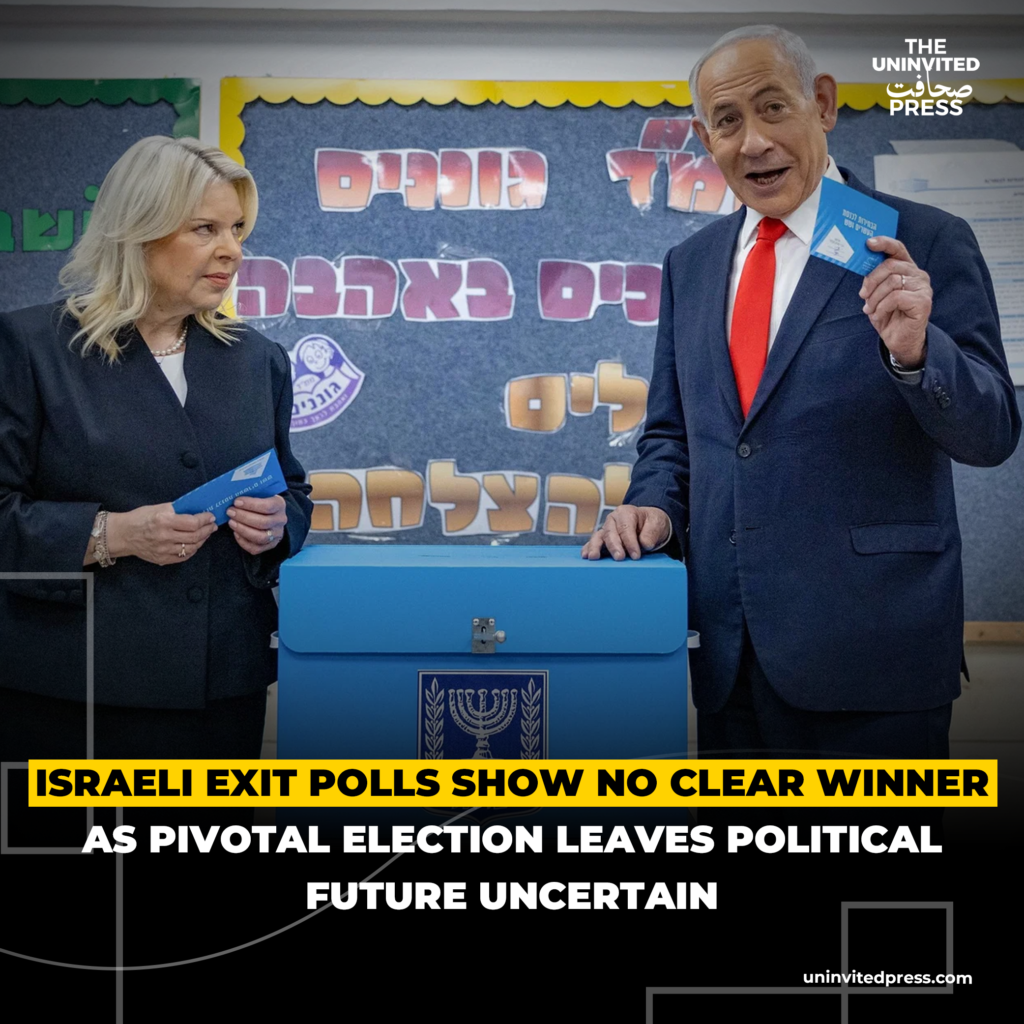
Neither Netanyahu’s right-wing bloc nor Eisenkot-led opposition secures majority; strong Arab party gains complicate path to government amid high turnout.
Exit polls from Israel’s major television networks indicate no clear winner in the country’s general election, with both Prime Minister Benjamin Netanyahu’s right-wing bloc and the opposition alliance led by former military chief Gadi Eisenkot falling short of a parliamentary majority.
According to projections released after voting closed on Tuesday, Netanyahu’s Likud-led coalition of far-right and ultra-Orthodox parties was forecast to win between 50 and 52 seats in the 120-member Knesset. The opposition “change” bloc, anchored by Eisenkot’s Yashar party along with other Jewish-led parties, was projected at 49 to 53 seats. Neither side reached the 61 seats required to form a government on its own.
Likud was expected to remain the largest single party with around 24 to 27 seats, while Yashar was projected to secure 20 to 23 seats. Arab-led parties, including the Joint List and Ra’am, were forecast to win a combined 17 to 19 seats-a significant increase from their previous representation and a potential kingmaker role in any coalition negotiations.
High turnout and immediate reactions:
Voter turnout reached approximately 77.7 percent by the time polls closed, the highest level recorded at that stage in decades, according to the Central Elections Committee. The elevated participation reflected the high stakes of the election, held against the backdrop of ongoing regional conflicts and deep domestic divisions.
Opposition figures quickly claimed a moral victory, arguing that Netanyahu’s current coalition had lost its majority. Netanyahu, speaking later at Likud headquarters, asserted that his bloc retained a strong position and vowed to form a government with his traditional allies. Final official results are expected in the coming days and may shift the projections by several seats.
Israel Election Deadlock Leaves Netanyahu’s Future Uncertain:
The fragmented outcome sets the stage for potentially protracted negotiations. Most Jewish opposition parties have previously ruled out forming a government dependent on Arab parties, while Netanyahu has also rejected relying on them. This stance leaves both major blocs without an obvious path to a stable majority.
Israel’s proportional representation system and the 3.25 percent electoral threshold often produce complex coalition arithmetic. Analysts note that smaller parties could emerge as pivotal players, and the process of government formation could take weeks. In the interim, Netanyahu is expected to remain in office as caretaker prime minister.
The election outcome underscores the deep polarisation in Israeli politics. With neither side able to claim a decisive mandate, the country faces a period of uncertainty over leadership, policy direction and the handling of security and diplomatic challenges. Official tallies and subsequent talks will determine whether a new government can be assembled or whether another election becomes necessary.