

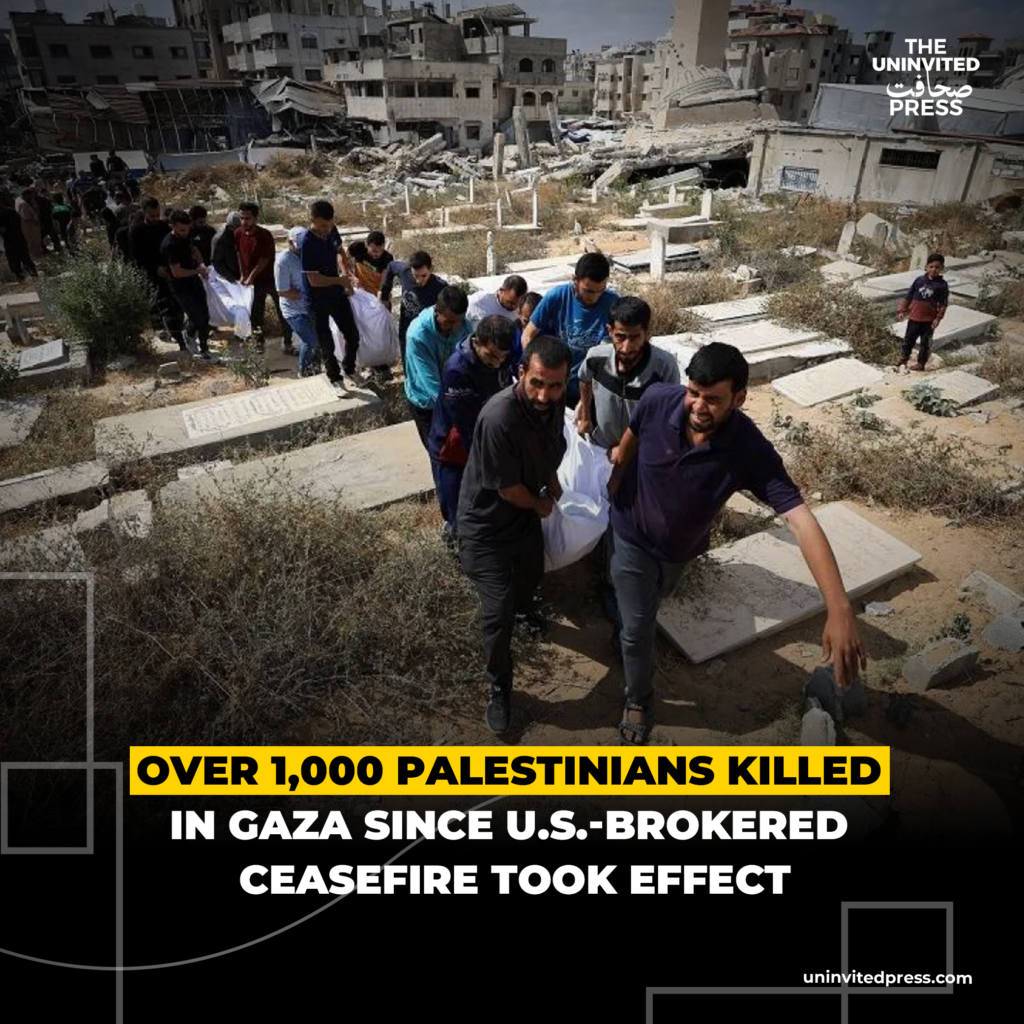
Fragile truce in name only as daily strikes continue amid humanitarian catastrophe.
Palestinian health officials say Israeli forces have killed more than 1,000 people in Gaza since a US-brokered ceasefire agreement took effect last October, casting fresh doubt on the durability of the fragile truce and highlighting the persistent violence that has plagued the enclave.
According to the Gaza Health Ministry, 1,005 Palestinians have been killed and more than 3,000 others injured in Israeli attacks across the territory since the ceasefire began on October 10, 2025. Among the dead are hundreds of women and children.
The latest figures come as images from Gaza cemeteries show grieving families and volunteers carrying bodies wrapped in white shrouds for burial, scenes that have become tragically familiar even after the supposed end to major hostilities.
Gaza ‘Ceasefire’ Under Fire as Israeli Strikes Continue:
Palestinians and rights groups describe the agreement, mediated by the United States, as a “ceasefire in name only.” While the deal halted the most intense phase of fighting that devastated large parts of Gaza, Israeli strikes, raids, and incursions have continued with regularity.
“These are the Palestinians that Israel has killed during Gaza’s ‘ceasefire’,” Media reported in a recent video package documenting the deaths.
Israeli officials have justified many of the operations as targeting “imminent threats” from remaining Hamas elements or other militants. However, Palestinian authorities and eyewitnesses say the strikes frequently hit civilian areas, homes, and people seeking food or attempting to return to their neighbourhoods.
The ceasefire was part of a phased US-backed plan that included hostage releases, limited Israeli troop withdrawals, and increased humanitarian aid. Yet eight months later, much of Gaza remains in ruins, with restrictions on movement and aid delivery still severely hampering recovery efforts.
Gaza Death Toll Surpasses 73,000:
The Palestinian death toll since the war began in October 2023 now exceeds 73,000, according to Gaza health officials, with the enclave’s health system barely functional and reconstruction efforts stalled.
UN agencies and humanitarian organisations continue to cite the Gaza Health Ministry’s figures as broadly reliable, despite Israel’s long-standing restrictions on independent foreign media access to the territory. Satellite imagery shows vast areas of destruction, particularly in places like Rafah and northern Gaza.
Residents report ongoing hardship, including shortages of food, clean water, and medical supplies. Many families displaced multiple times during the war have been unable to return home due to Israeli military presence in parts of the Strip.
Gaza Ceasefire Hangs by a Thread:
Both sides have accused the other of violating the truce terms. Hamas and Palestinian factions say Israel has failed to fully withdraw forces as agreed and continues to impose a suffocating blockade. Israeli officials, meanwhile, point to security concerns and incomplete hostage returns.
The second phase of the US-brokered plan-which was expected to involve further withdrawals, reconstruction, and moves toward a more permanent arrangement-has seen little progress, with negotiations repeatedly stalled.
International observers warn that without genuine enforcement mechanisms and accountability for violations, the fragile calm could unravel entirely, plunging Gaza back into full-scale war.
As funerals continue in the battered landscape of Gaza, many Palestinians say the so-called ceasefire has brought little relief from the cycle of violence and loss that has defined their lives for years.