

Strike described as retaliation for alleged assault on Iranian telecommunications tower as fragile lull in regional conflict appears to fray.
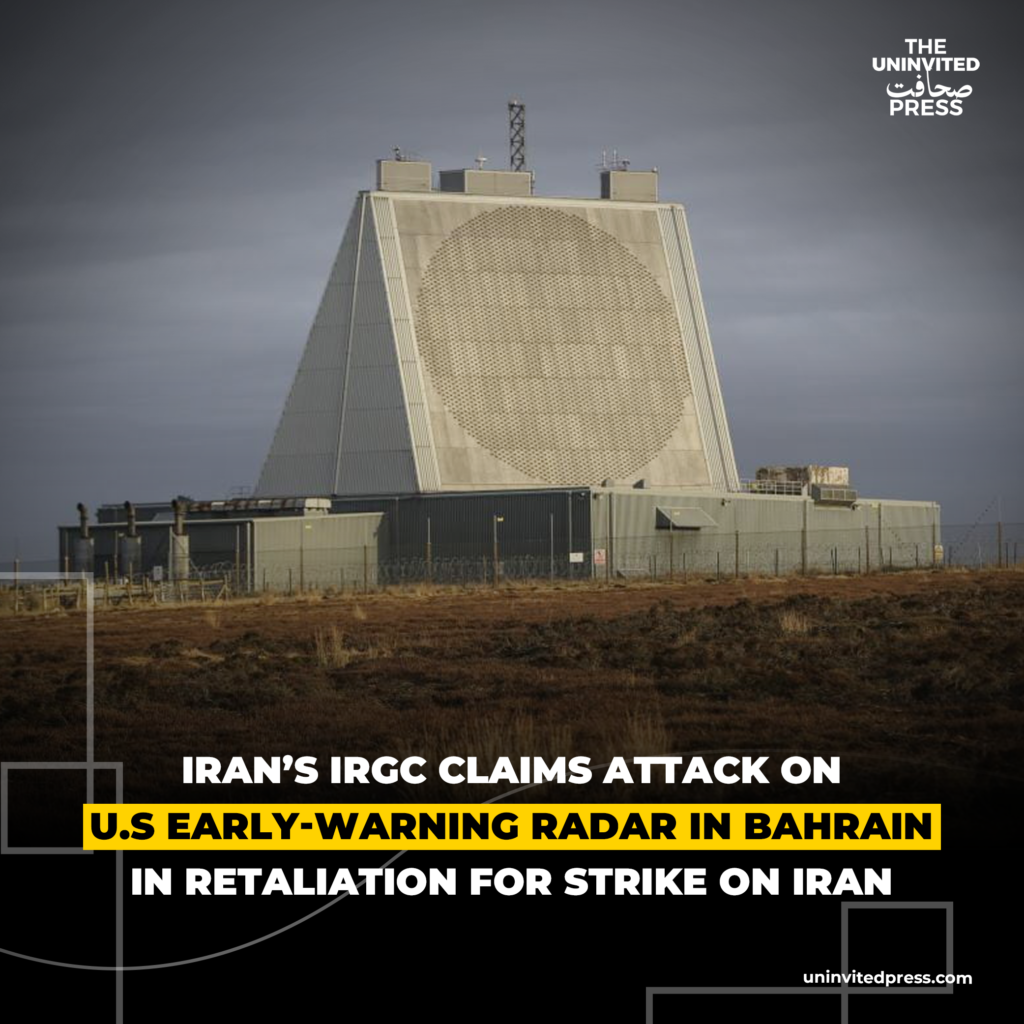
Iran’s Islamic Revolutionary Guard Corps (IRGC) has claimed responsibility for an attack on a US early-warning radar installation in Bahrain, describing the operation as retaliation for what it called an air strike on a telecommunications tower in southern Iran. The assertion, made on Friday, marks the first such claim of an attack on American military assets in a Gulf country since early September and comes amid a fragile lull in the months-long conflict between Iran and the United States.
In a statement carried by Iranian state media and the semi-official Tasnim news agency, the IRGC said its Aerospace Force “targeted and destroyed” the radar on the island of Bahrain. The Guards framed the action as a direct response to an alleged aerial attack on a telecommunications tower in Sirik county, in Hormozgan province. Iran’s state news agency IRNA had earlier reported, citing official sources, that the port city of Sirik was hit by “enemy fire” on Thursday.
IRGC Warns of Escalation Over Hormuz Provocations:
“This is a serious warning to the aggressor enemy to stop its aerial provocations and oil smuggling in the Strait of Hormuz,” the IRGC statement said. “Should these violations and acts of aggression recur, the IRGC Aerospace Force stands in full readiness to engage without limits.” The Guards also warned that companies it accused of being “deceived by the enemy” would face “more severe punishment.”
There was no immediate comment from the United States or Bahrain, which hosts the headquarters of the US Navy’s Fifth Fleet. The extent of any damage to the radar installation has not been independently verified. US Central Command has previously stated that it regularly moves personnel and assets to optimise mission readiness, without addressing the specific claim.
The latest exchange occurs against the backdrop of a wider regional conflict that began with US and Israeli strikes on Iran on 28 February 2026. That initial assault triggered Iranian missile and drone attacks on US bases across Gulf states, attempts to restrict shipping through the strategic Strait of Hormuz, and a US naval blockade of Iranian ports. Gulf countries have borne significant consequences, with energy infrastructure, ports and American military facilities repeatedly targeted in the ensuing months. A relative lull had taken hold in recent weeks before the reported incidents around Sirik and Bahrain.
Hormuz Tensions Raise Fears of Renewed Gulf Conflict:
Bahrain’s strategic importance as a hub for US naval operations in the region has made it a recurring focus of Iranian attention throughout the conflict. Earlier phases of the war saw repeated strikes on facilities linked to the US presence there, with satellite imagery and official acknowledgements later confirming damage to infrastructure at Naval Support Activity Bahrain. Analysts note that early-warning radar systems are high-value targets because they form part of the detection network intended to track incoming threats.
For communities across the Gulf and beyond, the resumption of tit-for-tat claims raises the risk of renewed escalation at a time when regional economies remain strained by disrupted trade routes and elevated energy prices. The Strait of Hormuz continues to serve as a critical artery for global oil and gas supplies, and any further tightening of military activity around it carries implications far beyond the immediate parties to the conflict.
As of Friday, neither Washington nor Manama had confirmed or denied the IRGC’s account. Iranian media presented the operation as both defensive and deterrent in nature. Whether the claimed strike signals a temporary breach in the fragile pause or the start of a new phase of confrontation remains to be seen, but the language from Tehran leaves little doubt that the Guards view further “provocations” as grounds for unrestricted response.