

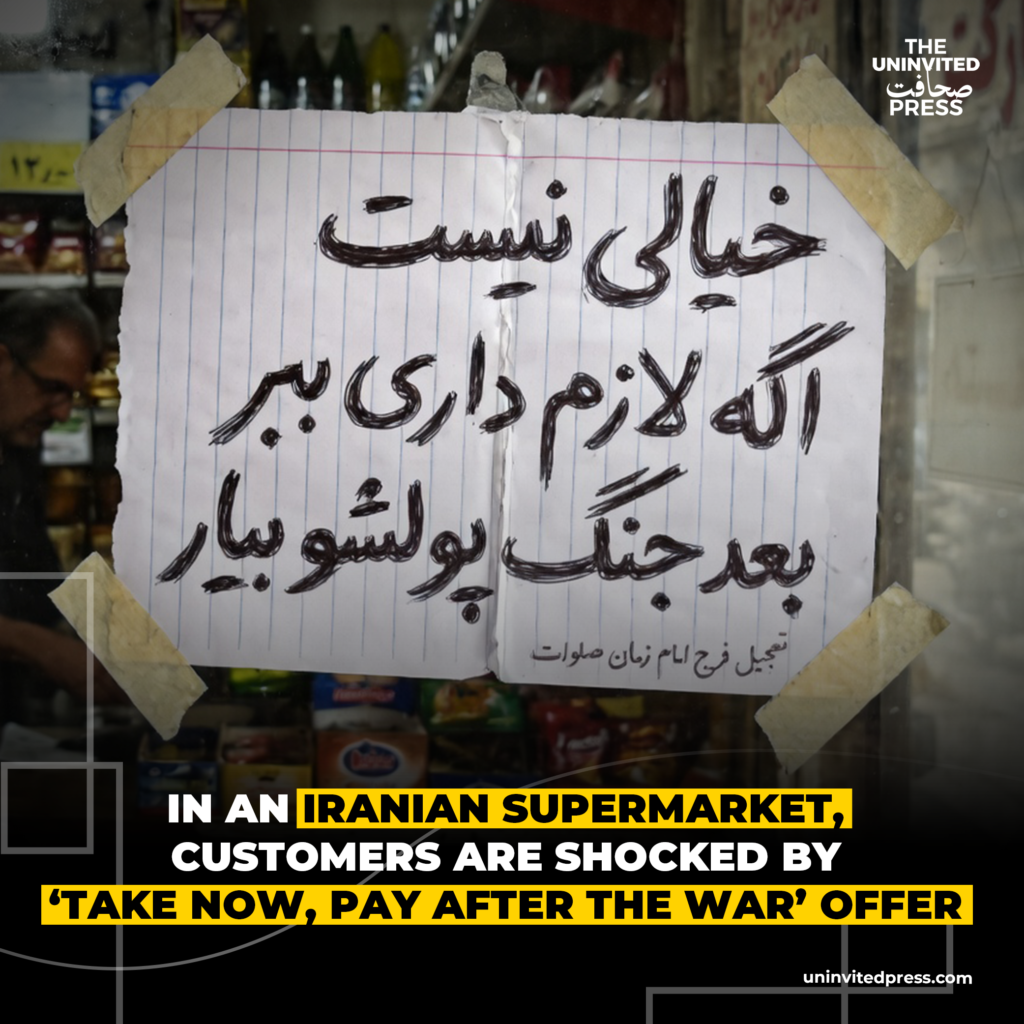
A handwritten sign in an Iranian supermarket offering “Take now, pay after the war” has gone viral, capturing the human cost of the ongoing US-Israel conflict. Customers face economic strain as fighting enters its fourth week.
Iranian Shopkeeper Offers “Pay After War” Support:
In an Iranian supermarket, a piece of lined notebook paper now speaks louder than any official statement. The sign, written in bold black marker, reads: “خیالی نیست-الله لازم داری ببر-بعد جنگ پولشو بیار.” Translated: “No worries. If you need it, take it. Bring the money after the war.”
Customers entering the store have been left visibly shocked. With missile exchanges still rattling the region and everyday prices under pressure, the shopkeeper’s offer of unlimited credit until the fighting ends has spread like wildfire online. It is not a corporate promotion. It is one small business owner’s raw response to a nation under strain.
A Simple Sign, A Powerful Symbol of Humanity Amid Crisis:
The note is taped prominently to the glass entrance with yellowing masking tape. Shoppers see it before they even step inside. A man in the background of the widely shared photograph appears to be browsing shelves stocked with biscuits, detergents and packaged goods-everyday items that have become harder to afford amid the conflict.
The offer is straightforward and unconditional: take what you need now, pay later when the war is over. No paperwork, no interest, no deadline beyond “after the war.” The small text at the bottom of the sign includes a religious invocation wishing victory for the “Imam of the Age,” a common Shiite expression of faith and hope.
Within hours of the photo appearing online, the story exploded. Users described it as “a symbol of humanity amid crisis.” Others called it a heartbreaking glimpse into the reality of life inside Iran right now.
War Deepens Economic Strain as Iranian Retailers Turn to Trust-Based Survival:
Iran’s economy was already fragile before the latest escalation. Western sanctions dating back decades, intensified after the 2018 US withdrawal from the nuclear deal, have kept inflation high and growth slow. As recently as mid-February 2026, The Wall Street Journal reported that some Iranian grocers were already experimenting with informal payment plans as households struggled with rising food costs. The IMF had projected just 1% economic growth for the year-the weakest in the Middle East.
That backdrop changed dramatically on 28 February 2026 when the United States and Israel launched a full-scale military campaign against Iranian targets. The strikes quickly escalated into sustained air operations and missile exchanges. Iran has fired hundreds of ballistic missiles toward Israel, many carrying cluster munitions, while Israeli and US forces have targeted Iranian missile infrastructure and energy sites. Iran’s decision to disrupt shipping through the Strait of Hormuz has sent global oil prices surging, but the domestic consequences inside Iran have been immediate: supply-chain disruptions, higher transport costs and squeezed household budgets.
Small retailers are feeling the pinch hardest. With customers delaying payments or simply unable to pay upfront, some shopkeepers are choosing trust over turnover. The “pay after the war” sign is the most visible example yet of how the conflict is reshaping daily commerce.