

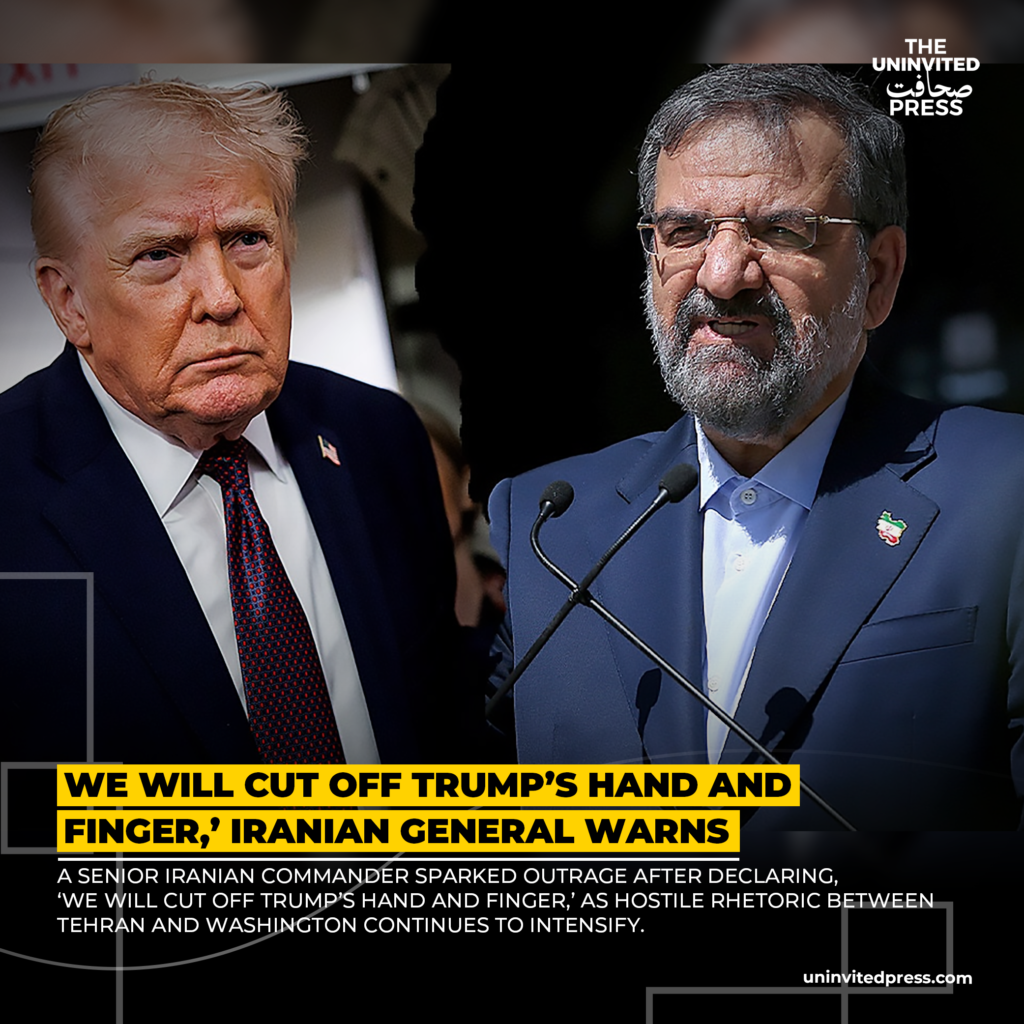
Senior Iranian IRGC commander Mohsen Rezaei threatens to ‘cut off Trump’s hand and finger’ in response to U.S warnings over protest crackdowns, escalating tensions and risks to regional bases.
From Truth Social to Tehran Streets: 48 Hours of Escalation Between Trump and Iran:
A top Iranian military commander has issued a stark personal threat against President Donald Trump, declaring “we will cut off his hand and his finger” in response to U.S warnings of potential strikes over Tehran’s violent suppression of protests. Mohsen Rezaei, a senior general in the Islamic Revolutionary Guard Corps (IRGC) and member of Iran’s Expediency Council, made the remarks on January 15, 2026, during a public speech, signaling Iran’s defiance and abandonment of restraint. This fiery rhetoric intensifies U.S-Iran tensions, raising alarms over regional stability and the safety of American forces, as Trump weighs military options while claiming his pressure halted mass executions.
Trigger to Threat: Rezaei's Hand-Cutting Warning Follows Trump's 'HELP IS ON ITS WAY':
On January 15, 2026, Mohsen Rezaei addressed a gathering in Tehran, directly challenging President Trump’s recent threats. “Trump has said his hand is on the trigger. We will cut off his hand and his finger,” Rezaei stated, according to state media and international reports. He added, “If we move forward, there will be no talk of a ceasefire anymore,” and warned that U.S bases in the region would not be safe if attacks occur.
The comments came two days after Trump, on January 13, posted on Truth Social: “HELP IS ON ITS WAY,” amid briefings on military options against Iran. Protests had intensified in late December 2025 over economic hardships, leading to a brutal crackdown with nearly 500 deaths by January 11. Trump responded by deploying additional U.S forces to the Middle East and evacuating personnel from bases like al-Udeid in Qatar.
By January 15, Trump announced he was holding off on strikes after receiving assurances that Iran had canceled over 800 executions. White House Press Secretary Karoline Leavitt confirmed to reporters that Tehran communicated the halt following U.S warnings. Rezaei’s speech rejected this narrative, accusing the U.S of ignoring Iran’s “restraint and strategic patience” and vowing escalation.
No strikes have occurred as of January 19, 2026, but Trump reiterated in a Fox News interview on January 17 that “we’re not ruling out potential military action going forward.” Iranian Foreign Minister Abbas Araghchi dismissed U.S claims as “propaganda,” insisting no executions were planned.
From Revolution to Brinkmanship: The Deep Roots and High Stakes of U.S-Iran Hostility:
U.S-Iran relations have been hostile since the 1979 Islamic Revolution, but tensions spiked under Trump’s first term with the 2020 killing of IRGC General Qasem Soleimani, prompting Iranian missile strikes on U.S bases. Trump withdrew from the 2015 nuclear deal, imposing “maximum pressure” sanctions that devastated Iran’s economy.
In 2025, after Iran breached nuclear commitments, Israel and the U.S conducted strikes in Operations Rising Lion and Midnight Hammer, a 12-day conflict ending in a Trump-brokered ceasefire. Iran’s nuclear program was set back, but not eliminated, fueling ongoing distrust.
The current crisis stems from December 2025 protests over inflation and unemployment, echoing the 2022 Mahsa Amini unrest. By January 2026, authorities imposed internet blackouts and reported nearly 500 protester deaths. Trump’s threats aim to leverage human rights for pressure, though critics note selectivity given U.S alliances elsewhere.
Rezaei, a veteran of the Iran-Iraq War and former IRGC head (1997-2021), is a hardliner known for provocative statements. His role in the Expediency Council advises Supreme Leader Ali Khamenei. The threat punctuates Iran’s strategy of asymmetric warfare, using proxies like Hezbollah while avoiding direct confrontation, but it risks miscalculation in a nuclear-shadowed rivalry.
It tests Trump’s resolve, potentially rallying Iranians against foreign interference or emboldening protesters if U.S action weakens the regime. It also strains U.S alliances, with Arab states urging restraint to avoid broader war.