

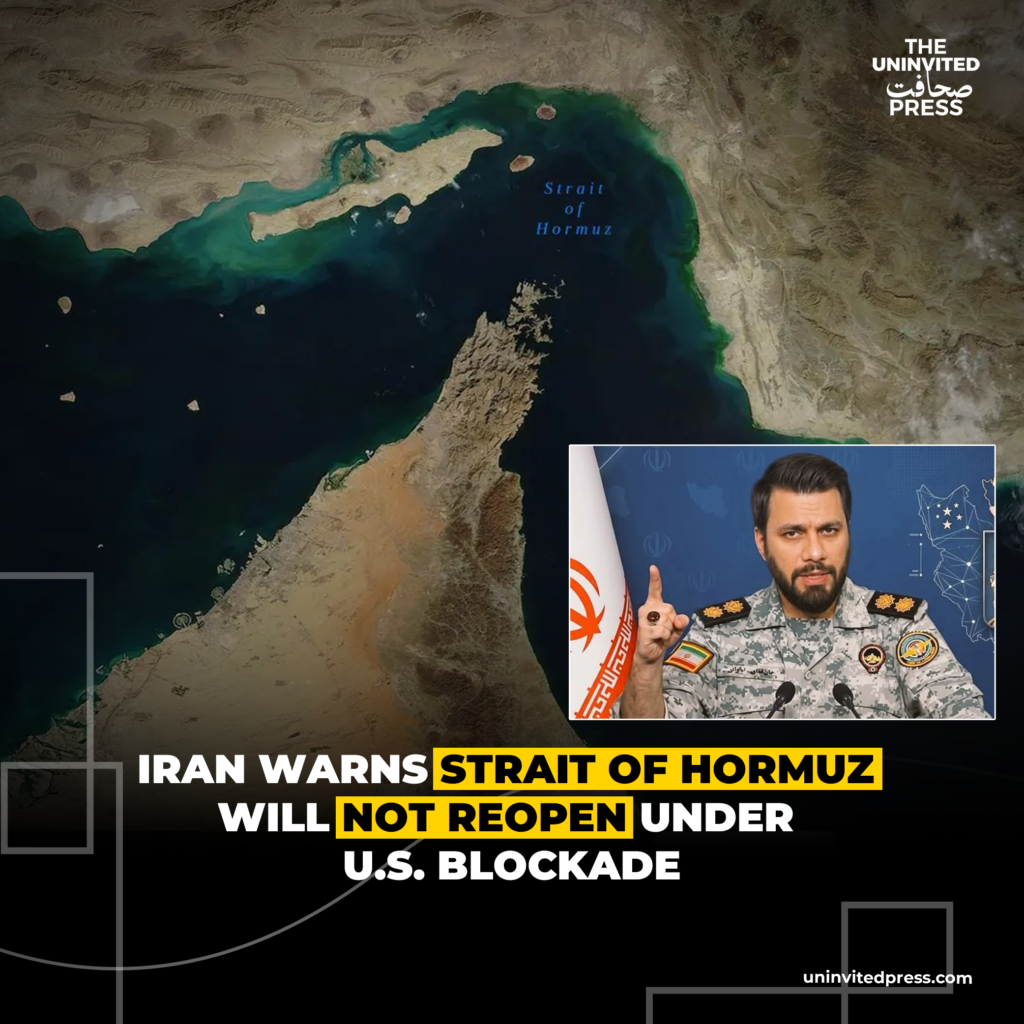
Tehran accuses Washington of violating fragile ceasefire as IRGC tightens control over key oil chokepoint, firing on vessels and seizing ships amid stalled diplomacy.
Iran has issued a stark warning that the Strait of Hormuz will not reopen to unrestricted commercial traffic as long as the United States maintains its naval blockade of Iranian ports, escalating tensions in the strategic waterway that carries nearly one-fifth of global oil supplies.
The Islamic Revolutionary Guard Corps (IRGC) and senior Iranian officials declared the vital maritime chokepoint under “strict control” of Iranian armed forces, reversing a brief reopening announced only days earlier. Any vessel attempting to transit without authorisation faces interception, with reports of Iranian forces firing on and seizing at least three commercial ships in recent days.
“Reopening the Strait of Hormuz is not possible amid the blatant violation of the ceasefire,” said Mohammad Bagher Ghalibaf, Iran’s parliament speaker and chief negotiator in talks with the US. He described the ongoing US blockade as rendering any limited reopening meaningless.
Blockade sparks tit-for-tat escalation:
The standoff intensified after US President Donald Trump extended a fragile ceasefire with Iran while refusing to lift the naval blockade imposed on Iranian ports and vessels. Iranian officials view the blockade as a direct breach of truce terms and an act of economic warfare.
The IRGC Navy warned that ships approaching the strait from anchorage in the Persian Gulf or Gulf of Oman would be considered “cooperation with the enemy” and targeted. Reports emerged of Iranian gunboats firing on tankers, including vessels linked to third countries, as Tehran reasserted dominance over the narrow passage between the Persian Gulf and the Gulf of Oman.
Military spokesperson Ebrahim Zolfaghari, addressing the media in uniform, reinforced Tehran’s position that full control of the strait has returned to Iranian forces until the blockade ends and “lasting peace” is achieved. Iran has also begun demanding transit certificates and fees from vessels it permits to pass, further complicating international shipping.
Strait of Hormuz Disruption Sparks Global Energy and Shipping Crisis:
The closure-or severe restriction-of the Strait of Hormuz has already sent ripples through global energy markets, with oil prices surging before partially easing amid uncertainty. Analysts warn that prolonged disruption could trigger a broader fuel crisis, hitting importers in Europe, Asia and beyond.
Gulf states and major shipping companies have expressed alarm, with some vessels turning back or rerouting at significant cost. The US has reportedly turned away dozens of vessels attempting to navigate the area under its blockade enforcement.
Iran maintains it is exercising its sovereign right to defend its territorial waters and respond to what it calls “US piracy” and economic siege. Officials stress that Iran remains the “guardian” of the strait and will not allow one-sided pressure while its own oil exports and ports remain strangled.
Strait of Hormuz Tensions Rise as Iran-US Talks Stall:
The latest escalation comes as indirect talks, reportedly mediated in part by Pakistan, show little progress. Trump has claimed “good news” on negotiations and suggested Iran is willing to reopen the Strait of Hormuz, but Tehran insists any agreement must first include lifting the US naval blockade.
Iranian officials have rejected what they call US pressure tactics, stating that control of the strait will remain under Iranian oversight until the conflict fully ends. The Supreme National Security Council reaffirmed this position amid rising tensions.
Critics warn the US approach could further destabilize the region, especially as shipping disruptions drive up global oil prices and insurance costs. Iran has also seized vessels it accuses of violating restrictions, deepening the maritime standoff.
The Strait of Hormuz remains a major flashpoint, with fragile diplomacy overshadowed by military tensions and uncertainty over global energy flows.