

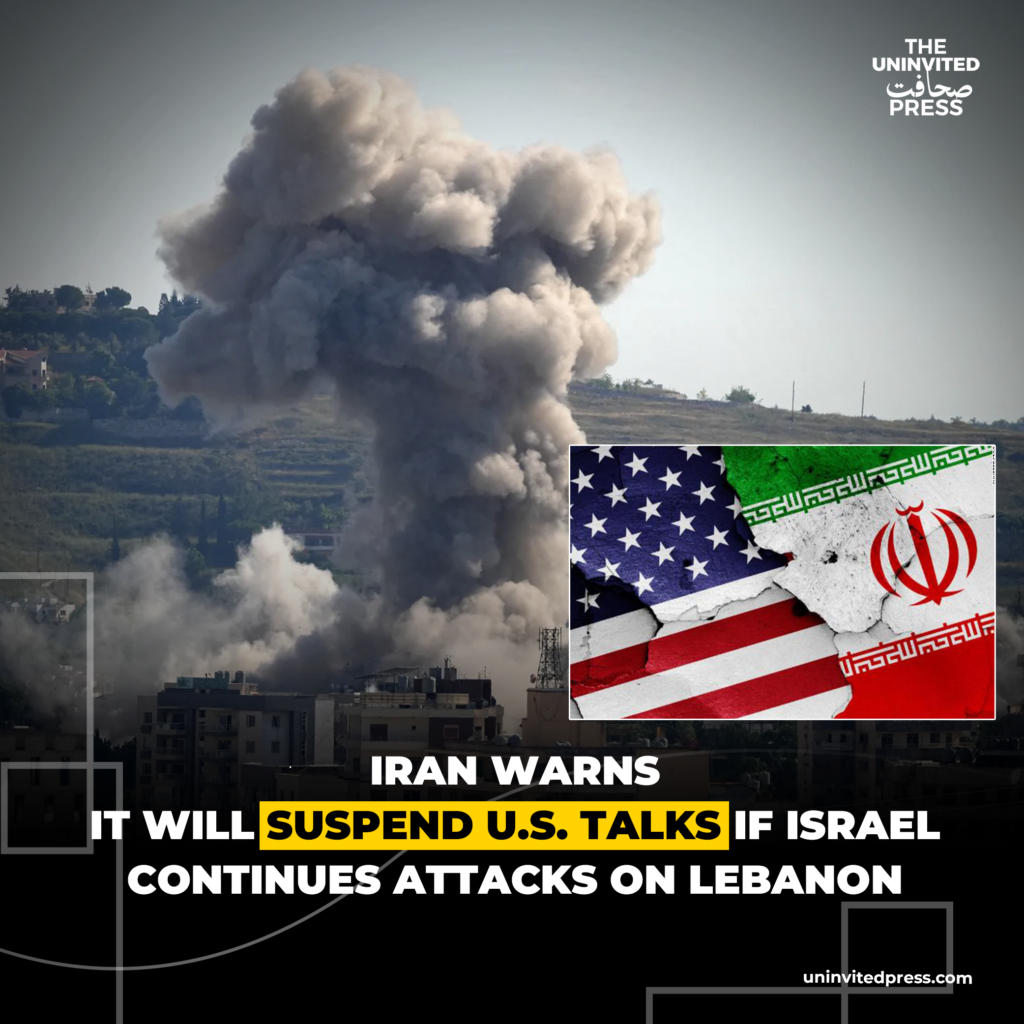
Tehran ties any ceasefire agreement to end of hostilities across fronts, raising fears of renewed regional escalation.
Iran has suspended indirect negotiations with the United States in protest against Israel’s continued military operations in Lebanon, Iranian state media report, casting a shadow over fragile US-brokered efforts to stabilise the region.
The announcement comes amid reports of intensified Israeli strikes in southern Lebanon, with plumes of smoke visible over hills and towns as Israeli forces target Hezbollah positions. Iranian officials have explicitly linked the resumption of talks to a comprehensive cessation of attacks “on all fronts, especially in Lebanon.”
Iranian Parliament Speaker Mohammad Bagher Ghalibaf told his Lebanese counterpart Nabih Berri that if Israeli “crimes” continue, Tehran will not only halt the negotiation process but will also “stand against the Zionist regime.”
Ceasefire on all fronts:
The move highlights deep divisions over the scope of a US-Iran ceasefire agreement reached in recent months. While Washington and Israel have maintained that the truce does not necessarily cover Israeli operations against Hezbollah, Iran insists any deal must encompass a full halt to hostilities in Lebanon and Gaza.
“The ceasefire between Iran and the United States is unequivocally a ceasefire on all fronts, including in Lebanon,” Iranian officials have repeatedly emphasised.
Semi-official Iranian outlets, including Tasnim news agency, reported that Tehran’s negotiating team would stop exchanging messages through mediators until Israel ends its “expanding offensive” in Lebanon.
Middle East Peace Push Under Pressure:
The development risks derailing diplomatic efforts led by the Trump administration to wind down a broader conflict that has already disrupted global energy markets and raised fears of a wider war. Israeli officials have described their actions in Lebanon as necessary self-defence against Hezbollah, which continues to fire rockets into northern Israel in violation of ceasefire understandings, according to Jerusalem.
Lebanese Prime Minister Nawaf Salam has condemned the ongoing Israeli assaults, particularly around Tyre and Nabatieh, calling for an immediate ceasefire and full Israeli withdrawal from Lebanese territory.
Analysts warn that the suspension of talks could embolden hardliners in Tehran and further complicate efforts to revive diplomacy. Meanwhile, the United Nations Security Council was expected to hold emergency discussions on the Israel-Hezbollah war.
As smoke continues to rise over southern Lebanon, the coming days may prove decisive in determining whether fragile ceasefires hold or whether the region slides back into open conflict involving multiple actors.