

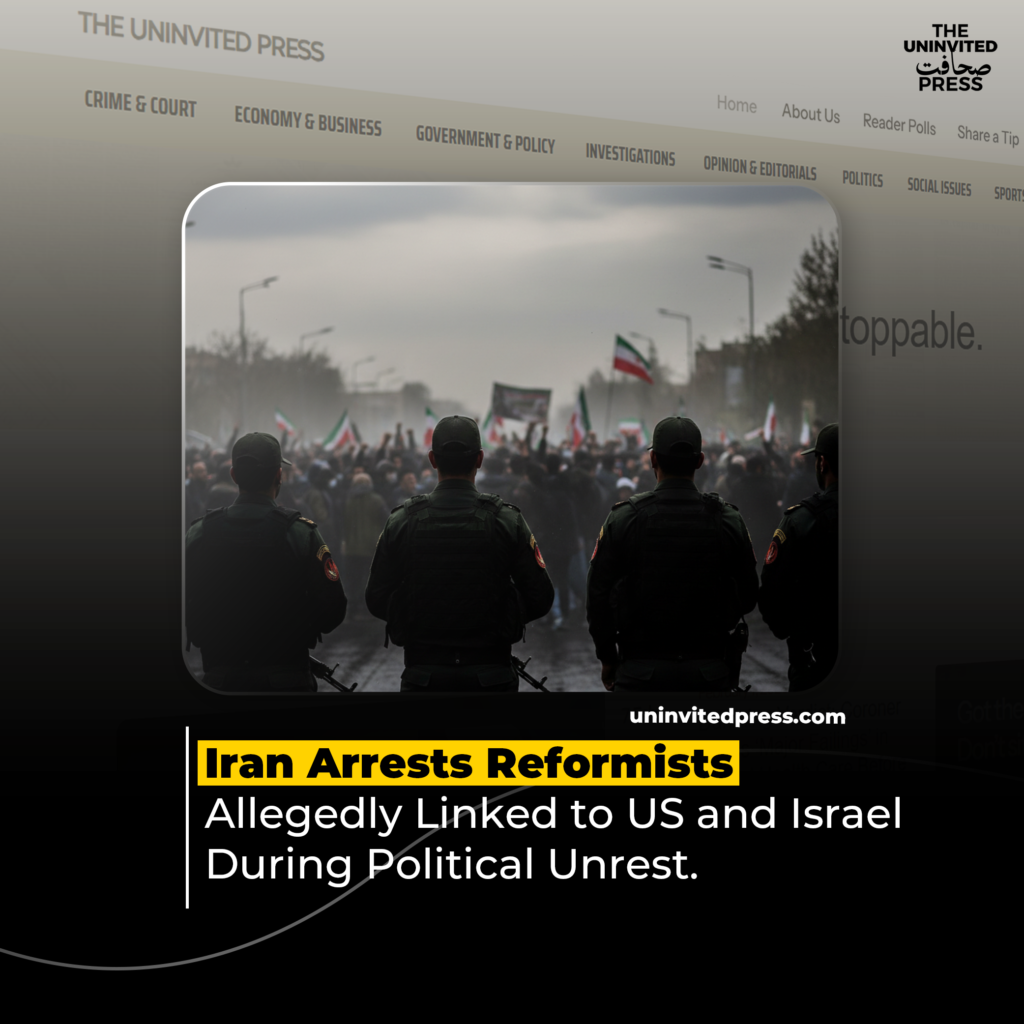
Iranian authorities arrest four reformist leaders over alleged US-Israel ties during January 2026 protests, amid crackdown killing thousands and arresting tens of thousands in Tehran.
Tehran Arrests Reformists Over Alleged US-Israel Ties:
In a bold escalation of its crackdown on dissent, Iranian authorities arrested at least four high-profile reformist politicians on February 8 and 9, 2026, accusing them of colluding with the United States and Israel to incite nationwide protests that rocked the country last month. The move signals Tehran’s determination to silence critics amid ongoing economic turmoil and geopolitical tensions, potentially derailing fragile nuclear talks and deepening internal divisions. As thousands remain detained from the unrest, these arrests highlight the regime’s zero-tolerance stance, raising alarms over human rights and stability in the Islamic Republic.
Deadly Protests Trigger Tehran Arrests of Reformists:
The arrests unfolded rapidly over a 24-hour period. On the evening of February 8, IRGC agents detained Azar Mansouri at her home in Tehran under a judicial order, as confirmed by the Reformists Front. Mohsen Aminzadeh and Ebrahim Asgharzadeh were taken into custody shortly after, followed by Javad Emam early the next day. Additional summons were issued to figures like Mohsen Armin, Badralsadat Mofidi, and Feizollah Arab Sorkhi, requiring them to report to Evin prison’s prosecutor’s office.
Iran’s judiciary, through its Mizan news agency, announced the indictments on February 9, stating the individuals were “important political elements supporting the Zionist regime and the United States.” No evidence was publicly presented, but officials claimed the group organized efforts to undermine national cohesion during the protests.
These developments cap a month of turmoil. Protests erupted on December 28, 2025, initially over a sharp currency devaluation and soaring inflation, but quickly morphed into calls for systemic change, including an end to clerical rule. By early January 2026, demonstrations had spread to all 31 provinces, with major clashes on January 8 and 9. Security forces responded with lethal force, deploying live ammunition, snipers, and heavy weaponry in over 400 cities.
The crackdown was unprecedented. Supreme Leader Ali Khamenei reportedly ordered a no-mercy approach on January 9, leading to mass killings. By mid-January, the unrest had largely subsided under intense repression.
Rial Collapse to Deadly Uprising: Iran’s 2026 Crisis Explained:
Iran’s January 2026 protests fit a pattern of recurring unrest driven by economic hardship and political repression. The rial’s collapse-exacerbated by U.S. sanctions, post-war recovery costs from the June 2025 Israel conflict, and mismanagement-ignited the spark. Inflation hit record highs, with food prices doubling in months, pushing millions into poverty.
This echoes prior waves; the 2019 fuel price hikes that killed over 1,500, and the 2022 Mahsa Amini protests against mandatory hijab laws, which claimed hundreds of lives. But the 2026 events stand out for their scale and lethality. Following the 12-day war with Israel in June 2025-triggered by Israeli strikes on Iranian nuclear sites-Tehran ramped up internal security, arresting thousands suspected of espionage.
The reformists arrested have deep roots in Iran’s political landscape. Mansouri leads the Reformists Front, a coalition advocating gradual change within the system. Aminzadeh served under reformist President Mohammad Khatami (1997-2005), while Asgharzadeh, once a radical student leader in the 1979 U.S. embassy siege, evolved into a moderate critic. Their detentions target voices close to current President Masoud Pezeshkian, who campaigned on reform but has faced hardliner backlash.
Significantly, these arrests occur amid indirect U.S.-Iran nuclear talks in Oman, restarted February 7, 2026. The 2015 deal’s revival hangs in the balance, with U.S. President Donald Trump threatening strikes and deploying naval forces in the Gulf. Iran’s accusations of foreign meddling-echoing claims during the 2025 war-serve to justify repression and rally domestic support.
The human cost is staggering. Death toll estimates vary; Iran’s government reports 3,117 killed, attributing most to “rioters.” Independent groups like HRANA verify 6,961 deaths, with 11,730 more under review, including 92 children. UN Special Rapporteur Mai Sato suggests over 20,000 may have died, citing medical sources amid internet blackouts. Arrests exceed 40,000, with detainees held in makeshift facilities and facing mass trials.
This purge underscores the regime’s fragility. With a dwindling Jewish community and minorities under scrutiny post-2025 war, Tehran’s scapegoating of external enemies masks internal failures, potentially fueling more dissent.