

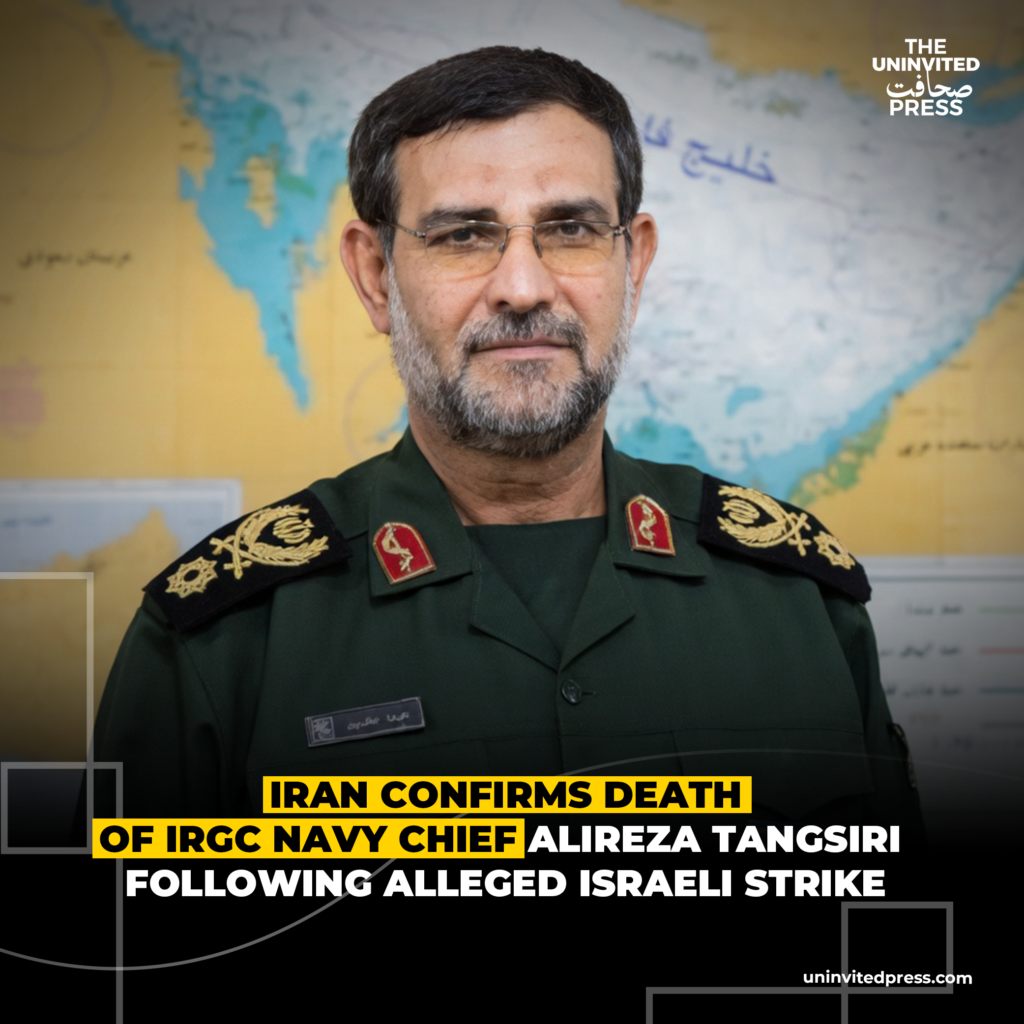
Revolutionary Guards say senior naval chief succumbed to severe injuries sustained in what Iran describes as an act of aggression by Israeli forces; strike comes amid escalating US-Israeli military campaign against Iran.
Iran’s Islamic Revolutionary Guard Corps (IRGC) has officially confirmed the death of its Navy commander, Brigadier General Alireza Tangsiri, who succumbed to severe injuries from an Israeli airstrike last week in the southern port city of Bandar Abbas.
The IRGC announced on Monday that Tangsiri, 64, died while “organising and strengthening defensive positions along Iran’s islands and coastlines” targeted by “hostile forces”. The statement described his death as “martyrdom” and extended condolences to his family and the Iranian people.
Israeli Defence Minister Israel Katz claimed responsibility for the strike on March 26, describing it as a “precise and lethal operation” that eliminated Tangsiri along with several senior naval command officials. Katz accused the commander of orchestrating the mining and partial closure of the Strait of Hormuz, a critical waterway for global oil shipments.
Precision strike amid an ongoing regional conflict:
The strike took place in the early hours of March 26 in Bandar Abbas, a key IRGC naval base near the Strait of Hormuz. Iranian media reported that Tangsiri was injured in the attack and later died from his wounds, with the IRGC delaying full confirmation until Monday.
Tangsiri, a hardliner known for his fiery rhetoric, oversaw Iran’s naval operations in the Gulf and had publicly warned against threats to Iranian interests in the strategic chokepoint, through which roughly one-fifth of the world’s oil passes.
The killing marks one of the highest-profile losses for the IRGC since the US-Israeli military campaign against Iran intensified in late February 2026. It follows earlier waves of assassinations targeting senior Iranian military and political figures.
Iran vows response as tensions rise:
Iran’s Foreign Ministry denounced the strike as an “act of aggression” and vowed a “fierce revenge”. Officials described the assassination as part of a broader effort by Israel and the United States to weaken Iran’s defensive capabilities in the Gulf.
The IRGC statement emphasised Tangsiri’s role in bolstering coastal defences amid repeated Israeli threats and strikes on Iranian territory and shipping interests.
US Central Command (CENTCOM) confirmed the death shortly after Israel’s announcement, with one senior US officer stating that the elimination of Tangsiri “makes the region safer”.
Strategic consequences for Gulf security:
Analysts say the death of the IRGC Navy chief could disrupt Iran’s naval command structure at a sensitive time, as Tehran continues to face pressure over the Strait of Hormuz and its support for regional allies.
The incident has heightened fears of further escalation in the Gulf, where oil prices have already surged due to disruptions and threats to shipping lanes. Kuwaiti and Emirati authorities have expressed concern over the safety of maritime traffic following recent attacks on vessels in the area.
Tangsiri’s death comes as diplomatic efforts, including reported indirect talks between the US and Iran, remain fragile. US President Donald Trump has alternated between claiming progress toward a deal and issuing fresh threats against Iranian infrastructure if the Strait of Hormuz is not fully reopened.
Funeral arrangements for Tangsiri are expected to be announced soon, with senior Iranian officials likely to attend in a show of defiance and unity.