

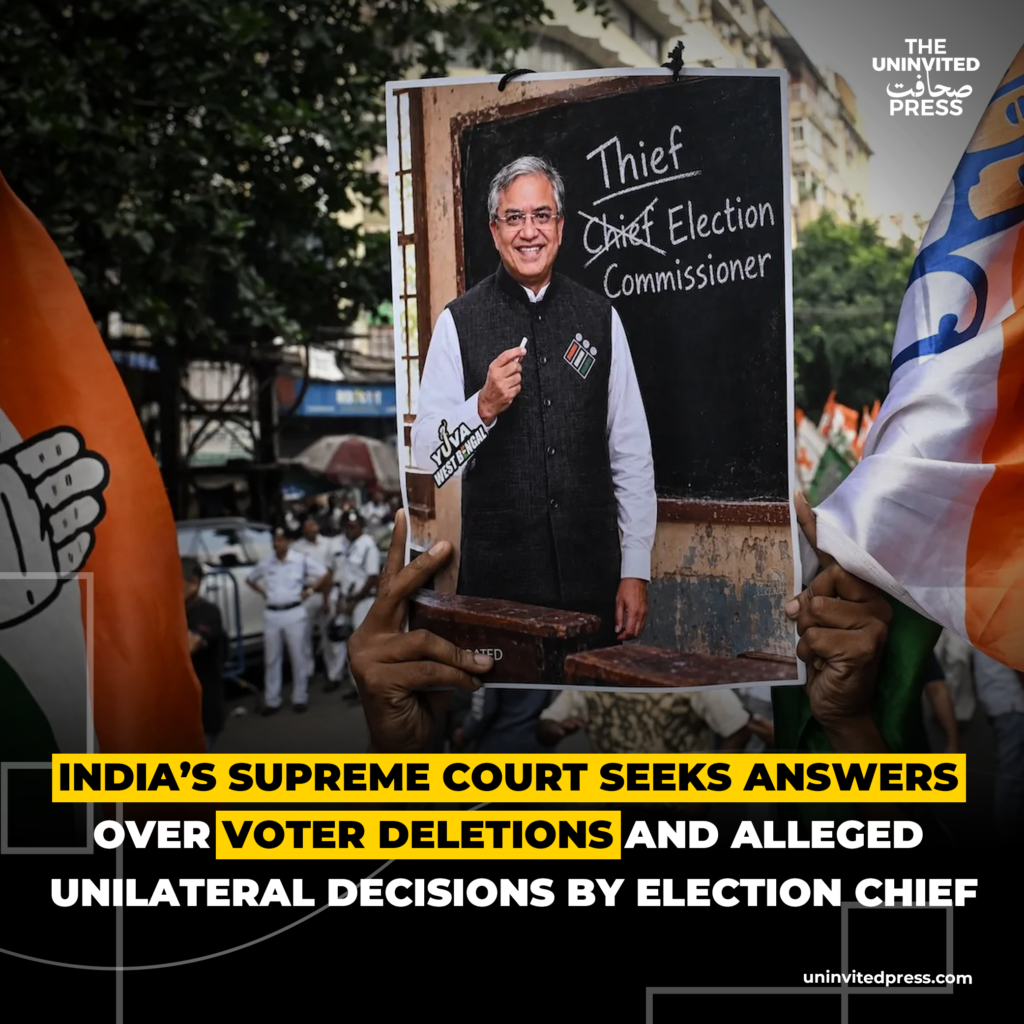
Top court issues notices to government, poll body and Chief Election Commissioner amid claims that tens of millions were removed from electoral rolls without full collegial approval.
India’s Supreme Court has directed the central government, the Election Commission of India (ECI) and Chief Election Commissioner Gyanesh Kumar to respond to petitions alleging large-scale voter deletions and unilateral decision-making during a nationwide revision of electoral rolls.
A three-judge bench led by Chief Justice of India Surya Kant, along with Justices Joymalya Bagchi and V Mohana, issued notices on Monday after hearing public interest litigation that raises serious questions about the functioning of the multi-member poll body. The court declined to pass an interim order suspending Kumar but made clear it would scrutinise the decisions in question.
India Voter Deletions Under Court Review:
The petitions, one of them filed by Rakesh Kumar Singh, rely heavily on a recent investigative report claiming that the other two Election Commissioners-Sukhbir Singh Sandhu and Vivek Joshi-formally recorded written objections on at least 14 occasions over a 10-month period between late 2025 and August 2026. The objections allegedly concerned key steps in the Special Intensive Revision (SIR) of electoral rolls, including the addition and deletion of names, changes to registration forms, and access to voter data systems.
Petitioners argue that several decisions were taken in the name of the full Commission without the concurrence or majority approval required under the Constitution and the Chief Election Commissioner and Other Election Commissioners Act of 2023. They have sought a declaration that such decisions are unconstitutional and void, an independent probe or special investigation team inquiry into the deletions, and, in some cases, action against the CEC.
The SIR exercise, which the Election Commission describes as a necessary purification of electoral rolls to remove duplicate, deceased, permanently shifted or ineligible entries, has resulted in the removal of approximately 13 crore (130 million) names from draft lists across dozens of states and union territories, according to figures cited in petitions and media reports based on official data. Critics, including opposition parties and civil society groups, contend that the scale of deletions-many marked under categories such as “absent,” “shifted,” “logical discrepancies” or technical mapping issues-has effectively disenfranchised large numbers of eligible citizens and shifted the burden onto individuals to prove their eligibility and seek restoration through appeals.
India Poll Body Under Supreme Court Scrutiny:
The Supreme Court had earlier upheld the constitutional validity of the SIR process itself, ruling that the ECI has the authority to conduct special revisions. However, the current proceedings focus on the manner in which decisions were taken and implemented. During Monday’s hearing, the bench observed that the Election Commission is a multi-member body expected to decide either unanimously or by majority. “If any decision is not in accordance with the law, we will annul it,” the court indicated, while seeking production of relevant records, including those related to modifications of Form 6 used for voter registration.
The court also clarified that it had not approved any altered version of Form 6 and directed respondents to reply in a clear and transparent manner. Notices were also issued to the other Election Commissioners, a deputy election commissioner and a senior information technology official of the ECI.
The controversy has triggered protests in several cities, with demonstrators demanding the resignation of the Chief Election Commissioner and the restoration of deleted names. Opposition leaders and rights groups have described the deletions as a threat to the principle of universal adult suffrage. The ECI maintains that the exercise is a routine and legally mandated effort to maintain accurate rolls and that safeguards, including notice and appeal mechanisms, are in place.
The Supreme Court’s intervention places the institutional integrity of the Election Commission and the protection of voting rights under intense judicial scrutiny at a time when India continues to prepare for future electoral cycles. Responses from the Centre and the poll body are expected in the coming days as the court examines whether the contested decisions were lawfully taken.