

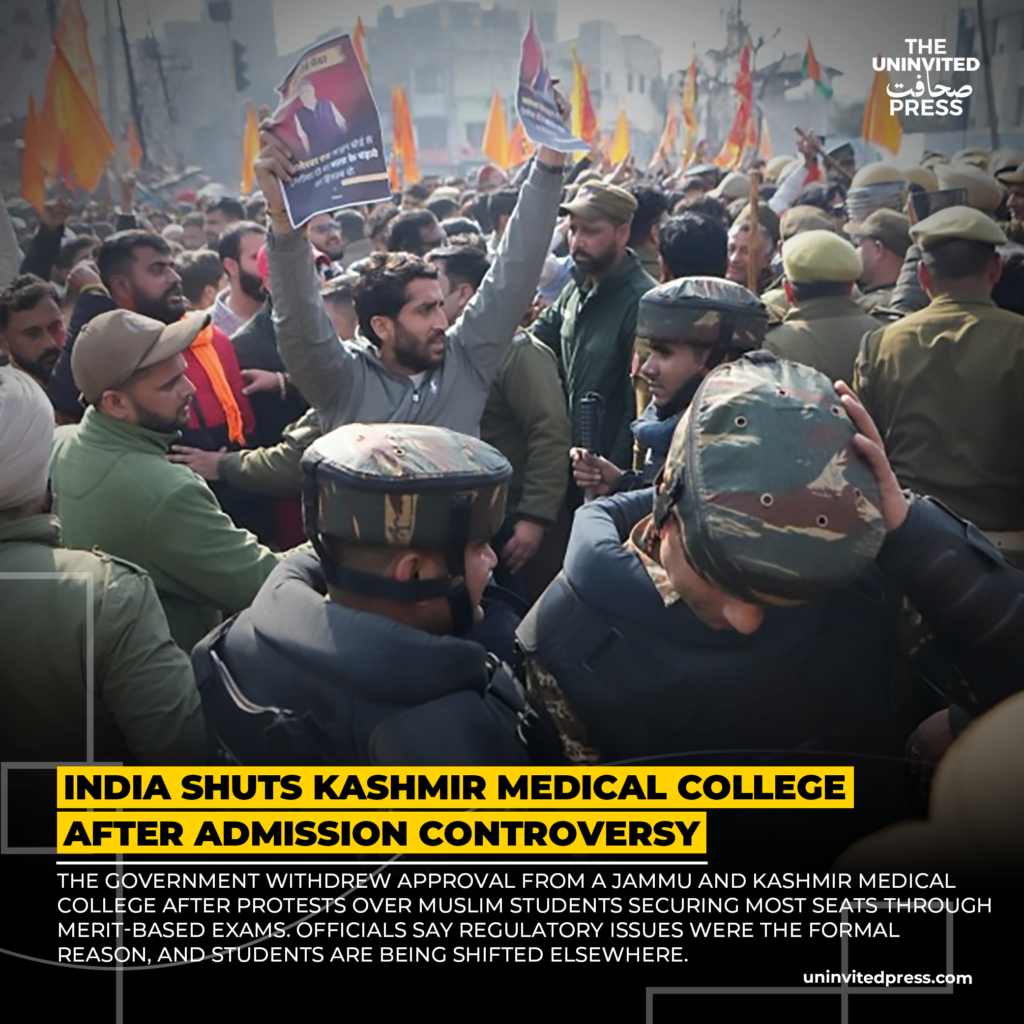
Regulatory Lapses Cited, But Timing Fuels Accusations of Communal Pressure in Jammu and Kashmir Education. India shuts down Jammu and Kashmir’s SMVDIME medical college after protests over Muslim students dominating merit admissions, citing regulatory failures. Students relocate amid fears of communal bias in education.
Shutdown of Shri Mata Vaishno Devi Medical College Exposes Regional Fault Lines:
In early January 2026, India’s National Medical Commission pulled the plug on a newly established medical college in Jammu and Kashmir, citing severe infrastructure and faculty shortcomings. The decision came just weeks after intense protests by right-wing Hindu groups over the college’s first batch, where 42 out of 50 students were Muslims admitted through national merit exams. Critics argue the shutdown exposes deepening religious divides in education, potentially worsening doctor shortages in a region already strained by conflict and underdevelopment.
This closure not only disrupts the dreams of 50 aspiring doctors but also raises alarms about merit being overshadowed by politics in India’s sensitive border territory. As students pack up and relocate, the move highlights ongoing tensions five years after the revocation of Jammu and Kashmir’s special status, where communal narratives continue to influence public institutions.
From Approval to Abrupt Shutdown:
The timeline began in 2024 when the Shri Mata Vaishno Devi Shrine Board, chaired by Jammu and Kashmir Lieutenant Governor Manoj Sinha, received in-principle approval for SMVDIME. The college, linked to the 417-bed Shri Mata Vaishno Devi Narayana Superspeciality Hospital inaugurated by Prime Minister Narendra Modi in 2016, aimed to address regional healthcare gaps with an initial 50 MBBS seats, expandable to 100.
Admissions for the 2025-26 academic year were handled strictly through the National Eligibility cum Entrance Test (NEET), a merit-based national exam. Of the 50 seats, 42 went to Muslim students, predominantly from Kashmir Valley, seven to Hindus and one to a Sikh. This composition, with 85% seats reserved for local domiciles, triggered immediate backlash.
Protests erupted in late 2025, led by the Shri Mata Vaishno Devi Sangarsh Samiti, a group supported by BJP and RSS affiliates. Demonstrators, including local traders and political figures, argued that the college-funded largely by donations from Hindu pilgrims to the Vaishno Devi shrine-should prioritize Hindu students. They formed alliances with nearly 60 organizations, holding rallies and demanding the cancellation of the admission list.
By early January 2026, the NMC( National Medical Commission) conducted a surprise inspection and revoked the LoP, stating the institute failed to meet minimum standards. Deficiencies included faculty shortages, inadequate labs and libraries, low inpatient/outpatient numbers, and bed occupancy below norms. The college disputes these claims, pointing to its state-of-the-art hospital facilities operational since 2016.
Students began evacuating the campus by January 10, with some expressing devastation. One anonymous student told reporters the facilities were “up-to-the-mark,” calling the closure “reckless.”
A Region's Healthcare Dreams Derailed:
Jammu and Kashmir has long grappled with inadequate medical infrastructure. The territory’s doctor-to-population ratio lags behind national averages, exacerbated by remoteness, natural disasters, and political instability-including a brief war with Pakistan in May 2025. SMVDIME was envisioned as a boost, creating jobs and improving access in Reasi district, a pilgrimage hub.
The controversy echoes broader communal frictions since the 2019 abrogation of Article 370, which integrated Jammu and Kashmir more closely with India but deepened divides between Hindu-majority Jammu and Muslim-majority Kashmir. Protesters’ demands for religious reservations clash with India’s Constitution, specifically Articles 14 and 15, which bar discrimination in education. The college, as a statutory body, is not a minority institution entitled to such preferences under Article 30.
In 2015, Jammu residents campaigned for an AIIMS hospital, highlighting a push for better facilities. A decade later, celebrating a college’s closure marks a stark reversal, prioritizing ideology over public health amid India’s nationwide doctor shortage of over 600,000 professionals.