

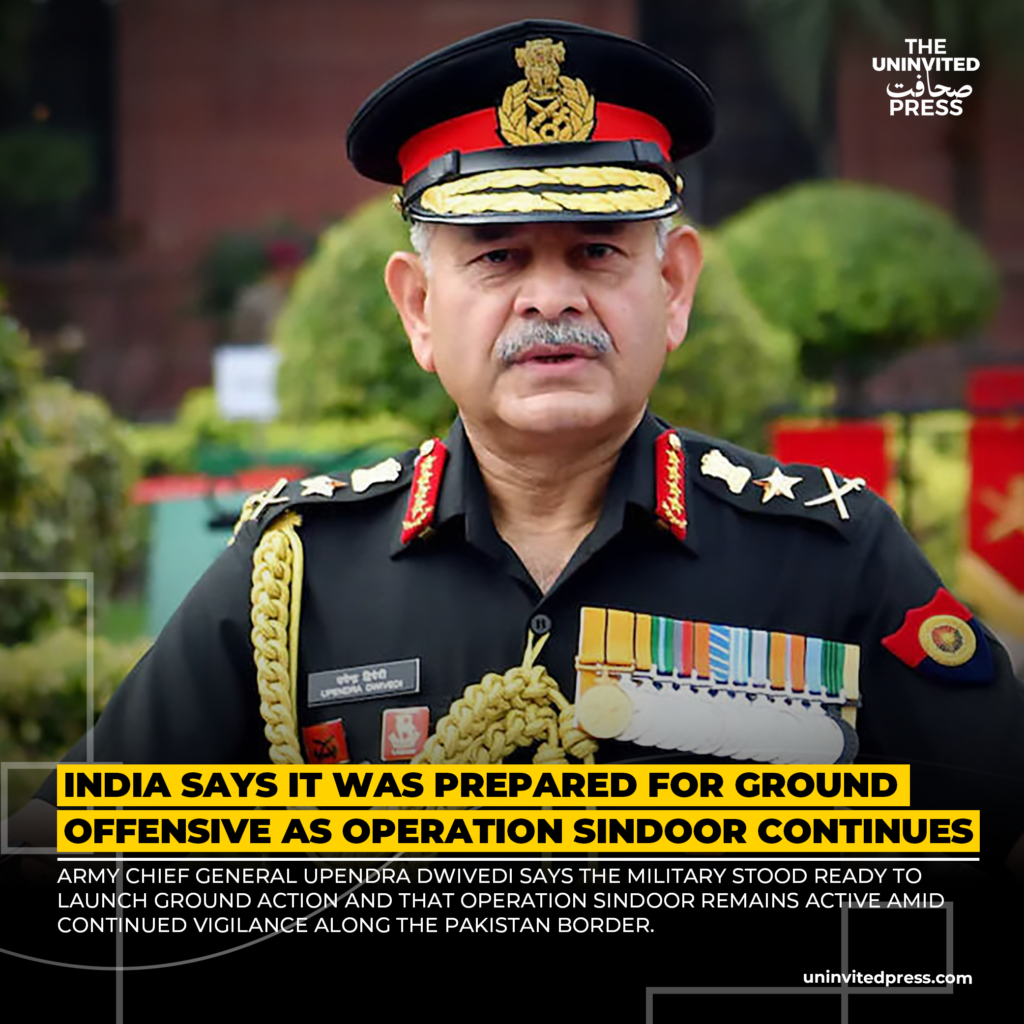
Indian Army Chief General Upendra Dwivedi reveals forces were ready for ground offensive in Operation Sindoor, which remains active against Pakistan-based terrorism amid border tensions in Jammu and Kashmir.
Army Chief Confirms Ground Forces Were Ready to Strike in Operation Sindoor:
Indian Army Chief General Upendra Dwivedi has revealed that forces were fully mobilized and prepared to launch ground operations during Operation Sindoor in May 2025, a revelation underscoring India’s readiness to escalate if provoked. Speaking at his annual press conference in New Delhi on January 13, 2026, he confirmed the operation remains active, with troops maintaining constant surveillance along the Pakistan border. This statement highlights India’s shift to proactive counterterrorism, potentially deterring future attacks but risking renewed conflict in a region shadowed by nuclear capabilities.
From 22-Minute Strike to Ceasefire: The Full Chronology of Operation Sindoor:
At the annual press conference held at Manekshaw Centre in New Delhi on January 13, 2026, General Upendra Dwivedi provided a detailed update on Operation Sindoor, emphasizing its ongoing nature and India’s strategic posture. “Operation Sindoor remains ongoing, and any misadventure by the adversary will be dealt with effectively,” he stated, adding that during the 2025 strikes, the Army had expanded conventional space to such an extent that ground operations were fully prepared if Pakistan made a wrong decision.
The operation traces back to the Pahalgam terror attack on April 22, 2025, where militants from The Resistance Front-a Lashkar-e-Taiba affiliate-killed 26 civilians, including tourists. In response, India initiated Operation Sindoor on the night of May 6-7, targeting nine terrorist infrastructure sites in Pakistan and Pakistan-occupied Kashmir (PoK). The strikes, involving cruise missiles like SCALP and precision-guided munitions from Rafale jets, were completed in 22 minutes, showcasing tri-service synergy.
Pakistan retaliated on May 8 with Operation Bunyanum Marsoos, launching drones and missiles at over a dozen Indian military sites, including air bases in Srinagar, Pathankot, and Bhuj. India countered by neutralizing Pakistani air defenses and command centers, downing at least five Pakistani jets and one early warning aircraft. The four-day exchange resulted in civilian casualties on both sides-31 in Pakistan and 16 in India from artillery fire-before a ceasefire was agreed on May 10 via direct military hotline talks, facilitated by U.S mediation.
In his January remarks, Dwivedi highlighted the operation’s success in dismantling terror networks, noting that 31 terrorists were eliminated in 2025, with 65% of Pakistani origin, including Pahalgam perpetrators. He stressed seamless inter-service coordination and India’s no-first-use nuclear policy as factors enabling calibrated escalation without territorial ambitions.
By January 17, 2026, Dwivedi reiterated these points at an investiture ceremony in Jaipur, affirming round-the-clock monitoring of enemy movements. No new strikes have occurred, but the Army reports detecting drone activities near the LoC, maintaining high alert status.
Balakot, Kargil, Sindoor: Decoding the Dangerous Ladder of India-Pakistan Confrontations:
Operation Sindoor fits into a long history of India-Pakistan tensions rooted in the Kashmir dispute since 1947. Previous cross-border actions include the 2016 surgical strikes post-Uri attack and the 2019 Balakot airstrikes after Pulwama, both targeting Jaish-e-Mohammed and Lashkar-e-Taiba camps. These groups, designated terrorists by the UN and U.S, have been accused of operating from Pakistani soil with state support-a charge Islamabad denies.
The 2025 conflict marked the most intense since the 1999 Kargil War, occurring amid domestic pressures in both nations. In India, under Prime Minister Narendra Modi, it reinforced a “zero-tolerance” policy against terrorism. Pakistan, facing economic woes and political instability under Prime Minister Shehbaz Sharif and Army Chief General Asim Munir, viewed the strikes as sovereignty violations.
The nuclear dimension loomed large; both nations possess arsenals, with Pakistan’s lower threshold for use adding risk. India’s strikes punctured Pakistan’s nuclear rhetoric, expanding space for conventional operations without triggering Armageddon. The U.S. role in de-escalation, including Secretary Marco Rubio’s call to Munir, highlighted global stakes in preventing nuclear flashpoints.
Significantly, Sindoor demonstrated India’s advancing military tech, from Rafale integrations to drone warfare, while exposing vulnerabilities like initial information delays. It also spurred Pakistan’s lobbying efforts in Washington, spending on advocacy to counter India’s narrative and seek intervention.