

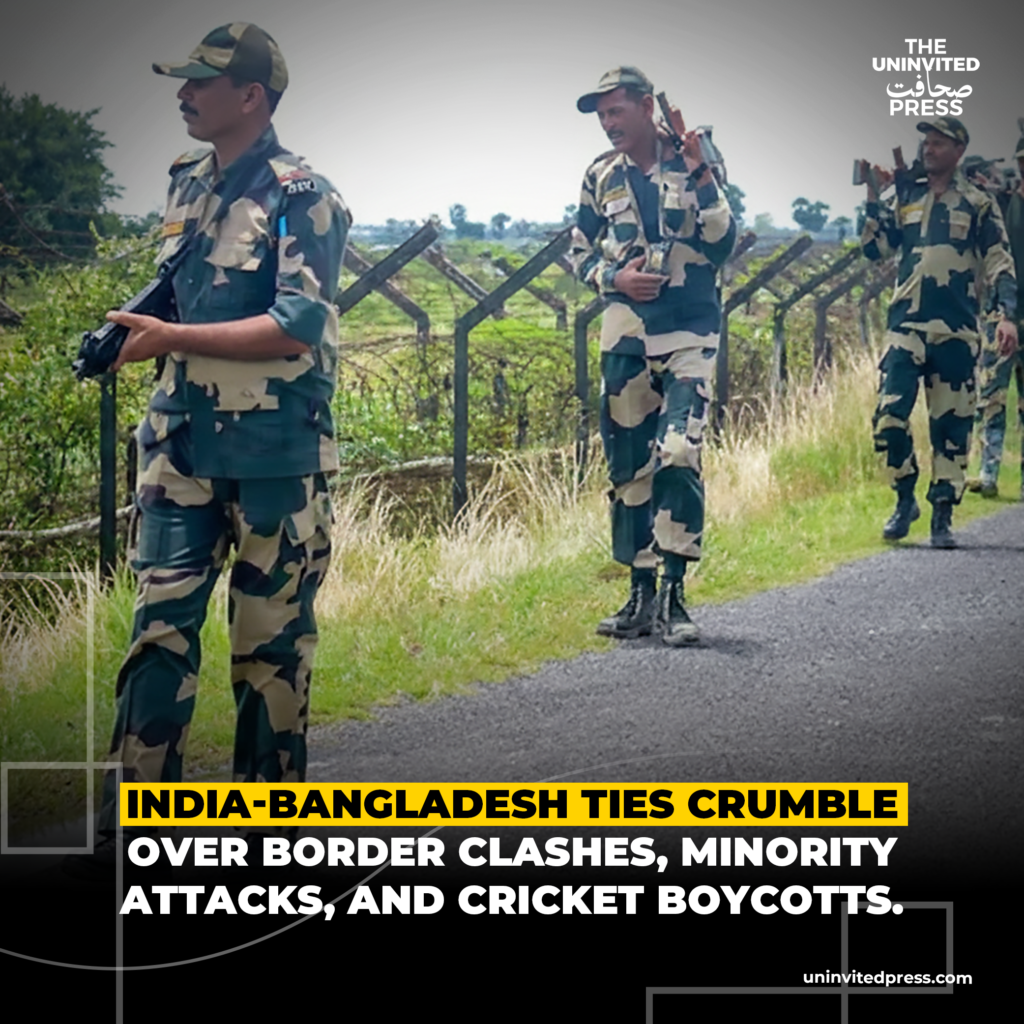
India-Bangladesh relations hit crisis mode with surging border infiltrations, deadly attacks on Hindu minorities, and cricket boycotts threatening the T20 World Cup-explore the facts behind the fallout.
India-Bangladesh Relations Hit Decades-Low as Politics, Security and Sport Collide:
Relations between India and Bangladesh have plunged to their lowest point in decades, fueled by a spike in border infiltrations, targeted attacks on Hindu minorities in Bangladesh, and a bitter cricket dispute that has seen players dropped, broadcasts banned, and international tournaments threatened. With Bangladesh’s general elections looming on February 12, 2026, and the T20 World Cup set to begin just days earlier, the fallout risks broader regional instability in South Asia. This rift, rooted in political upheaval since 2024, underscores how old alliances can fracture under new pressures.
When Violence Crossed the Border: Inside the Events That Turned India and Bangladesh Against Each Other:
The crisis erupted into public view in late 2025, when a series of violent incidents in Bangladesh ignited cross-border fury. On December 18, 2025, 27-year-old Hindu garment worker Dipu Chandra Das was accused of blasphemy in Mymensingh district, beaten to death by a mob, and his body set ablaze. This horrific act, captured in eyewitness accounts and confirmed by Bangladeshi police who arrested 12 suspects, symbolized the escalating threats to the country’s Hindu minority, which makes up about 8% of the population.
Hours later, prominent Bangladeshi student leader Sharif Osman Hadi, known for anti-India protests, was shot dead in Dhaka. His supporters alleged the killer, tied to the ousted Awami League party, fled to India-a claim Bangladeshi authorities could not confirm. These deaths sparked widespread protests: in Bangladesh, crowds targeted Indian diplomatic missions, pelting stones at the Assistant High Commission in Chittagong and painting anti-India graffiti in Dhaka. In India, Hindu nationalist groups rallied in Kolkata and Siliguri, burning effigies of Yunus and demanding action against minority violence.
By mid-December 2025, both nations suspended visa services in cities like Delhi and Dhaka, summoning each other’s high commissioners in a diplomatic tit-for-tat. The border, already a flashpoint, saw heightened activity; Indian agencies detected 1,104 infiltration attempts in 2025 alone, the highest in nearly a decade, leading to over 2,550 detentions of Bangladeshi nationals. While no large-scale armed clashes were reported, communal tensions boiled over in border areas, including a violent incident in Tripura’s Kailashahar where Chief Minister Manik Saha warned against disruptions to peace.
The feud spilled into cricket, a shared passion turned diplomatic weapon. On January 3, 2026, the BCCI directed the Kolkata Knight Riders to release Bangladeshi pacer Mustafizur Rahman from his IPL 2026 contract, citing “recent developments.” Rahman, who had signed for 9.2 million Indian rupees, quickly joined Pakistan’s Super League instead. In retaliation, Bangladesh banned IPL broadcasts nationwide and requested the ICC to shift its T20 World Cup group matches from India to Sri Lanka over safety fears. The ICC has assured security but warned of potential replacement by Scotland if Bangladesh forfeits.
The Roots of Rupture: Revolution, Exile, and the Remaking of India-Bangladesh Relations:
This breakdown traces back to August 2024, when student-led protests-dubbed the Monsoon Revolution-toppled Prime Minister Sheikh Hasina after 15 years in power. Hasina, accused of authoritarian rule and suppressing dissent, fled to New Delhi, where India granted her asylum. Bangladesh’s interim government, led by Nobel laureate Yunus, sentenced her to death in late 2025 for protester killings, demanding her extradition-a request India has ignored.
Post-revolution, Bangladesh has seen a rise in hardline Islamist influence, with groups like Jamaat-e-Islami gaining ground ahead of elections. This has coincided with increased violence against minorities; Human Rights Watch documented at least 51 attacks on Hindus since 2024, including 10 killings. Reports indicate 116 minority deaths from June 2025 to January 2026, though the Yunus government claims most of 645 incidents in 2025 were criminal, not communal, with only 71 confirmed as sectarian.
Historically, the 1947 partition created a porous border prone to smuggling and migration, but recent political shifts have amplified distrust. India’s support for Hasina is seen in Bangladesh as meddling, while Dhaka’s warming ties with Pakistan have alarmed New Delhi.