

Comptroller and Auditor General report highlights irregularities in water resources and mining sectors, raising questions over public funds and environmental compliance.
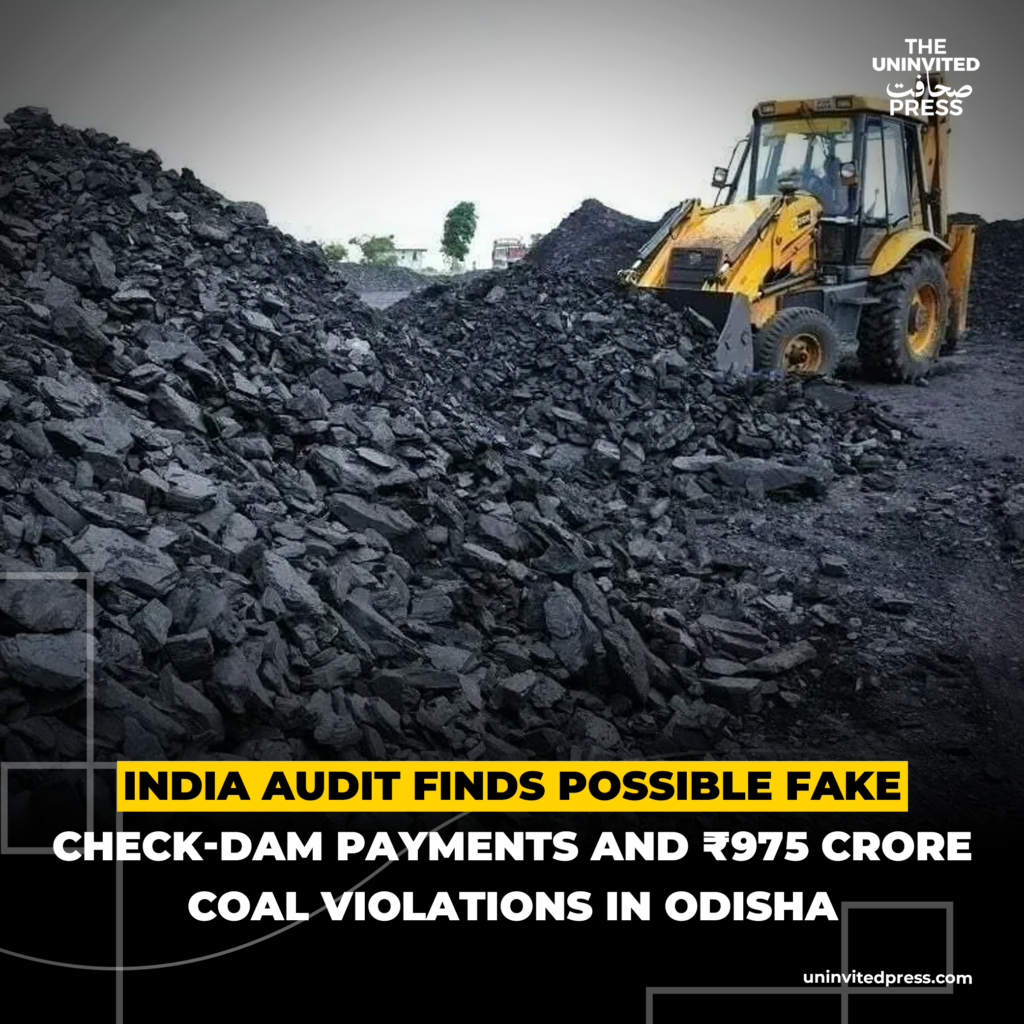
India’s national auditor has flagged serious irregularities in Odisha, including possible fraudulent payments for check dams that already existed and the production of coal worth nearly ₹975 crore in violation of environmental norms.
The findings form part of the Comptroller and Auditor General (CAG) compliance audit report for the year ended March 2024, which was tabled in the Odisha Assembly this week. The report examined several state departments and pointed to lapses that could involve misuse of public money and breaches of environmental clearances.
CAG Flags Possible Duplicate Check-Dam Payments:
In the water resources department, the CAG found that ₹4.26 crore was spent on constructing seven check dams under the Mukhyamantri Adibandha Tiari Yojana (MATY) at locations where such structures already stood.
Auditors examined geo-tagged data and satellite imagery, including Google Earth Pro, for 331 of 481 check dams built across 12 sampled minor irrigation divisions. They discovered that seven dams in four divisions were already present when fresh construction contracts were awarded between April 2023 and January 2025.
“Incurring expenditure on construction of check dams that may have already been in existence indicates a possibility of fraudulent payments which needs to be investigated by appropriate authorities,” the report stated.
The state government offered explanations, saying some structures dated back to 2017-18 or were earthen bunds built by locals, and disputed one location identified by the auditors. The CAG rejected these replies, noting that superintending engineers had still executed fresh agreements and released the funds.
Coal production beyond environmental limits:
In the mining sector, the CAG reported that more than 1.17 crore tonnes of coal were extracted from two mines operated by Mahanadi Coalfields Limited (MCL) either beyond permitted limits or without a valid environmental clearance. The lessee is liable to pay ₹975.57 crore for the unlawful production, according to the audit.
The bulk of the violation occurred at the Kalinga Open Cast Project in the Talcher mining circle. Its environmental clearance expired in October 2021 even after accounting for COVID-related extensions granted by the central environment ministry. Yet the mine continued operations and extracted 1.15 crore tonnes of coal between October 2021 and March 2023, valued at ₹956.56 crore.
At the second mine, Kulda Open Cast Project, production exceeded the revised environmental clearance limit by about 2.3 lakh tonnes in 2022-23, attracting a further liability of ₹19.02 crore.
Together the two cases involved 1,17,96,540 tonnes of coal. The CAG criticised local mining authorities for failing to properly verify the validity of environmental clearances and production ceilings while assessing operations.
Odisha Audit Flags Mining and Spending Irregularities:
The report also noted other shortfalls in mining dues, including short levy of royalty and unrealised interest running into tens of crores of rupees. Officials in the departments concerned have been asked to respond; in several instances the government’s final reply was still awaited at the time the audit was finalised.
Odisha is one of India’s major mineral-producing states, and coal from MCL supplies power plants across the country. Check dams, meanwhile, form a key part of efforts to improve irrigation and water conservation in rural areas. The CAG findings therefore touch both environmental governance and the integrity of development spending.
The state government has yet to announce any specific investigation or recovery action based on the report. Opposition parties are expected to raise the issues in the Assembly, while civil society groups have called for transparent probes into the alleged irregularities.
The audit once again underscores the gap that can open between rules on paper and their enforcement on the ground in India’s resource-rich regions.