

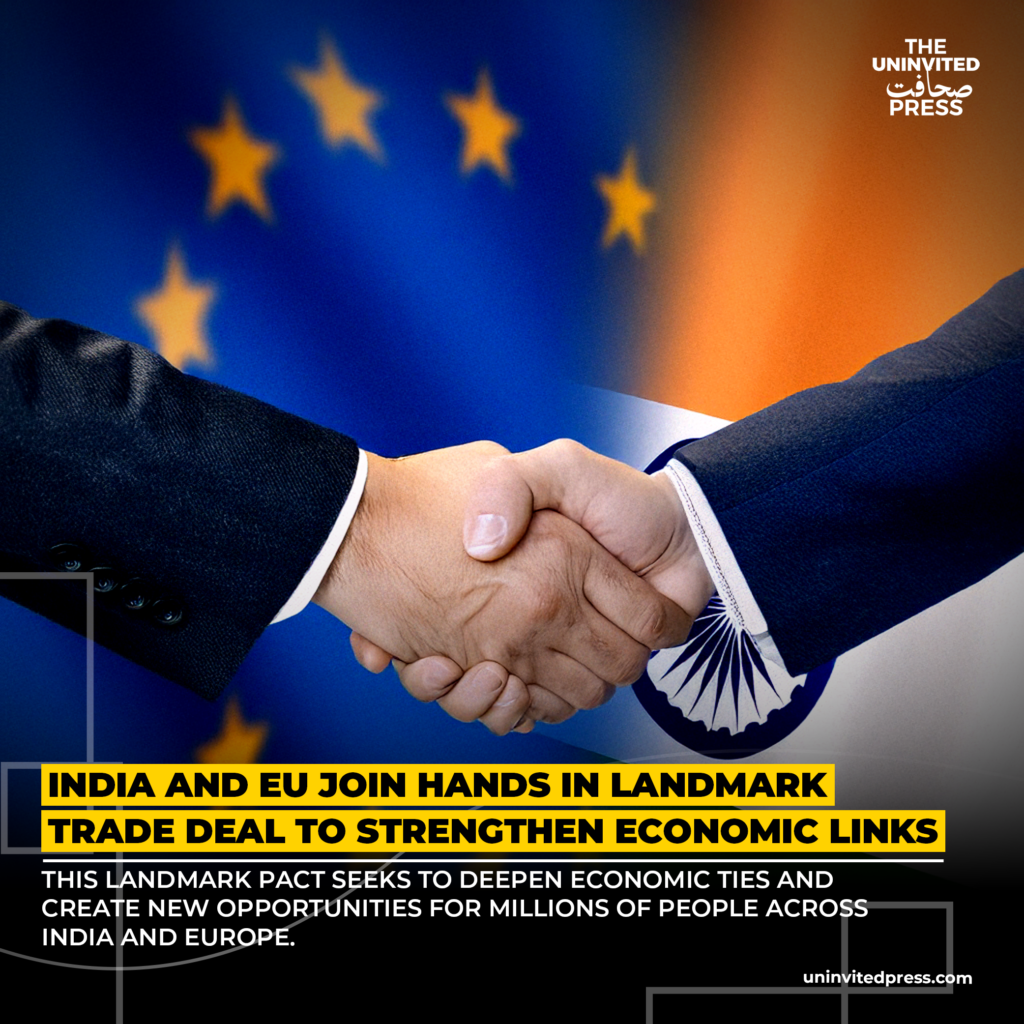
India and the EU concluded negotiations on a landmark Free Trade Agreement on January 27, 2026, in New Delhi, aiming to slash tariffs and boost trade for millions. This ‘mother of all deals’ signals stronger economic and strategic ties.
India-EU Seal Landmark Free Trade Pact, Creating One of the World’s Largest Economic Blocs:
India and the European Union announced the conclusion of negotiations for a comprehensive Free Trade Agreement on January 27, 2026, at a high-stakes summit in New Delhi. This deal, dubbed the “mother of all deals” by EU leaders, is poised to create a massive free trade zone encompassing two billion people and accounting for a quarter of the world’s GDP. It comes at a time of heightened geopolitical tensions, offering a buffer against uncertainties like potential U.S. trade disruptions under the incoming Trump administration.
The pact seeks to eliminate or reduce tariffs on over 96% of traded goods, potentially doubling EU exports to India by 2032 and boosting bilateral trade from its current $136 billion annually. Indian Prime Minister Narendra Modi hailed it as the “biggest in India’s history,” emphasizing how it will generate huge opportunities for millions across sectors like textiles, pharmaceuticals, and IT.
January 27, 2026-The Day the Deal Dropped: Contours of a Game-Changing Pact Revealed:
The announcement marks the end of a marathon negotiation process that began in 2007 but stalled in 2013 due to disagreements over tariffs, intellectual property, and market access. Talks resumed in June 2022, gaining urgency after a 2021 commitment by both sides to forge an ambitious, mutually beneficial pact. The final push came in late 2025, with the 14th round of formal discussions in October, followed by intensive technical and political dialogues.
On January 27, Modi and von der Leyen jointly unveiled the deal’s contours at the summit, highlighting its scope; the EU will cut duties on 90% of Indian goods immediately upon implementation, benefiting exports like textiles, gems, pharmaceuticals, and IT services. In return, India will ease access for European cars, wine, aircraft, chemicals, and machinery, with projected savings of €4 billion in duties for EU firms. The agreement also establishes a new EU-India climate cooperation platform launching in 2026, aimed at cutting emissions and promoting sustainable industries.
Indian Commerce Secretary Rajesh Agrawal confirmed the closure of talks on January 26, paving the way for the summit’s declaration. The deal’s scale is unprecedented, covering a combined market of 1.8 billion people and aiming to elevate trade volumes significantly in the coming decade.
Beyond Trade: The Strategic Power Play Behind the India-EU Pact:
This pact arrives amid shifting global alliances, with both India and the EU seeking to reduce reliance on volatile partners like China and the U.S. India’s trade with the EU hit $136.5 billion in the fiscal year ending March 2025, making the bloc its second-largest trading partner after the U.S. For the EU, India represents a fast-growing market of 1.4 billion consumers, offering diversification from overdependence on Asian supply chains.
Negotiations faltered over sensitive issues: India pushed for easier visas for its professionals and protection for generic drugs, while the EU sought stronger intellectual property safeguards and lower barriers for its autos and spirits. The resumption in 2022 was spurred by post-pandemic recovery needs and shared concerns over Russia’s invasion of Ukraine, which disrupted energy and food supplies.
The deal’s significance extends beyond economics. It strengthens strategic ties, including defense and technology cooperation, as both sides navigate U.S. President-elect Donald Trump’s tariff threats. Experts view it as a hedge against protectionism, potentially adding billions to GDPs and creating jobs in manufacturing and services.