

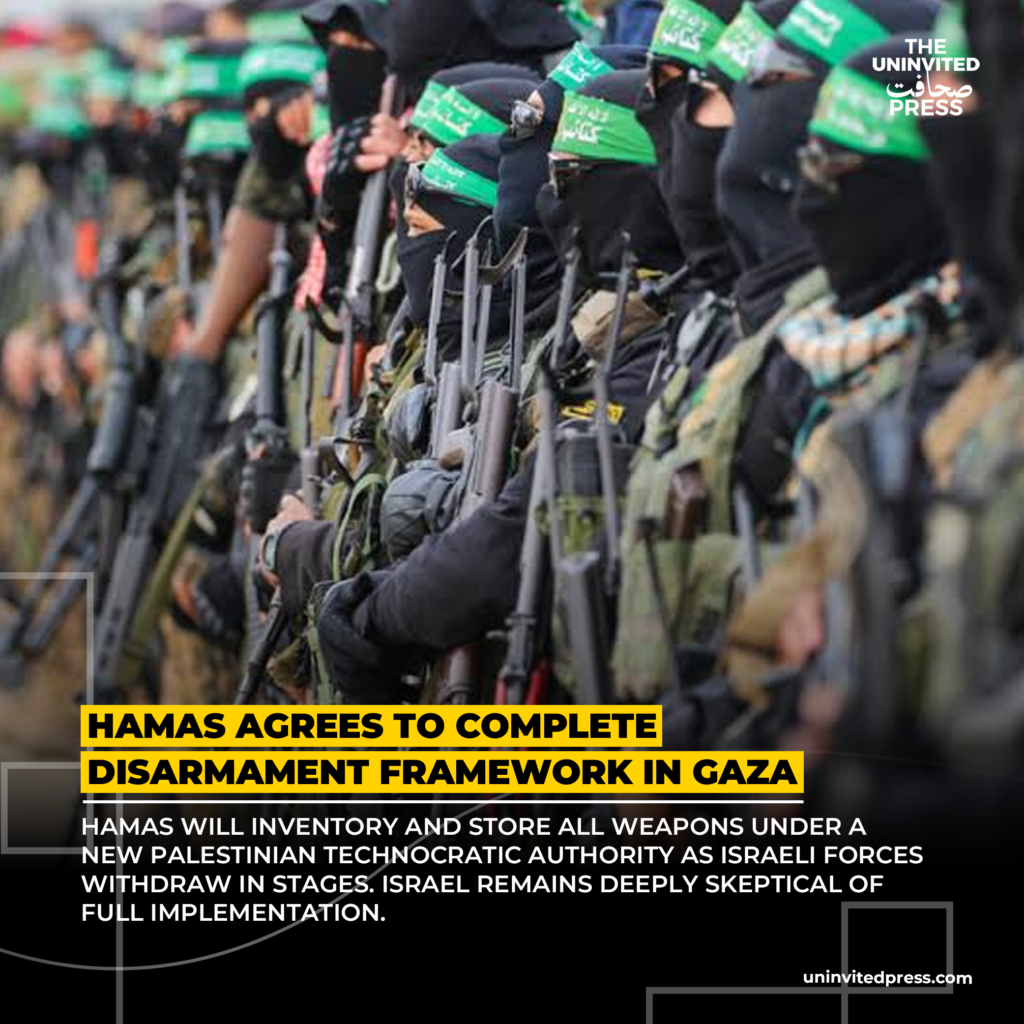
Weapons to be inventoried and stored under new Palestinian technocratic authority as Israeli forces withdraw in stages; Israel remains deeply sceptical of full implementation.
Hamas has agreed for the first time to a detailed framework for the complete disarmament of its fighters and other armed groups in the Gaza Strip, according to US officials, mediators and the group itself, in what American President Donald Trump has described as a “historic” step towards ending the nearly three-year war.
Under the plan, endorsed by Hamas and other Palestinian factions, remaining weapons will be inventoried and placed in storage under the supervision of a newly established Palestinian technocratic body known as the National Committee for the Administration of Gaza (NCAG). Israeli forces would then withdraw in phases as the process advances, with an International Stabilisation Force and a new Palestinian police service eventually taking responsibility for security.
The agreement forms part of a broader US-backed roadmap overseen by the Board of Peace, an international mechanism established under Trump’s 20-point plan for Gaza. Officials said the precise implementation timeline is to be finalised within 14 days, with possible extensions subject to verification by an international body.
Key Details of the Framework:
According to details released by the Board of Peace, US officials and confirmed by Hamas sources, the process is designed around the principle of “one authority, one law, one weapon.” The NCAG, a transitional technocratic administration, would hold a monopoly on all weapons in Gaza. Hamas and other armed factions would relinquish both governing and military roles.
The sequence outlined includes:
- Transfer of weapons held by Hamas’s civilian police forces first.
- Inventorying and secure storage of heavy weapons, ammunition and related stockpiles under Palestinian oversight.
- Dismantling of tunnel networks and weapons production facilities.
- Collection of small arms in accordance with Palestinian law.
- Parallel gradual withdrawal of Israeli troops, linked to verified progress on demilitarisation.
Hamas has insisted that weapons will not be handed over to Israel or any non-Palestinian entity, and that the process of “inventorying and storing” will take place under the NCAG’s authority with international observers present. A senior Hamas official involved in the talks told the Media the negotiations were “long and extremely difficult,” with the group rejecting language that implied direct surrender of arms to Israel.
Egyptian state media and mediators from Egypt, Qatar and Türkiye confirmed that Hamas and other factions had informed them of their approval. A meeting in Cairo is expected to reaffirm commitments.
Israel Sceptical as Hamas Disarmament Plan Advances:
Israeli officials have reacted with deep scepticism, questioning whether Hamas will fully implement the commitments or attempt to retain significant capabilities. Successive Israeli governments have long insisted that Hamas must be completely demilitarised and removed from any governing role before a durable end to the conflict is possible.
Board of Peace and US officials acknowledged that Israeli withdrawals will only proceed in tandem with verified progress on the ground. “Israel cannot reasonably be expected to withdraw from areas where terrorist infrastructure or armed threats remain,” one official said.
The war, which began with Hamas’s October 7, 2023 attack on Israel and Israel’s subsequent military campaign in Gaza, has caused catastrophic destruction and a severe humanitarian crisis. A fragile ceasefire has been in place since late 2025, but progress on the second phase-including governance arrangements and demilitarisation-had stalled over the weapons issue.
Trump called the development a “monumental step” toward lasting peace, saying Israeli forces would withdraw after disarmament, while an International Stabilisation Force would work with a new Palestinian police force. The agreement could pave the way for Gaza’s reconstruction and civilian administration, but major challenges remain, including verifying disarmament and overcoming deep mistrust.