

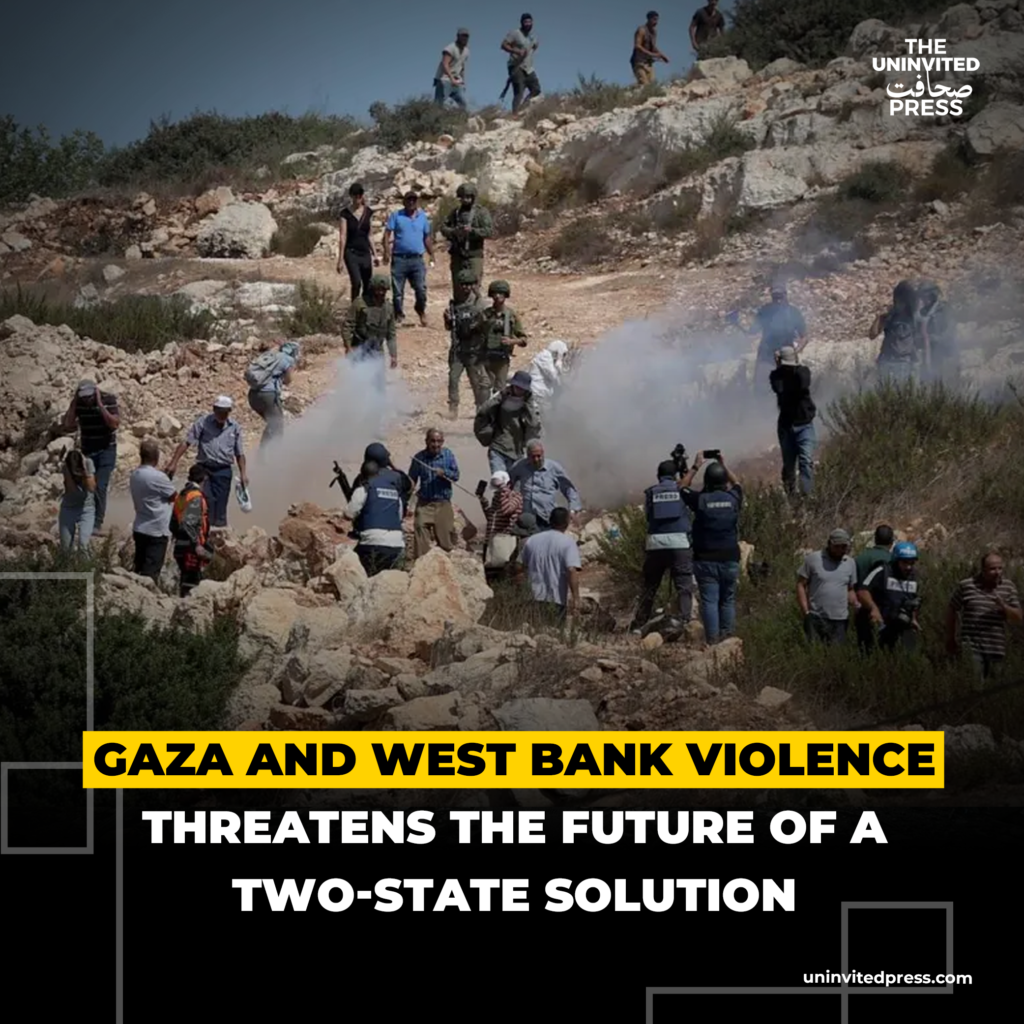
Officials warn that stalled reconstruction in Gaza, expanding Israeli control and surging settler attacks in the occupied West Bank have left no credible pathway to a negotiated peace.
A top official overseeing the fragile Gaza ceasefire has issued one of the starkest assessments yet of the Israeli-Palestinian conflict, warning that continued violence in both Gaza and the occupied West Bank is rendering a two-state solution “practically impossible.”
Nickolay Mladenov, high representative for Gaza under the US-backed Board of Peace, told the Hili Forum in Abu Dhabi that more than 50 percent of the Gaza Strip remains under Israeli military control while Hamas retains influence over the remainder. Combined with “everything that is happening in the West Bank,” he said, “there is no credible pathway forward to a political resolution of the conflict.”
The remarks come as Israeli forces continue operations in both territories, Palestinian casualties mount, and settlement construction accelerates-developments that diplomats and UN officials say are systematically dismantling the territorial and political basis for two independent states living side by side.
West Bank Faces Escalating Violence and Displacement:
The occupied West Bank has seen a sharp deterioration throughout 2026. UN figures show dozens of Palestinians killed by Israeli forces or settlers this year, including children, alongside thousands displaced by settler attacks, home demolitions and military operations. Settler violence has reached unprecedented levels, with more than 1,430 documented incidents causing casualties or property damage affecting hundreds of Palestinian communities.
Since October 2023, dozens of Palestinian villages and hamlets have been fully or partially emptied. Israeli security forces have frequently failed to intervene against settler assaults and, in some cases, have been accused of facilitating them. At the same time, large-scale raids in places such as Jenin, Nablus and surrounding villages have left homes destroyed and residents barred from returning.
The expansion of settlements continues apace. Plans for the E1 area east of Jerusalem, if implemented, would physically separate the northern and southern West Bank and cut East Jerusalem off from the rest of the territory-moves widely described as an existential threat to any future contiguous Palestinian state. More than 500,000 Israeli settlers now live in the West Bank, a population that has grown steadily under successive Israeli governments.
Gaza Ceasefire Fails to Halt Bloodshed:
In Gaza, an October 2025 ceasefire has failed to halt the killing. Gaza’s Health Ministry reports more than 1,000 Palestinians killed by Israeli strikes, gunfire and shelling since the truce took effect, with the overall death toll since October 2023 exceeding 73,000. Israeli forces now control a majority of the territory and have established dozens of military positions, while the civilian population remains confined to a shrinking, overcrowded area with limited access to shelter, water and medical care.
Reconstruction has barely begun. Humanitarian agencies report that large parts of the Strip remain inaccessible or heavily restricted. Hamas has agreed in principle to a roadmap involving the decommissioning of heavy weapons under international supervision and a transition to Palestinian civilian administration, but implementation has stalled amid disagreements over sequencing-whether Israeli withdrawal or Palestinian disarmament should come first.
Mladenov stressed that without transitional governance, weapons decommissioning and a genuine Israeli withdrawal, the political horizon will disappear. “The only way that we can build back to that is if we have transitional governance, if we have decommissioning of weapons, if we have withdrawal in Gaza,” he said.
Two-State Solution Faces Growing Threat:
UN briefings to the Security Council have repeatedly linked the two crises. Speakers have warned that the humanitarian catastrophe in Gaza and the violence and land seizures in the West Bank are “not separate crises” but manifestations of the same occupation and culture of impunity. Resolution 2803 (2025) and the Comprehensive Plan to End the Gaza Conflict remain largely unimplemented.
International recognition of a Palestinian state by several countries in 2025 has not translated into concrete pressure capable of reversing facts on the ground. Meanwhile, Israeli officials have spoken of expanded control in Gaza and issued warnings of further military action in the West Bank. The result, diplomats say, is a landscape in which the territorial integrity required for a viable Palestinian state is being steadily eroded.
Palestinian civil society and some Israeli voices continue to argue that a two-state outcome remains the only internationally recognized framework capable of delivering security and self-determination to both peoples. Yet as settlement blocs expand, Gaza remains fragmented under military control, and daily violence persists, that framework looks increasingly theoretical.
Without an immediate halt to settlement construction, accountability for settler violence, a genuine end to hostilities in Gaza, and a time-bound political process leading to an end of the occupation, officials warn the window for two states may close permanently. The alternative, they caution, is not stability but further fragmentation, displacement and cycles of conflict that will continue to exact a heavy human cost on both sides.