

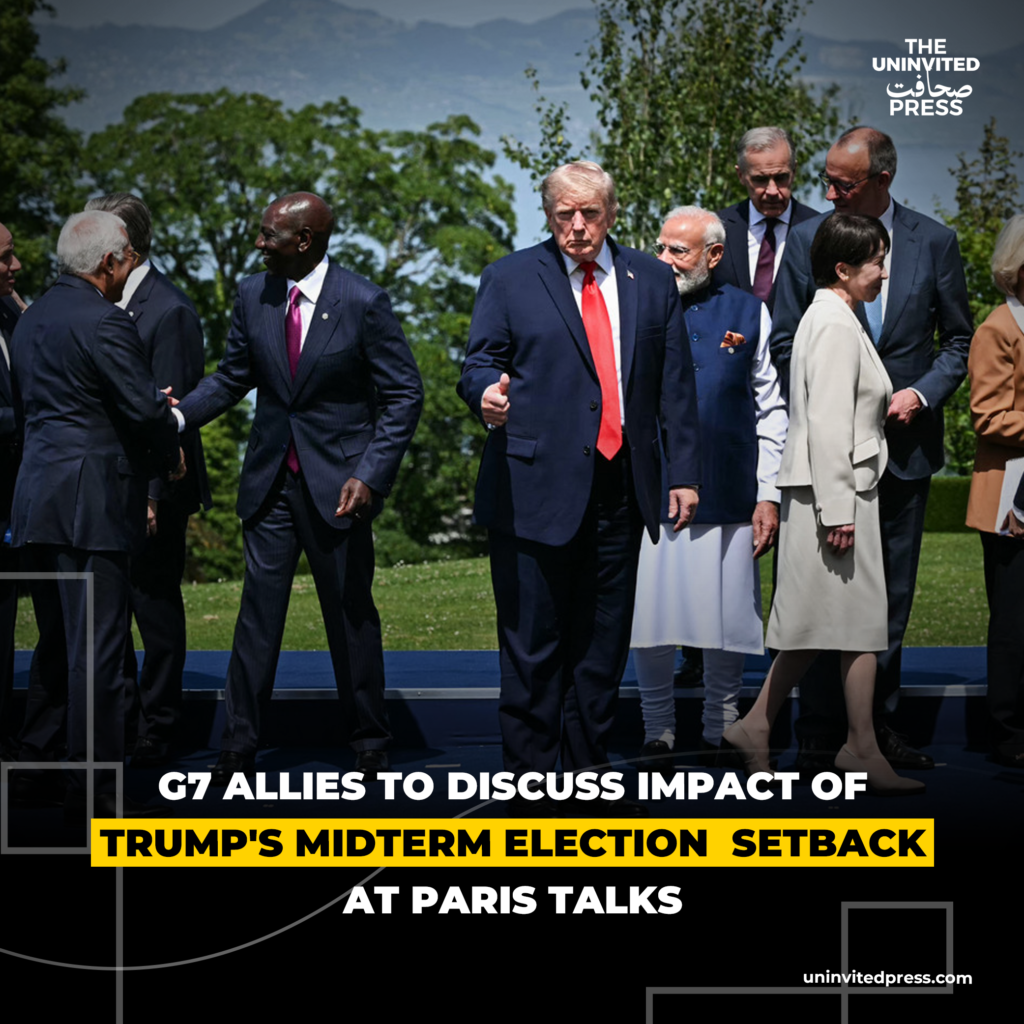
European and Asian partners seek clarity on US policy shifts over Ukraine, the Middle East and global alliances after Democrats seize Congress.
Foreign ministers from the Group of Seven (G7) nations convened in the French capital on Monday for talks that will serve as the first major opportunity for Washington’s closest allies to evaluate the consequences of President Donald Trump’s significant midterm election setback.
The two-day meeting, originally scheduled for Marseille but relocated to Paris at short notice due to security concerns linked to ongoing protests across France, brings together diplomats from Britain, Canada, France, Germany, Italy, Japan and the United States, along with the European Union. Ministers from Ukraine, Saudi Arabia, Egypt, South Korea and Brazil are also participating.
G7 Allies to Discuss Ukraine and Middle East After US Midterm Elections:
According to four G7 diplomats, the gathering will allow allies to gauge whether the Democrats’ decisive gains-which handed them control of both chambers of Congress-will constrain the Trump administration’s approach to Ukraine, the Middle East and relations with traditional partners. While the midterm results are expected to narrow the White House’s domestic room for manoeuvre, officials cautioned against expectations of a full return to conventional US multilateralism, noting that foreign policy remains firmly under Trump’s direction.
US Secretary of State Marco Rubio, widely viewed as a potential contender for the 2028 presidential race, is making his first appearance before the G7 allies since the elections. His participation is being closely watched as a signal of the administration’s post-midterm posture.
Ukraine tops the agenda. The Paris talks precede trilateral discussions scheduled for Tuesday in Abu Dhabi involving Ukraine, Russia and the United States. European partners are particularly concerned about ensuring they have a meaningful voice in any potential settlement and that Kyiv is not pressured into an unfavourable deal. Italian Prime Minister Giorgia Meloni has previously stressed the need for a unified European strategy on the conflict, while allies are expected to push for increased air defence systems and energy support for Ukraine.
Iran and broader Middle East dynamics are also expected to feature prominently. G7 partners have repeatedly expressed scepticism about further US military action, warning that escalation could deepen rather than resolve regional instability. Differences between Paris and Washington over a proposed new security framework for Lebanon may also surface during the discussions.
G7 Nations Weigh US Policy Shift After Midterm Elections:
The midterm elections, held earlier this month, delivered a clear repudiation of Trump’s second-term agenda. Democrats flipped multiple Senate seats in traditionally Republican strongholds, including Texas, Kansas and South Carolina, while securing a comfortable majority in the House. Analysts and diplomats alike have linked the results in part to public discontent over the economic fallout from the Iran conflict and broader cost-of-living pressures.
For G7 allies, the Paris meeting represents a delicate balancing act. They must navigate a more constrained US administration while recognising that Trump retains primary control over foreign policy decisions. The outcome of these talks could shape coordinated responses to ongoing crises and test the resilience of the transatlantic and Indo-Pacific partnerships in the remaining two years of Trump’s term.
As one European diplomat noted, the discussions will reveal whether the midterm verdict produces tactical adjustments in Washington or simply reinforces the existing “America First” framework under tighter congressional scrutiny.