

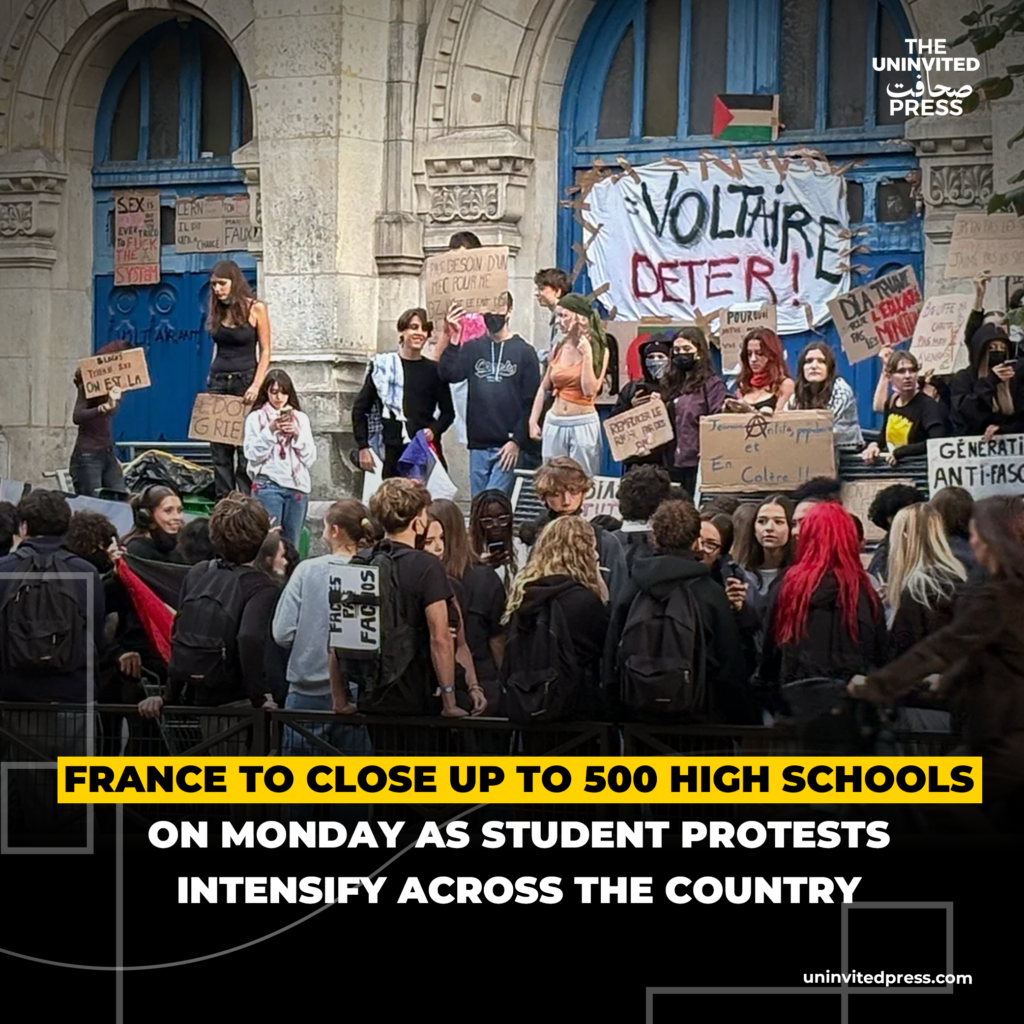
Education minister cites unmet security conditions after days of blockades, clashes and damage to schools; further demonstrations planned for Tuesday.
French authorities plan to fully or partially close between 400 and 500 high schools on Monday as a nationwide wave of student protests over school conditions continues to disrupt education across the country.
Education Minister Édouard Geffray announced on Sunday that lessons would be “totally or partly suspended” in those institutions because security conditions “have not been fulfilled.” He described the measure as a precautionary step aimed at enabling a “partial, progressive return to lessons.”
Geffray said 24 schools had been “burned or ransacked” since the protests began. At least 78 education staff members and around 170 students have been injured in related incidents, according to official figures.
France Student Protests Spread as Hundreds of Schools Close:
The protests, involving mainly high school students aged 15 to 18 at France’s lycées, started in mid-September at a school in the Paris region. They have since spread to cities including Montpellier, Nantes, Marseille, Lyon and beyond. Students are demanding improvements to teaching conditions, citing chronic teacher shortages and absences, overcrowded classrooms, poorly maintained or dilapidated buildings, and excessively long school days that can stretch from early morning until evening.
Organisers have called for large-scale demonstrations on Tuesday, arguing that the government has so far failed to offer concrete measures in response to their grievances. Teachers’ unions and some university students have expressed solidarity in parts of the country.
On Friday, Justice Minister Gérald Darmanin reported that 735 of France’s approximately 3,700 high schools had been affected “one way or another” by the unrest. More than 5,000 people, the majority of them minors, have been arrested since the start of the week of intensified action, according to Interior Ministry figures. Rights groups, including Amnesty International, have criticised the use of tear gas and other force against young protesters.
Geffray has accused far-left activists of infiltrating and hijacking what began as a student-led movement, leading to “extreme violence.” The government has acknowledged that some of the students’ demands regarding resources and conditions are legitimate while condemning acts of vandalism, arson and assaults on staff and police. In the Île-de-France region around Paris, more than a third of public high schools were expected to remain closed on Monday, regional officials said.
France Faces Growing Student Unrest:
The unrest comes as President Emmanuel Macron’s government navigates budget constraints and political tensions ahead of future elections. The scale of the closures-affecting roughly one in eight high schools-underscores the depth of frustration among secondary students over the state of public education.
Authorities have indicated that decisions on reopening will be made on a case-by-case basis depending on local security assessments and the condition of facilities. Students and unions maintain that without meaningful commitments on staffing, infrastructure and workload, the mobilisation will continue.