

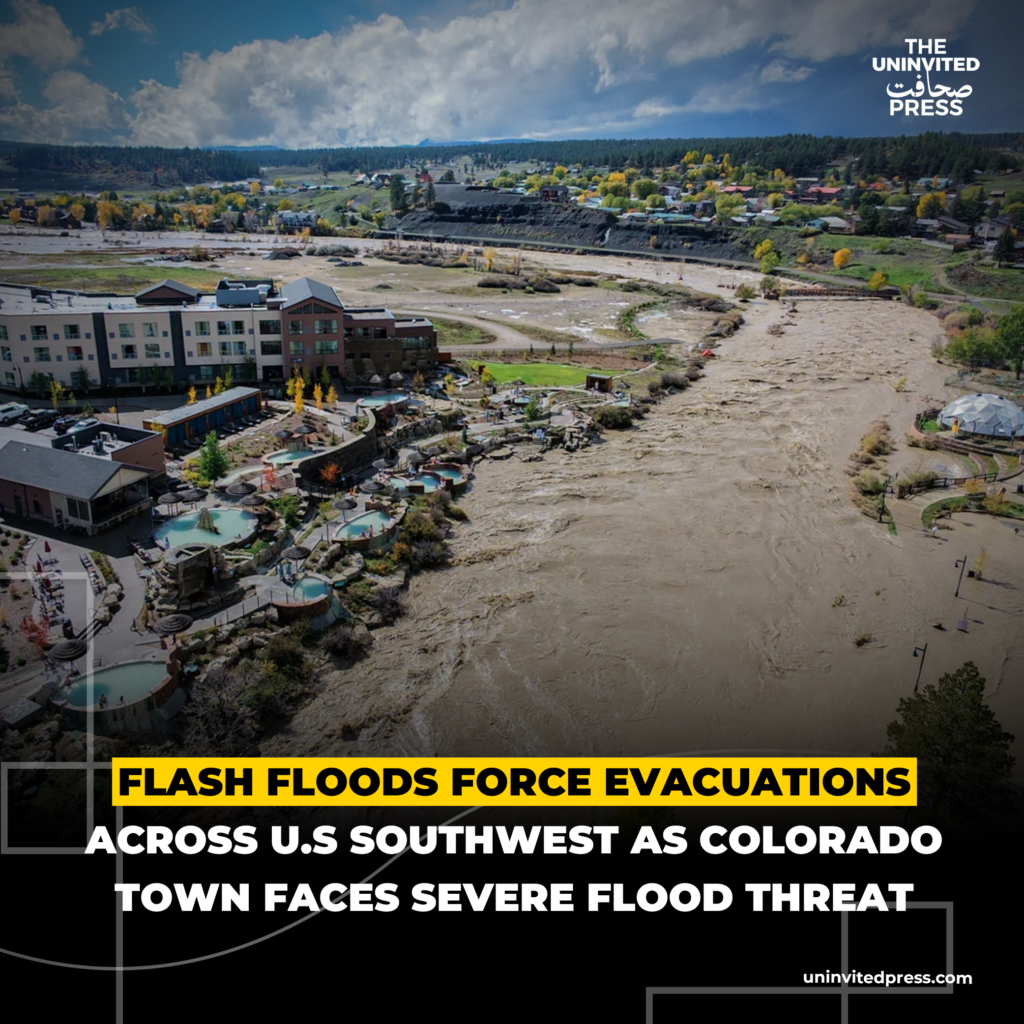
Heavy rains trigger mandatory evacuations in Arizona and Colorado; Pagosa Springs braces for potentially catastrophic rise of San Juan River.
Heavy rainfall has triggered widespread flash flooding and mandatory evacuations across parts of the southwestern United States, with authorities in a Colorado mountain town warning of a potentially catastrophic flood event as a key river approaches historic levels.
In southwestern Colorado, officials in Pagosa Springs-a community of more than 2,000 people known for its hot springs and proximity to ski resorts-ordered residents in low-lying areas to leave as the San Juan River was forecast to crest near or above 19 to 22 feet (about 5.8 to 6.7 metres) late on Sunday. That level would exceed the previous record of approximately 17.8 feet set during a devastating 1911 flood that largely destroyed the town at the time.
“This is a potentially catastrophic flood event. Extensive damage is expected,” the Archuleta County Sheriff’s Office said in a public warning. Officials urged people in evacuation zones along the San Juan, Rio Blanco, Navajo and Piedra rivers to leave immediately, noting that first responders’ ability to reach those in danger would be severely limited once the worst of the storm hit. Helicopters were expected to be grounded, and Highway 160 into the town was closed to inbound traffic.
Flooding Triggers Evacuations Across Colorado and Arizona:
The latest flooding comes just over a week after a previous round of heavy rains caused significant damage in the same region, including the inundation of homes and roads. Recovery efforts were still under way when the new storms arrived, saturating already waterlogged ground and raising the risk of rapid runoff.
Evacuations and road closures were also ordered in neighbouring La Plata, Rio Grande and Conejos counties. In La Plata County, authorities temporarily closed all county roads and directed residents of several mobile home parks and low-lying neighbourhoods near Durango, Bayfield and Ignacio to leave. Similar orders affected communities along the South Fork of the Rio Grande and the Conejos River.
In Arizona, officials in the tourist destination of Sedona ordered immediate evacuations for residents near Oak Creek as floodwaters rose rapidly and multiple people became trapped in their homes. Nearby Camp Verde issued similar orders for areas along the Verde River, West Clear Creek and Wet Beaver Creek. Flash flooding also prompted rescues in and around Tucson, where a National Weather Service meteorologist said the region was receiving the equivalent of two to three months of rain in just a couple of days.
Flood Threat Escalates Across U.S. Southwest:
Flood watches covered nearly all of Arizona and portions of southern Utah, southwestern Colorado, western New Mexico and southern Nevada-including the Four Corners region where the four states meet. The National Weather Service warned of the potential for additional flash flooding, river flooding and debris flows as residual moisture from Pacific storm systems continued to feed into the area.
The Southwest, typically arid, has faced repeated rounds of intense precipitation in recent weeks. Saturated soils mean that even moderate additional rainfall can quickly produce dangerous runoff. Emergency managers have emphasised the life-threatening nature of flash floods, noting that as little as a few inches of moving water can sweep away vehicles.
Shelters were opened in affected communities, and authorities advised residents outside mandatory evacuation zones to shelter in place and monitor official updates. Colorado National Guard units and specialised rescue teams were prepositioned to assist once conditions allowed. As of early Monday, the full extent of damage from the latest storms was still being assessed. Officials continued to stress that the situation remained fluid and urged the public to treat all flood warnings seriously and avoid travel in flooded areas.