

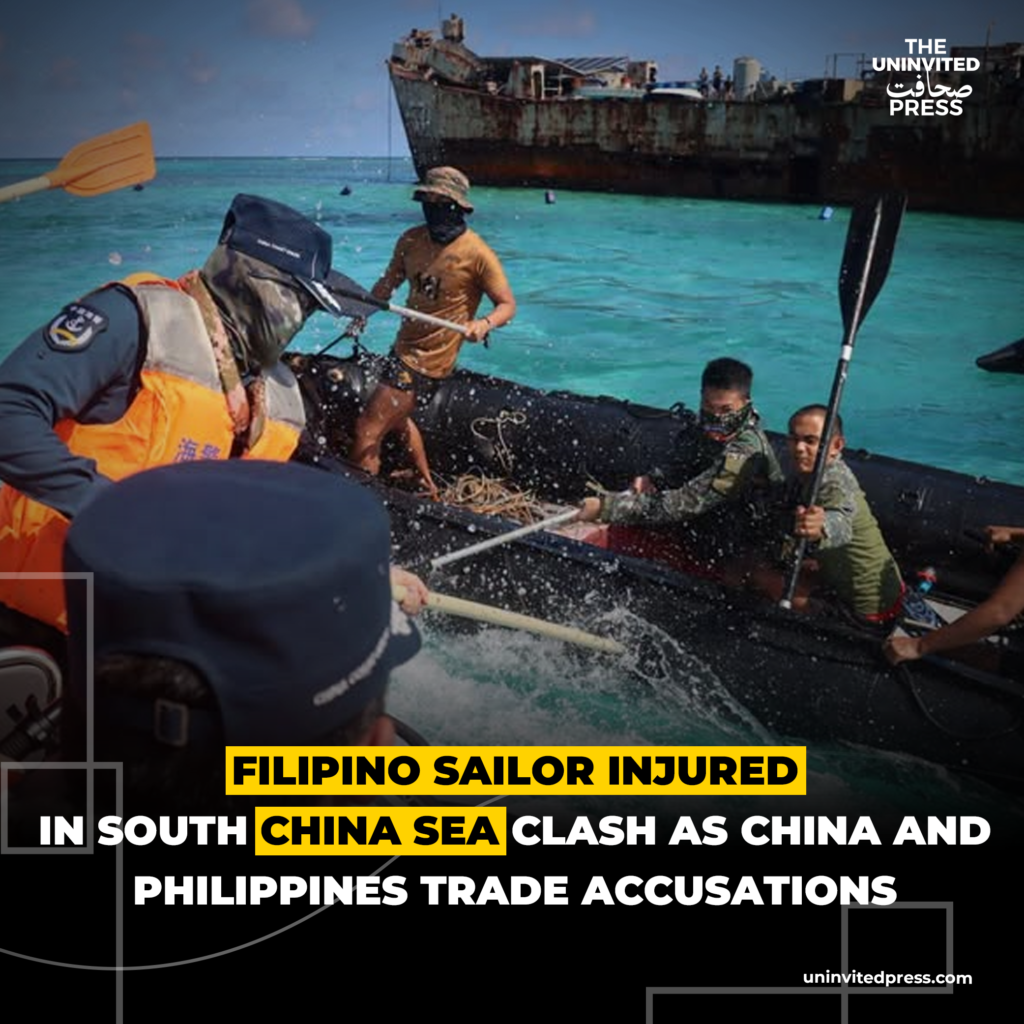
Manila accuses Beijing of ‘brutal’ assault; China claims Philippine vessels initiated dangerous manoeuvres.
In a sharp escalation of long-standing maritime disputes in the South China Sea, the Philippine military has reported that one of its sailors was seriously injured during a confrontation with Chinese Coast Guard personnel near Second Thomas Shoal (known locally as Ayungin Shoal) on Monday.
Philippine officials described the incident as an unprovoked attack, alleging that Chinese personnel aboard rigid-hulled inflatable boats struck a Filipino sailor on the head with a wooden baton multiple times. The clash also resulted in damage to a Philippine Navy rubber boat during a routine resupply mission to the grounded BRP Sierra Madre, a World War II-era vessel that serves as a Philippine outpost on the shoal
China, Philippines Trade Blame Over Sea Clash:
The Philippines maintains the incident occurred well within its exclusive economic zone (EEZ), in line with the 2016 arbitral tribunal ruling that invalidated China’s expansive “nine-dash line” claims. Manila has condemned the actions as “dangerous, illegal, and aggressive.”
In response, China’s Coast Guard and foreign ministry accused Philippine vessels of deliberately ramming Chinese ships and engaging in provocative behaviour. Beijing asserts its actions were lawful enforcement of sovereignty over what it considers its territory.
This latest flare-up mirrors previous violent encounters, including a 2024 incident in which a Filipino sailor lost a thumb.
Second Thomas Shoal Standoff Raises Risks:
The Second Thomas Shoal lies in the disputed Spratly Islands, where overlapping claims by China, the Philippines, Vietnam, and others have turned the area into one of Asia’s most volatile flashpoints. China has significantly expanded its presence through island-building, militarisation, and a large “grey zone” fleet of coast guard and maritime militia vessels, aiming to assert de facto control.
The United States quickly condemned China’s actions as “dangerous and aggressive,” reaffirming its commitment to the Philippines under their Mutual Defense Treaty. Washington has increased joint patrols and military support to Manila in recent years as part of efforts to counter Chinese assertiveness in the region.
Analysts warn that repeated incidents risk miscalculation, potentially drawing in external powers and destabilising vital sea lanes through which trillions of dollars in global trade pass annually.
The Philippines, under its current leadership, has pursued a policy of firm resistance combined with diplomatic engagement and strengthened alliances, particularly with the US, Japan, and Australia. Recent efforts include enhanced rotational troop deployments and joint exercises.
China, for its part, continues to reject the 2016 Hague ruling and insists on bilateral negotiations, while expanding its infrastructure and patrols.
As both sides trade accusations, the injured sailor’s condition and the full circumstances of the clash remain under scrutiny. International calls for restraint and de-escalation are growing, with many urging adherence to international law and freedom of navigation.
The incident underscores the fragile balance in the South China Sea, where tactical confrontations between coast guards and navies carry the constant risk of broader conflict in a region central to global geopolitics.