

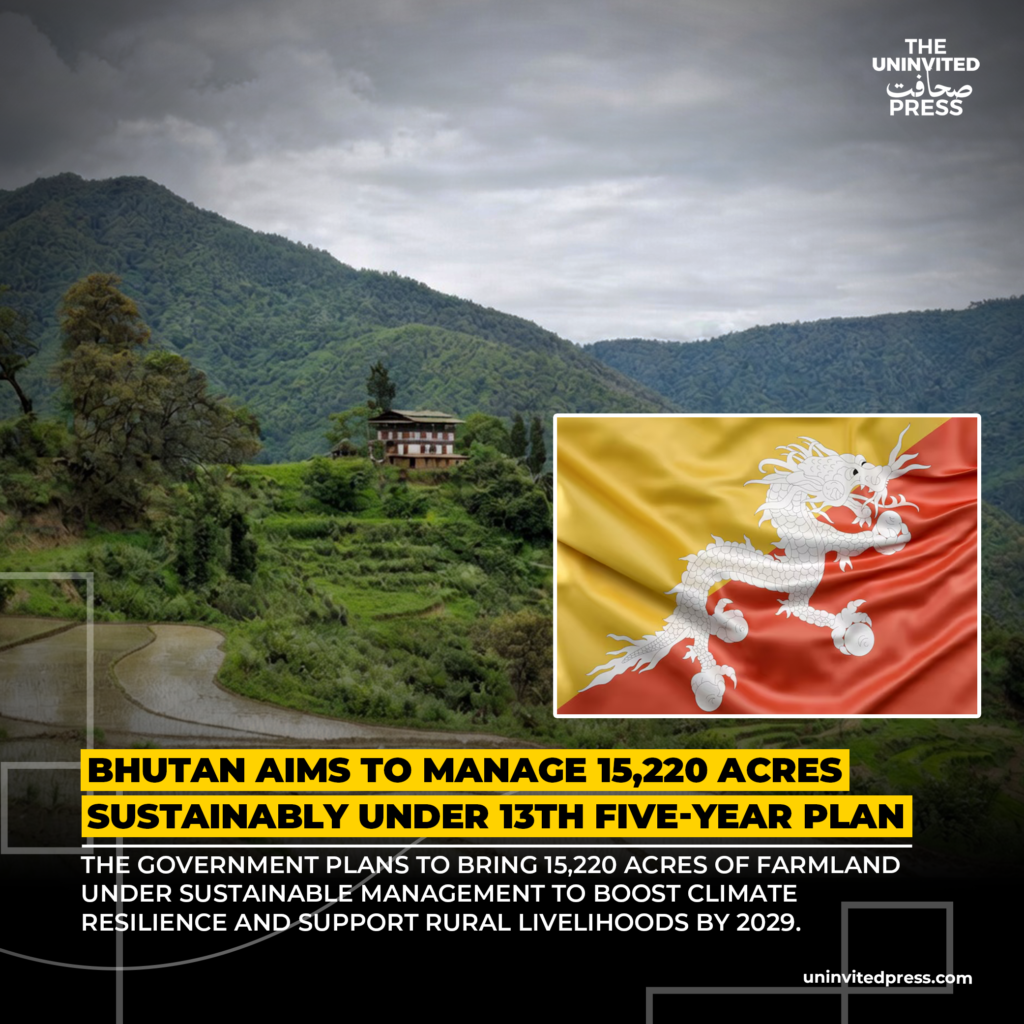
Bhutan sets ambitious target to sustainably manage 15,220 acres of farmland under the 13th Five-Year Plan, boosting soil health, slashing erosion, and strengthening climate resilience for rural communities by 2029.
Safeguarding Farmland in a Mountain Nation:
In the shadow of the Himalayas, where every inch of arable soil is a precious lifeline, Bhutan is drawing a firm line against land degradation. The government has unveiled a targeted push to bring 15,220 acres of farmland under sustainable land management (SLM) practices by the close of the 13th Five-Year Plan in June 2029. This initiative, led by the Ministry of Agriculture and Livestock (MoAL), aims to restore soil health, curb erosion on steep slopes, conserve moisture during droughts, and fortify rural livelihoods against the mounting pressures of climate change.
The stakes could not be higher. Bhutan’s rugged terrain limits usable agricultural land to roughly 7% of its total area-approximately 664,000 acres-much of it terraced and vulnerable. With nearly 30% of arable fields already lying fallow due to wildlife conflict, labor shortages, and degradation, this SLM drive represents a critical investment in food security and economic resilience for the thousands of smallholder families who still depend on the land.
From Test Fields to a Nationwide Movement:
Sustainable land management is not new to Bhutan. Earlier initiatives, backed by the Global Environment Facility, World Bank, and Bhutan Trust Fund for Environmental Conservation, established foundational practices after the 2006-2013 SLM project. Those efforts focused on contour hedgerows, check dams, and terracing to hold soil on slopes that can exceed 30 degrees.
The 13th FYP elevates this to strategic priority under the “Building resilience of smallholder farmers” flagship, part of a broader MoAL outlay of Nu 14.983 billion aimed at lifting the agrifood sector’s GDP contribution from Nu 31 billion in 2023 to Nu 50 billion by 2029. The SLM target sits squarely within that resilience pillar.
Key techniques include planting napier grass along contours to create living barriers that slow runoff and trap sediment, combined with stone bunds that double as pathways. On more degraded plots, bench terracing physically reshapes the land, creating level fields that retain topsoil and moisture. A decade-old pilot study by MoAL quantified the difference: untreated steep-slope farms lost 6.42 tonnes of topsoil per hectare annually; SLM interventions slashed that to 3.81 tonnes-with mature napier systems delivering a further 40% reduction.
These are not abstract gains. Reduced erosion means retained nutrients, higher yields, and less sediment choking rivers and hydropower turbines downstream. In a country committed to remaining carbon negative and maintaining 60%+ forest cover by constitutional mandate, protecting farmland also safeguards the wider ecosystem.
Scaling Sustainable Land Management:
Bhutan’s Sustainable Land Management (SLM) work began over a decade ago, with pilot projects in the 2000s-2010s supported by international partners. These tested methods like grass hedgerows, stone bunds, check dams, and terracing, which cut soil erosion on steep slopes by more than half.
Successful practices were expanded under the 11th and 12th Five-Year Plans, covering thousands of acres. By the start of the 13th Plan, about 11,620 acres were already under SLM.
Bhutan now aims to reach 15,220 acres by 2029, adding around 3,600 acres through targeted projects, civil society support, and new tools such as the Soil Atlas of Bhutan, improved soil testing, and the upcoming Bhutan Soil Information System.
- Soil Atlas of Bhutan (launched March 2024): High-resolution mapping from 1,882 soil samples across all 20 dzongkhags, identifying seven soil types for better planning.
- Upcoming Bhutan Soil Information System (BhuSIS): Digital platform for real-time data.
- Expanded soil testing (regional labs, rapid kits, sensors) to replace reliance on the single national lab.