

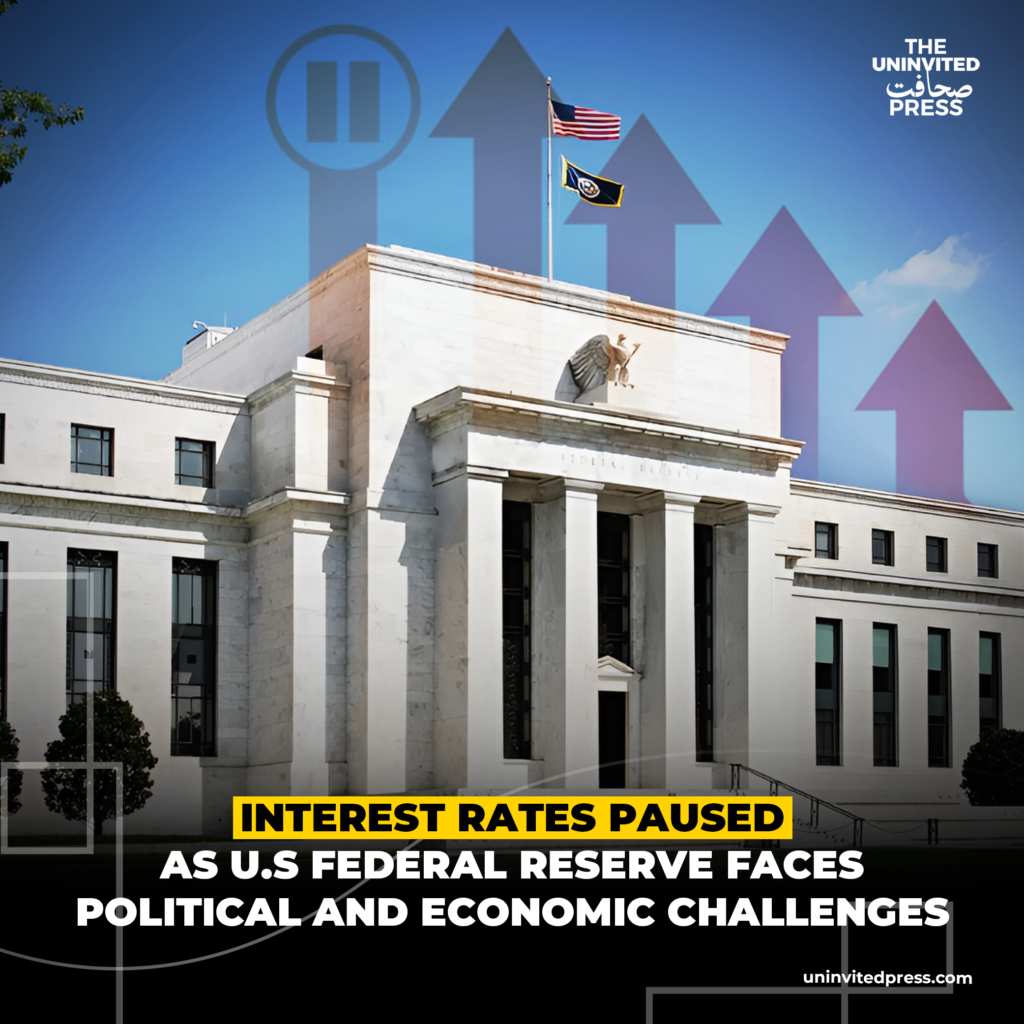
The U.S. Federal Reserve pauses rate cuts at 3.5-3.75%, navigating elevated inflation, political pressure from the White House, and economic uncertainty in early 2026.
Fed Freezes Rates as Economic Risks and Political Pressure Collide:
Washington, D.C.-In a high-stakes economic verdict that reverberated across global markets, the U.S. Federal Reserve decided to hold interest rates steady at 3.50% to 3.75% following its January 28, 2026 policy meeting-pausing after three consecutive rate cuts in 2025 and defying public pressure from President Donald Trump and his allies in Washington.
The move offers a rare and dramatic showcase of the Fed’s balancing act as it tries to navigate elevated inflation, a stabilizing but uncertain labor market, and soaring political interference-all while safeguarding its long-standing institutional independence.
Why the Fed Hit Pause After a Year of Rate Cuts?
In its first policy meeting of 2026, the Federal Open Market Committee (FOMC) elected to pause adjustments to the federal funds rate, holding it in its current range of 3.50%-3.75%. This decision comes after a series of three quarter‑percentage‑point rate cuts in 2025, intended to support economic activity amid signs of softness in the labor market and persistent inflation.
Inflation, measured by core personal consumption expenditures (PCE)-the Fed’s preferred metric-remains around 3.0%, well above the central bank’s 2% target, while unemployment figures show softening but not alarming trends with a stabilized labor market.
Fed Chair Jerome Powell underlined that while risks to inflation and employment have moderated, incoming economic data will drive future policy, and the committee is prepared to adjust as conditions evolve.
What makes this pause especially notable is the intense external pressure the Fed has faced, including public demands from President Donald Trump for deeper rate cuts and sustained attacks on the independence of the central bank.
From Pandemic Shock to Policy Crossroads:
Since the turbulence of the post‑pandemic economy, the Federal Reserve has navigated one of the most complex monetary policy landscapes in decades. Rapid inflation in 2022 forced a series of aggressive rate hikes, peaking above 5% in 2023-the fastest tightening cycle since the 1980s.
By late 2025, several signals-including slowing employment growth, regional economic volatility and continued price pressures-pushed the Fed into three consecutive rate cuts, bringing the benchmark lower to support sensitivity in markets and the broader economy.
Despite these cuts, inflation stayed stubbornly above target, leading many policymakers to advocate for a period of steadiness to assess the effects of prior actions and guard against reigniting inflationary pressures.
At the same time, the U.S. economy has been buffeted by politically charged fiscal and trade policies, contributing to uncertainty in economic projections. Former government shutdowns, tariff policies, and uneven job growth have complicated the Federal Reserve’s ability to interpret macroeconomic signals.