

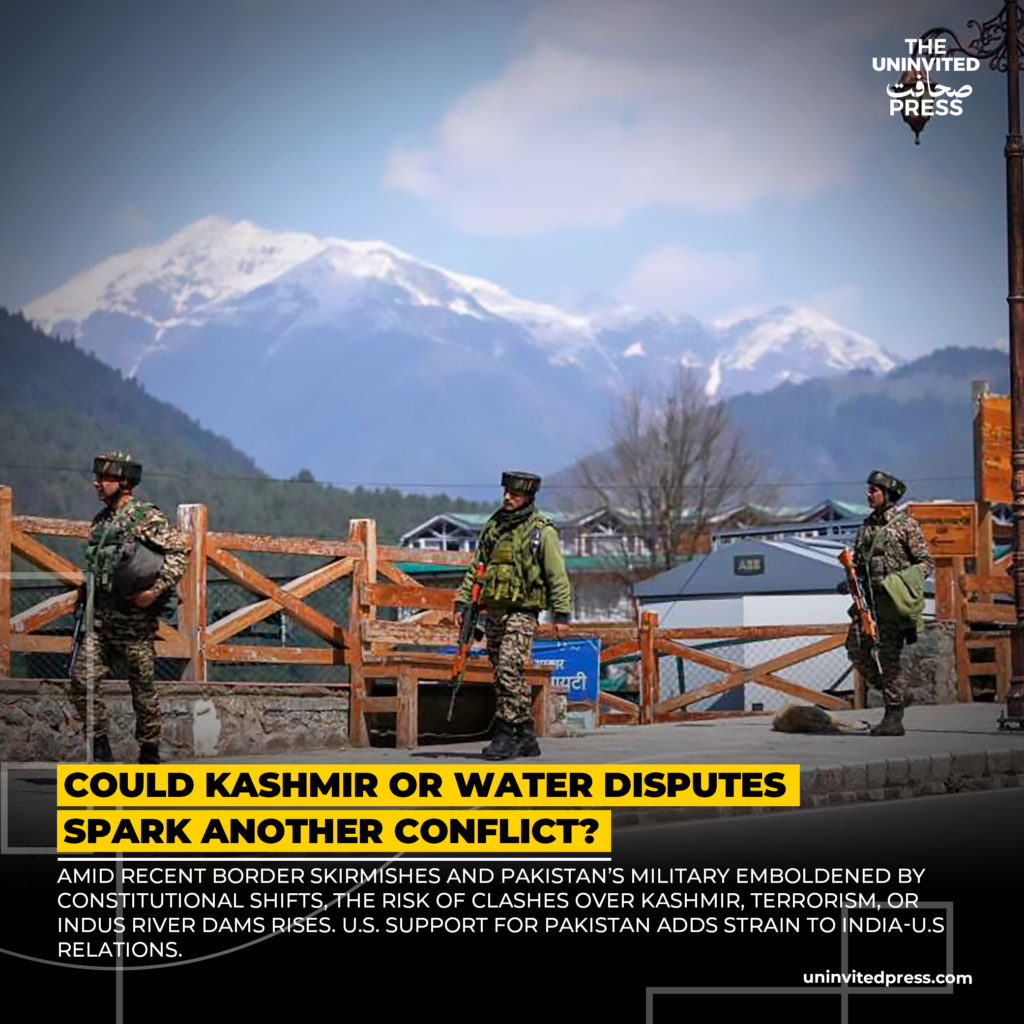
Tensions between India and Pakistan escalate over Kashmir terrorism and Indus River disputes, risking renewed conflict in 2026 amid suspended treaties and shifting alliances.
Nuclear Flashpoint: Kashmir’s Bloodshed and the Looming Water War:
A terrorist attack in Kashmir last April triggered a brief but intense military clash between nuclear-armed India and Pakistan, killing dozens and exposing deep-seated rifts over territory, terrorism, and vital water resources. As India builds dams on shared rivers and Pakistan bolsters its military through constitutional reforms, experts warn that unresolved disputes could spark another confrontation in 2026, with global ramifications for regional stability and nuclear risks.
Pahalgam to the Indus: The Chain Reaction From Tourist Killings to Suspended Treaties:
The seeds of the current crisis were sown on April 22, 2025, when militants attacked tourists in Pahalgam, Indian-administered Kashmir, killing 26 mostly Hindu civilians. India quickly pointed fingers at Pakistan-based groups, specifically linking the assault to Lashkar-e-Taiba (LeT), a U.S.-designated terrorist organization. Within days, New Delhi suspended the 1960 Indus Waters Treaty (IWT), closed the Attari border crossing, expelled Pakistani diplomats, and halted visa issuance for Pakistani nationals.
Tensions boiled over on May 7, when India initiated “Operation Sindoor,” launching missile and drone strikes on nine alleged terrorist targets across Pakistan and Pakistan-administered Kashmir. These included sites in Punjab and Azad Jammu and Kashmir, marking the deepest Indian incursion since 1971. India claimed over 100 militants killed and no civilian casualties. Pakistan condemned the strikes as an “act of war,” reporting 31 civilian deaths, including women and children.
Pakistan responded with “Operation Bunyan-um-Marsoos,” firing precision-guided missiles at Indian military facilities. The four-day exchange involved unprecedented drone warfare, artillery duels, and air engagements, with Pakistan claiming to down five Indian jets-a claim India denied. Cross-border firing along the Line of Control (LoC) caused additional civilian casualties on both sides.
A U.S.-brokered ceasefire took effect on May 10, but the fallout lingers. The IWT remains in abeyance, with India accelerating hydropower projects like Dulhasti Stage-II on the Chenab River, potentially violating treaty terms. In October 2025, Pakistan clashed with Afghanistan over Tehrik-e-Taliban Pakistan (TTP) militants, further destabilizing the region.
Recent border skirmishes in 2025 and early 2026, coupled with Pakistan’s constitutional amendments empowering its military, have heightened fears of escalation. Think tanks like the Council on Foreign Relations (CFR) assess a “moderate likelihood” of renewed conflict in 2026, driven by terrorism and water disputes.
Rivers Run Dry, Bombs Stay Ready: The Deep Roots of a Nuclear Flashpoint:
The India-Pakistan rivalry traces back to the 1947 partition, which left Kashmir divided and disputed. Three full-scale wars (1947-48, 1965, 1971) and numerous skirmishes have ensued, often over Kashmir, where India administers the valley amid a long-running insurgency. Pakistan has been accused of supporting militants like LeT and Jaish-e-Mohammed (JeM), responsible for attacks like Mumbai 2008 and Pulwama 2019.
The Indus River system, vital for 300 million people, adds fuel. The 1960 IWT allocates eastern rivers (Ravi, Sutlej, Beas) to India and western ones (Indus, Jhelum, Chenab) to Pakistan, but limits India’s storage on western rivers. Climate change-melting glaciers, erratic monsoons-exacerbates scarcity, with projections of a 50% deficit by 2030.
Pakistan’s 2024-2025 constitutional shifts, including the 26th and 27th amendments, centralized military power under Army Chief Asim Munir (now Field Marshal and Chief of Defence Forces), granting lifetime immunity and dissolving joint command structures. These moves, amid economic woes and TTP attacks, embolden Pakistan’s stance.
U.S. support for Pakistan-F-16 upgrades, oil deals, Trump-hosted visits-has strained India-U.S. relations, especially after Trump’s ceasefire claims. India views this as rewarding a “state sponsor of terrorism,” while Pakistan leverages it for diversification from China.
Nuclear thresholds loom; a miscalculation could escalate rapidly, as seen in May 2025’s drone and missile exchanges. Water weaponization risks humanitarian crises, affecting agriculture (80% of Pakistan’s irrigation) and heightening flood/drought vulnerabilities.