

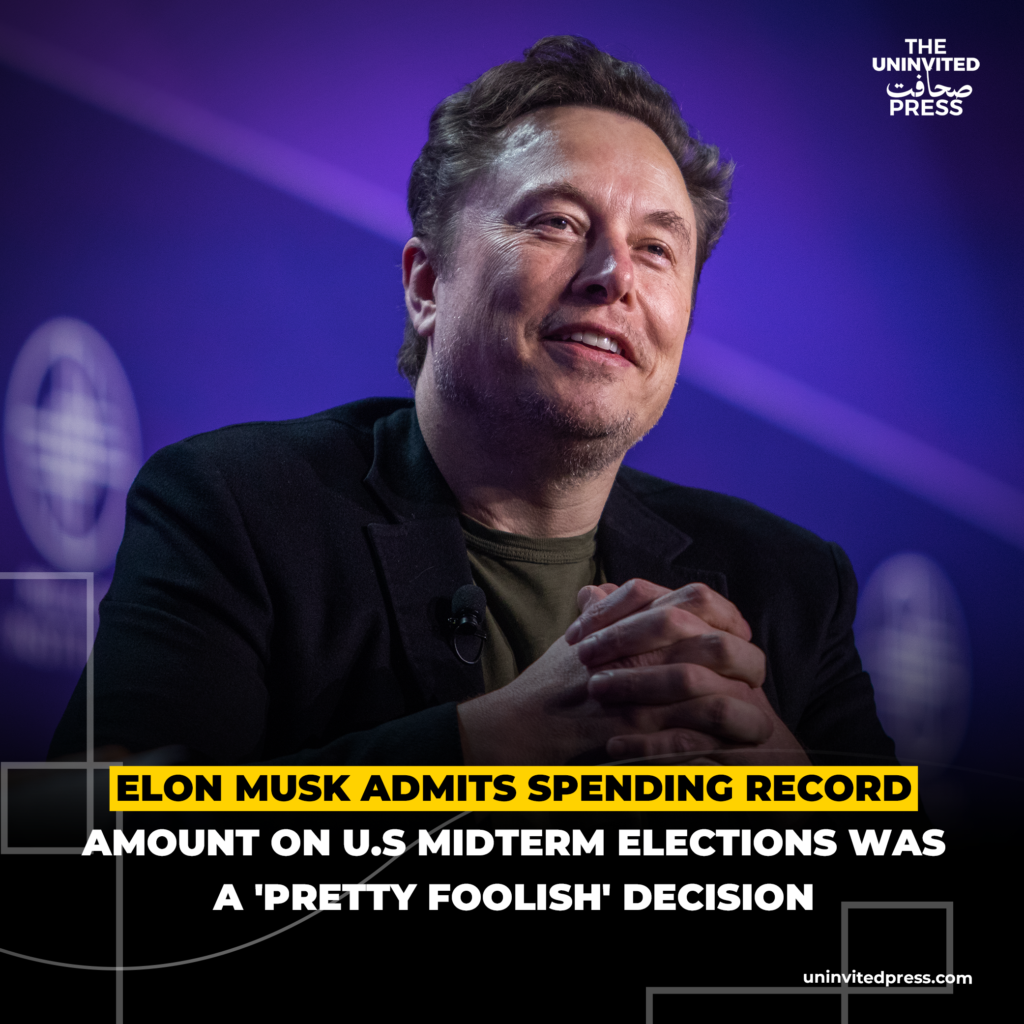
Billionaire admits nearly half a billion dollars yielded little as Democrats seize Congress and key Texas races.
Elon Musk has described the record sum he poured into the 2026 US midterm elections as a “pretty foolish” decision, saying he saw little return after Republicans suffered sweeping defeats.
Speaking virtually at The New York Times DealBook Summit on Wednesday, the Tesla and SpaceX chief executive and the world’s richest man said: “I feel pretty foolish about having spent so much money and not seeing much for it.” He added that, if he could rewind the clock, “I would have spent less money.”
Musk’s Millions Fail to Deliver Republican Wins:
Musk was the cycle’s largest individual donor, contributing roughly $445 million to $474 million according to campaign finance trackers, the bulk of it aimed at keeping Republicans in control of Congress and protecting Republican strongholds in Texas, home to major Tesla and SpaceX operations as well as a planned joint chipmaking venture.
Those bets largely failed. Democrats took both the House and Senate. In Texas, Democrat James Talarico defeated Republican Ken Paxton in the Senate race that had drawn the largest share of Musk’s spending, while Democrat Gina Hinojosa defeated longtime Republican Governor Greg Abbott. Musk later described Hinojosa as likely to prove “quite moderate.”
He acknowledged that Republican candidates might have performed even worse without his financial support, but said the results demonstrated the limits of money in American elections. “It certainly shows that American elections are not just about money,” Musk told the audience. “Obviously, you can put a lot of money into an election and have an effect that is relatively minor, and I think that was the case here.”
Musk spent heavily to help Donald Trump return to the White House in 2024 and later served as an unpaid special government employee and senior adviser, leading the Department of Government Efficiency (DOGE) in its early months. The two men experienced a public falling-out before reconciling; Musk has continued to advise and travel with the president, including during the recent Asia-Pacific Economic Cooperation meetings from which he joined the DealBook event by video link.
Musk Admits Political Spending Failed, Distances Himself From MAGA:
At the same time, Musk sought to distance himself from the Make America Great Again movement most closely associated with Trump. “I’m not Maga,” he said. “I’m not sure what Maga means… if that means sort of blind adherence to a set of policies by the Republican Party, then I certainly don’t have that.” He described his goal as preventing either party from holding a supermajority and ensuring that at least one of the presidency, House or Senate remained in Republican hands heading into 2029-a goal he conceded had failed.
The scale of Musk’s midterm outlays exceeded the roughly $250-290 million he is reported to have spent supporting Trump and other Republicans in 2024. Much of the 2026 money flowed through super PACs including America PAC and vehicles supporting the Senate Leadership Fund, with particularly heavy concentration on the Texas Senate contest. Campaign finance analysts note that the full picture may be larger still once darker-money groups and state-level spending are fully accounted for.
The outcome has revived longstanding debates about the influence of ultra-wealthy donors in US elections. Critics of unlimited political spending point to the midterms as evidence that even unprecedented sums cannot easily override broader voter sentiment, economic pressures, or dissatisfaction with incumbents. Supporters of the current system argue that large donations remain a legitimate form of political participation and that Musk’s experience simply illustrates that money is only one factor among many.
Musk has long maintained that his political involvement stems from concerns about regulation, free speech, and the future of technological innovation-areas in which his companies frequently collide with government policy. Whether the midterm results prompt a sustained recalibration of his approach remains to be seen. For now, the billionaire who once treated campaign spending as a high-stakes investment has publicly concluded that the returns fell far short of the outlay.