

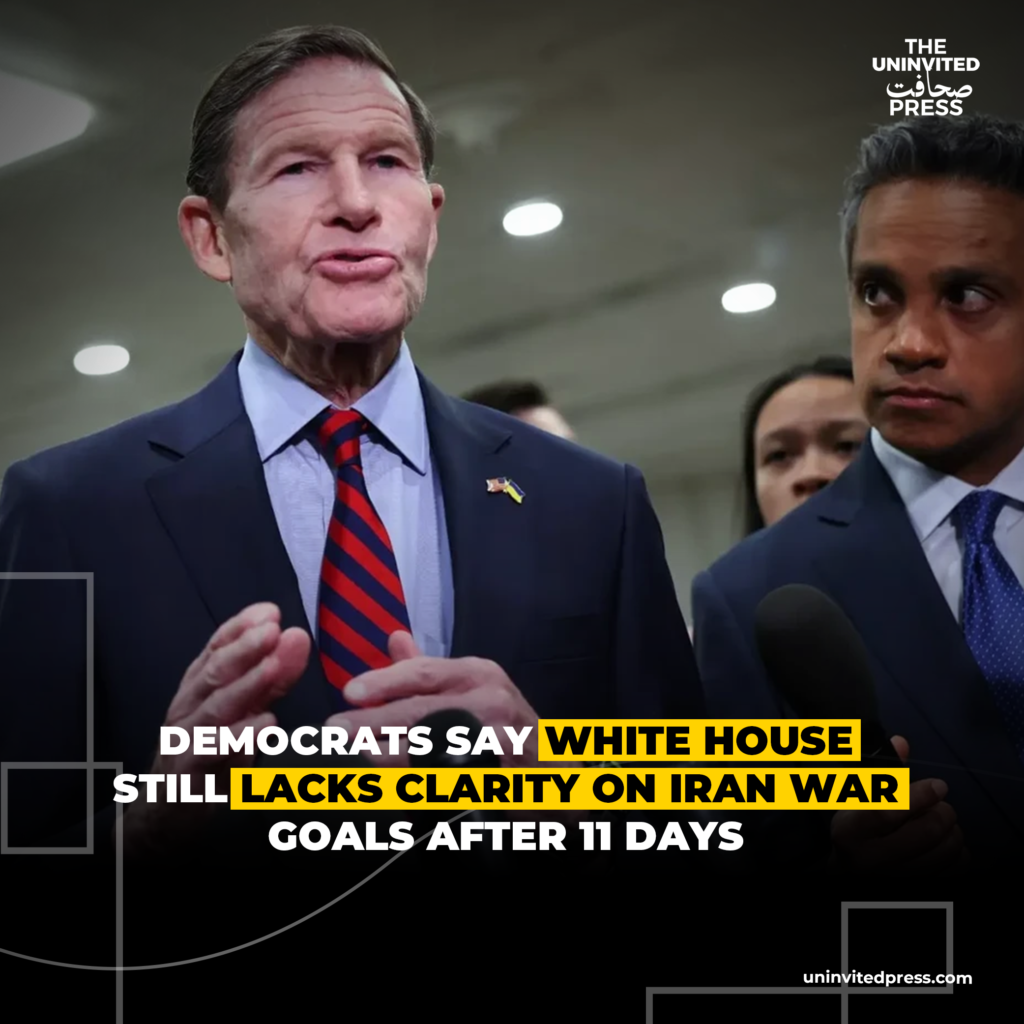
Democrats decry White House’s vague Iran war goals post-briefing, pushing hearings amid fears of endless conflict; war enters day 11 with shifting strategies.
Democrats Sound Alarm: No Clear Goals, Ground Troops Feared in Murky Iran War:
Democratic senators slammed the Trump administration for providing “no clarity” on its objectives in the escalating war with Iran, following a classified briefing that left them more concerned about potential U.S. ground troops and endless conflict. As civilian casualties climb and global markets waver, the criticism exposes deepening partisan rifts in Washington, raising alarms over unchecked presidential war powers and the risk of another prolonged Middle East quagmire. With American lives on the line, calls mount for transparency amid fears the strikes lack a coherent exit plan.
Democrats Decry Vague Goals, Push for Hearings and War Powers Votes:
A group of Democratic senators emerged from a closed-door classified briefing on the U.S.-Israel war against Iran, expressing deep frustration over the Trump administration’s vague and evolving objectives. Senator Richard Blumenthal of Connecticut voiced alarm, stating he was “more fearful than ever” about U.S. boots on the ground and unclear priorities-whether destroying Iran’s nuclear program, missiles, regime change, or curbing terrorism. Senator Chris Murphy of Connecticut echoed this, describing the goals as potentially unachievable in “four days, four months, or four years.”
The briefing, attended by key lawmakers, followed the war’s launch on February 28, when joint U.S.-Israeli airstrikes assassinated Iran’s Supreme Leader Ali Khamenei and targeted nuclear and missile sites. Iran retaliated with missile barrages on U.S. bases and Israeli cities, escalating to proxy attacks via Hezbollah in Lebanon and militias in Iraq and Syria. By March 10, the conflict had seen intense exchanges, including U.S. destruction of Iranian mine-laying vessels in the Strait of Hormuz.
Democrats, including Tim Kaine of Virginia and Cory Booker of New Jersey, announced an intensified push for public hearings, threatening to disrupt Senate business if Republicans refuse. They filed new War Powers resolutions to mandate U.S. withdrawal within 30 days unless Congress approves continued action. Senate Minority Leader Chuck Schumer criticized the administration’s “shifting goals” and lack of a “set plan,” warning of an “endless war.”
U.S.-Iran Conflict Sparks Middle East Escalation and War Powers Debate:
The war erupted amid longstanding U.S.-Iran tensions, rooted in Iran’s nuclear ambitions, support for regional proxies, and opposition to U.S. and Israeli policies. Trump’s 2018 withdrawal from the Iran nuclear deal (JCPOA) intensified sanctions, leading to Iranian uranium enrichment beyond limits and attacks on U.S. interests. Escalations included Israel’s April 2025 strike on an Iranian embassy in Syria and Iran’s October 2025 missile assault on Israel.
The February 28 strikes were justified by the White House as preemptive against an “imminent threat,” though Democrats like Senator Mark Warner dispute this, calling it a “war of choice.” Intelligence shared post-strike showed no immediate U.S. attack planned by Iran, per briefed lawmakers. The conflict has engulfed the Middle East, with Iranian strikes on Gulf oil facilities and closures of the Strait of Hormuz to U.S. and Israeli vessels.
This marks the largest U.S. military engagement since Afghanistan, highlighting congressional war powers debates under Article I of the Constitution. Past failures to curb presidential authority-seen in Iraq and Libya-fuel current concerns over unchecked executive action.