

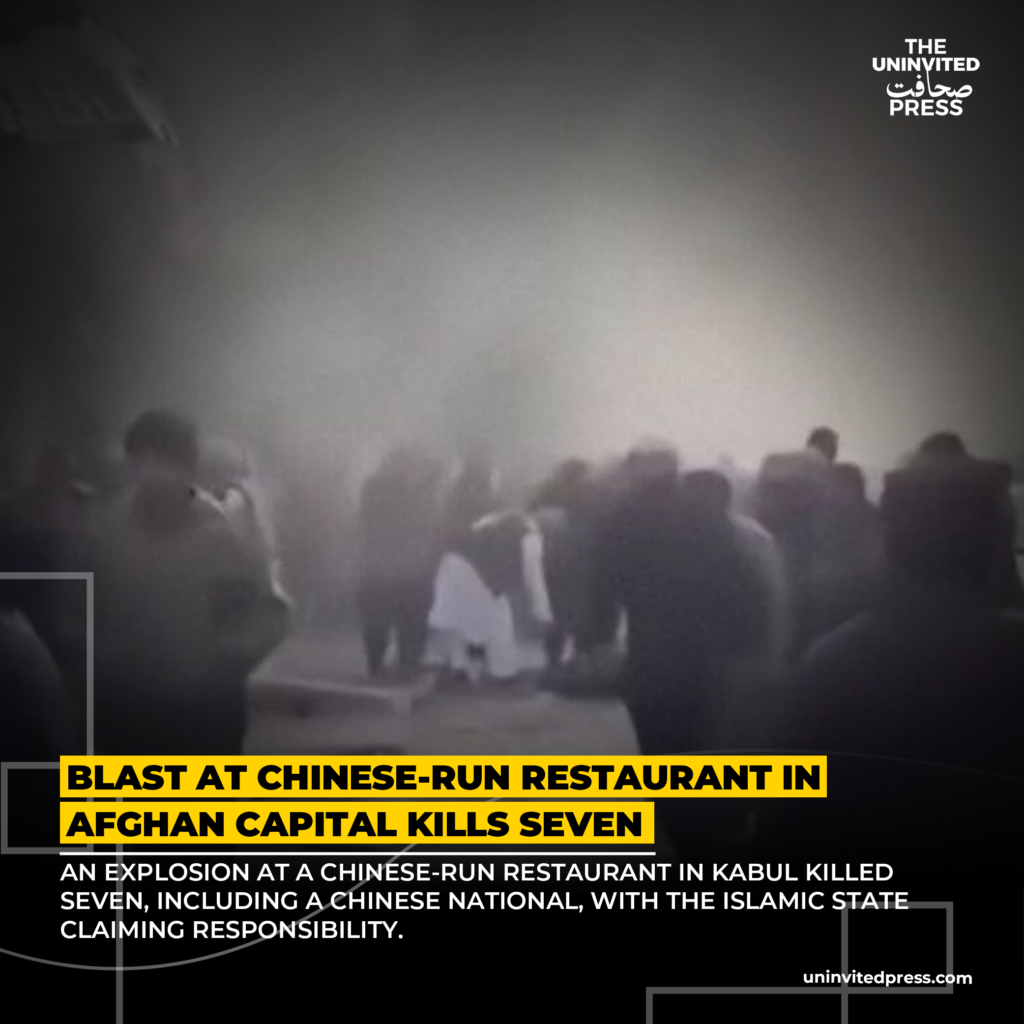
A deadly explosion at a Chinese restaurant in Kabul killed seven, with IS-K claiming responsibility over Uyghur issues, raising alarms for Beijing’s Afghan investments.
Deadly Kabul Blast Targets Chinese Interests, Raising Security Fears:
KABUL, Afghanistan-A powerful explosion ripped through a Chinese-run noodle restaurant in one of Kabul’s most secure neighborhoods on Monday, killing seven people and wounding over a dozen others in an attack claimed by the Islamic State. The incident has heightened fears for foreign nationals in Afghanistan, spotlighting the fragile security landscape under Taliban rule and straining Beijing’s growing economic ties with the country. As investigations unfold, China has demanded swift action to protect its citizens, underscoring the risks to its investments in the region.
Chaos in Shahr-e-Naw: Explosion Shatters Kabul's Secure Heart, Claims Lives in Crowded Restaurant:
The explosion struck without warning in the bustling Shahr-e-Naw district, a zone considered among Kabul’s safest since the Taliban regained power in 2021. Witnesses described a massive blast that tore a large hole in the restaurant’s facade, sending smoke billowing into the sky and shattering nearby windows. Videos circulating on social media showed debris-strewn streets and locals rushing to aid the injured.
Kabul police spokesman Khalid Zadran confirmed the casualties, noting the blast occurred near the kitchen but emphasized that its nature-whether a bomb, gas cylinder, or otherwise-is still being determined. Initial reports from Taliban sources suggested a possible gas explosion, but independent accounts and the IS-K claim point to deliberate violence. By evening, white sheets covered the damaged site as security forces cordoned off the area.
The human toll was immediate and devastating. Among the dead was Ayub, a Chinese national, whose funeral drew mourners the following day. Five other Chinese were among the wounded, alongside Afghans including civilians caught in the chaos.
From Hotel Siege to Kabul Blast: IS-K's Campaign Against Chinese Presence in Afghanistan:
This attack fits a pattern of IS-K aggression against foreign interests in Afghanistan, particularly Chinese ones, amid the group’s rivalry with the Taliban. Formed in 2015 as an affiliate of the Islamic State, IS-K has conducted nearly 100 civilian attacks in Afghanistan and Pakistan, clashing repeatedly with security forces. The group exploits sectarian divides and opposes the Taliban’s governance, viewing it as insufficiently extreme.
Chinese targets have escalated in recent years. In 2022, IS-K attacked a Kabul hotel popular with Chinese business people, killing three and injuring others. Last year, a Chinese mine worker was killed in Takhar province, and multiple incidents near the Tajik-Afghan border claimed six Chinese lives in November 2025. IS-K’s propaganda increasingly highlights China’s policies in Xinjiang, where rights groups accuse Beijing of abuses against Uyghur Muslims-claims China denies as interference.
Beijing’s stake in Afghanistan has grown since the Taliban’s 2021 takeover. China has invested in mining projects, oil extraction, and Belt and Road Initiative extensions, viewing the country as a resource-rich partner. However, persistent insecurity, including from IS-K and Uyghur-linked groups like the Turkestan Islamic Party, has stalled progress. The Taliban has pledged to curb such threats to attract investment, but attacks like this expose ongoing vulnerabilities.
We cross-checked casualty figures and the IS-K claim across multiple sources, confirming the death toll and claim’s authenticity. The suicide bombing detail remains alleged by IS-K but unconfirmed by Afghan authorities, who continue to investigate the explosion’s cause. Restaurant ownership and victim identities are verified through official statements, though some injury counts vary slightly between reports.