

Fears mount as government tightens grip on universities, with academics warning of return to era of political control and censorship.
Barely a year after a student-led uprising helped topple the long-ruling Awami League government, Bangladesh’s universities are once again facing mounting pressure, with critics accusing authorities of reimposing political oversight and undermining the brief window of academic freedom that followed the political transition.
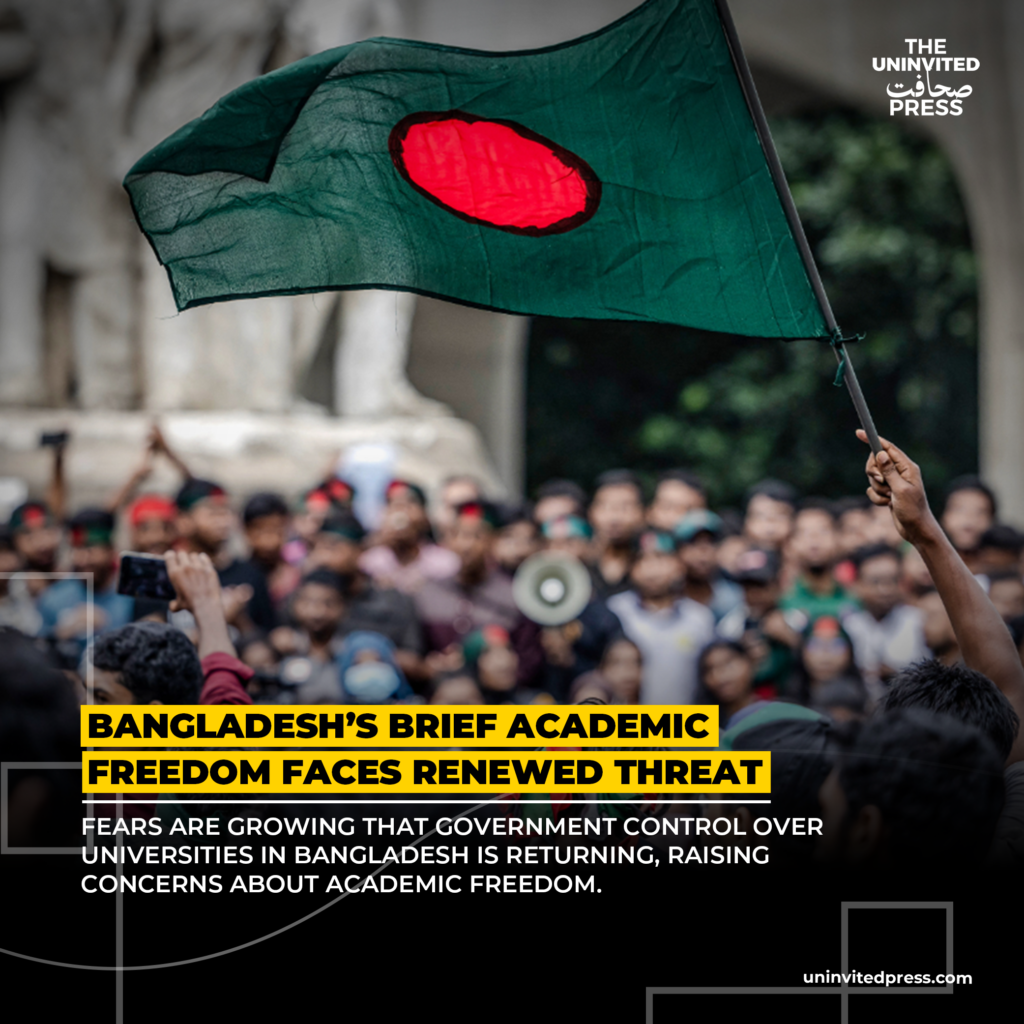
A new wave of concerns has been triggered by reports of administrative interference, surveillance of faculty members, and attempts to influence academic appointments and curricula. Images of student protests waving the national flag have circulated widely, symbolising both hope for democratic reform and anxiety over its reversal.
Reassertion of Control:
Following the dramatic events of 2024 that led to the fall of Sheikh Hasina’s government, many academics and students initially celebrated what they described as a new dawn for intellectual freedom. However, sources within several public universities say the interim authorities and emerging political forces are now reasserting influence over key institutions.
“After a short period of relative openness, we are seeing familiar patterns return-vice-chancellors being pressured, dissenting voices monitored, and research topics quietly discouraged,” said Dr. Shahidul Islam, a senior professor at Dhaka University who requested anonymity due to fear of reprisal.
Human rights groups and education watchdogs have documented cases of academics being summoned by security agencies, student unions aligned with political factions intimidating faculty, and delays in promised reforms to university governance.
Struggle Over Academic Autonomy in Bangladesh:
Bangladesh’s higher education sector has long been plagued by politicisation. Under the previous government, public universities were often criticised for serving as extensions of ruling party influence, with appointments based on loyalty rather than merit and widespread allegations of corruption in academic administration.
While the fall of the Awami League brought hope for change, analysts say the current transitional period has created a power vacuum that different factions are now attempting to fill.
“The struggle for academic freedom in Bangladesh is not new, but the stakes are particularly high right now,” said Meenakshi Ganguly, South Asia director at Human Rights Watch. “If the authorities fail to safeguard university autonomy, the hard-won gains of the student movement could quickly evaporate.”
Bangladesh Universities Face Fresh Political Tensions:
Student groups that played a pivotal role in the 2024 protests have begun mobilising again, organising rallies and issuing demands for transparent university reforms, depoliticisation of campuses, and protection of free speech.
University teachers’ associations have also issued statements urging the interim government to uphold commitments to academic independence and to prevent any return to the repressive practices of the past.
The developments have drawn quiet concern from international academic bodies and donor agencies that fund major projects in Bangladesh’s education sector. Several European and North American universities have reportedly paused collaborative programmes amid uncertainty over campus freedoms.
As Bangladesh navigates its fragile political transition, the fate of its universities is being closely watched as a litmus test for the country’s broader democratic aspirations.