

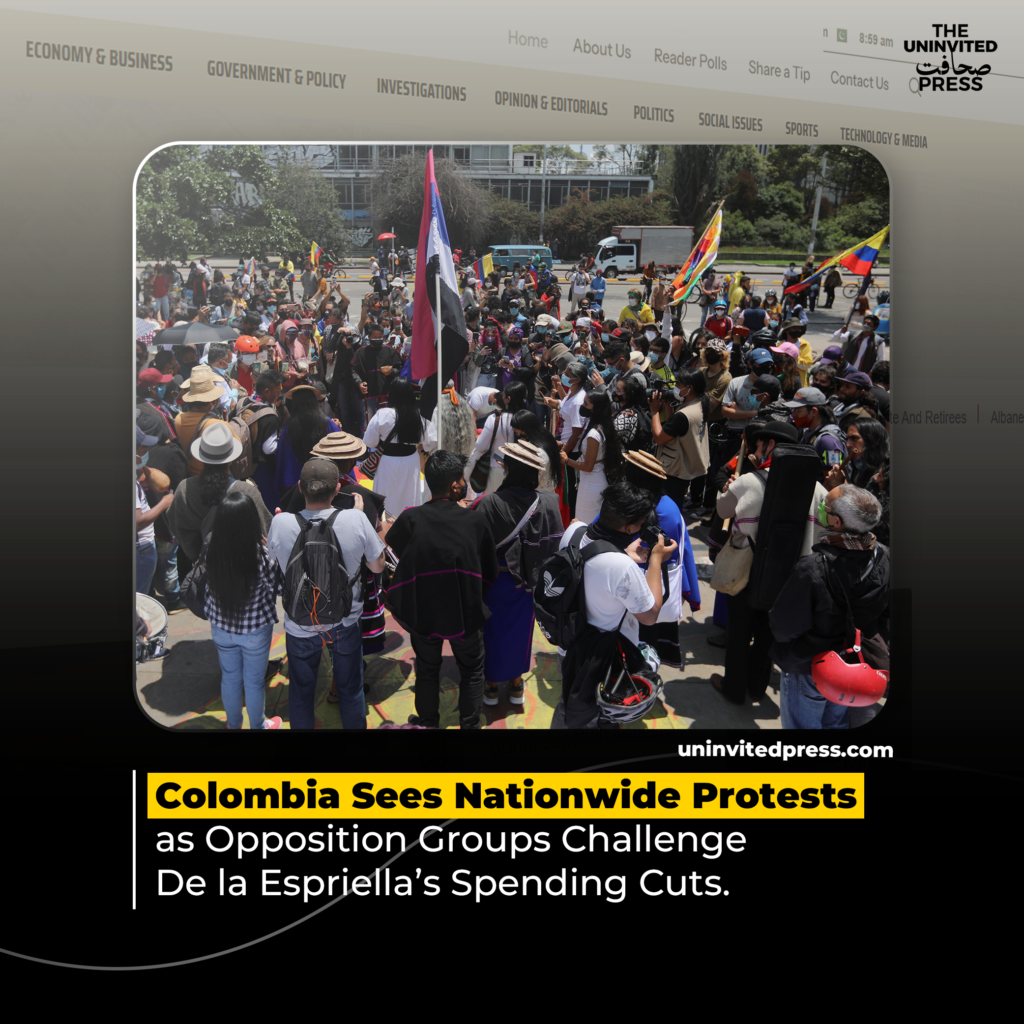
Thousands march in major cities against austerity measures, labour rollbacks and a new police decree under the right-wing president.
Thousands of Colombians took to the streets across the country on Wednesday in the first major nationwide protests against the government of right-wing President Abelardo de la Espriella, two months after he assumed office.
Demonstrators, organised by a broad coalition of opposition parties, trade unions, teachers’ federations, Indigenous organisations, students and social movements, marched in Bogotá, Medellín, Cali and other cities. They denounced planned spending cuts in the 2027 national budget, threats to labour protections and social programmes introduced under former left-wing President Gustavo Petro, and a newly signed decree tightening police rules for handling protests.
In the capital, several columns of protesters converged on Plaza de Bolívar despite rain. Former President Petro joined the march, as did prominent opposition figures including Senator Iván Cepeda of the Historic Pact coalition. Similar gatherings took place in other urban centres, with participants carrying banners defending public education, labour rights, pensions and Indigenous autonomy.
“I feel like we have no guarantees and that the little we did obtain … we’re about to lose,” Ester Guerra, a 32-year-old teacher, told AFP in Bogotá.
Austerity and fiscal confrontation:
At the heart of the unrest is the government’s push for fiscal austerity. De la Espriella’s administration has presented a 2027 budget that includes significant reductions in spending on culture, sports, social programmes, the Special Jurisdiction for Peace (JEP) transitional justice court, and other areas. Officials argue the cuts are necessary to address a severe fiscal deficit they attribute to the previous Petro government.
Colombia’s Congress faces a deadline to approve the budget. Allies of the president have advanced proposals to trim funding for several institutions, including a nearly 17 percent cut to the JEP, which investigates human rights abuses from the country’s long conflict. Critics say the reductions would undermine victim support, rural hearings and efforts to locate the disappeared.
Protesters also voiced alarm over potential reversals of Petro-era gains, including expanded access to public universities, higher minimum wages and stronger labour protections. Teachers, organised under the Colombian Federation of Educators (Fecode), highlighted concerns about working conditions and healthcare. Indigenous groups opposed measures they say threaten territorial autonomy, including proposed regulation of the Indigenous guard.
Colombia Protests Erupt Over New Police Decree:
The demonstrations coincided with the entry into force of Decree 1525, signed by De la Espriella the day before. The decree modifies earlier protocols on police conduct during protests, stating that dialogue and mediation are a “rule of preference” but not a prerequisite that delays action against those committing violence.
Opposition leaders described the decree as an attempt to intimidate and restrict the right to protest. Cepeda accused the government of pursuing an “intimidatory strategy.” De la Espriella has defended the measure as necessary to protect public order and prevent “urban terrorism disguised as protest,” while insisting peaceful demonstrators retain their rights. Most marches proceeded peacefully, though riot police used tear gas to disperse protesters in at least one location, Ibagué.
De la Espriella, a conservative lawyer who took office in August after a narrow victory, campaigned on promises of fiscal discipline, stronger security and a more pro-business orientation. He has repeatedly blamed the Petro administration for leaving public finances in crisis, citing high deficits, excessive spending and heavy reliance on debt.
Petro, Colombia’s first left-wing president (2022-2026), remains a polarising figure. His supporters view the new government’s early moves as a direct assault on social progress. The protests mark the first major street test of De la Espriella’s authority and the opposition’s capacity to mobilise after losing power by a slim margin.
Trade union leaders have already signalled that further action, including a possible general strike in November, remains on the table if the government continues on its current course. As Congress debates the budget and the new administration consolidates its agenda, Wednesday’s marches underscored deep divisions over the direction of Colombia’s economy, social policy and approach to public dissent.