

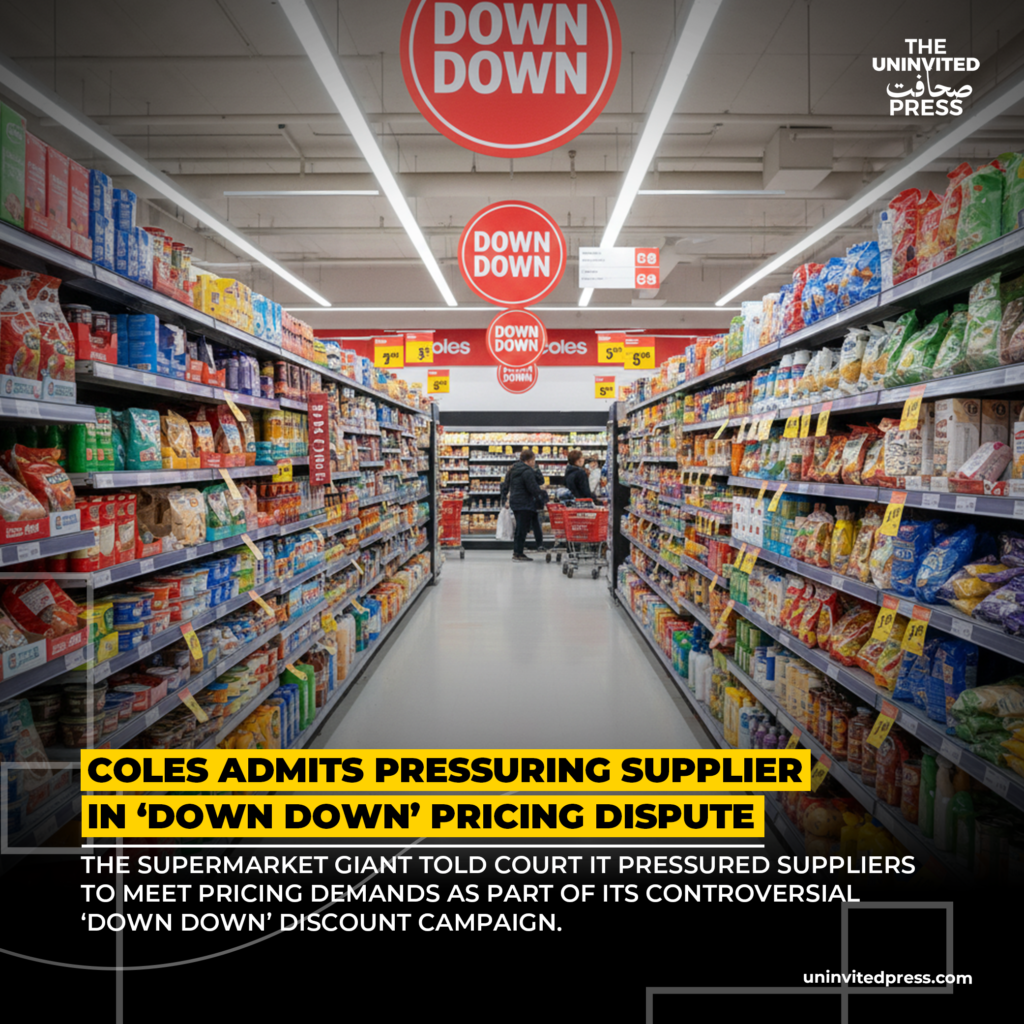
Coles admits in Federal Court it pressured suppliers to cut prices for ‘Down Down’ campaign, fuelling ACCC unconscionable conduct case and supermarket power debate.
Coles Admits Supplier Pressure Amid Price-Squeezing Fury:
Coles has told a Federal Court hearing that it deliberately pressured suppliers to slash prices so the retailer could maintain its aggressive “Down Down” discount promotions, a practice now at the centre of a major legal battle. The supermarket giant’s own barrister confirmed the chain issued ultimatums to suppliers, warning that failure to meet pricing demands could jeopardise future business. The admission has intensified public and political outrage over the supermarket duopoly’s treatment of farmers, manufacturers and small producers, at a time when grocery prices remain painfully high for millions of Australian households. Critics say the revelation exposes how Coles-and its rival Woolworths-have used their market dominance to squeeze margins at the expense of the supply chain.
Coles’ Hardline Supplier Tactics Exposed in Court:
The controversy erupted when the Australian Competition and Consumer Commission launched civil proceedings against Coles in late 2024, alleging the supermarket engaged in unconscionable conduct toward certain suppliers between 2015 and 2023. At the heart of the dispute is the long-running “Down Down” campaign, in which Coles prominently advertises hundreds of products at permanently reduced prices to signal value to cost-conscious shoppers.
During February 2026 hearings, Coles’ legal team openly acknowledged that the company had set specific pricing targets for suppliers and used leverage-such as the threat of reduced orders, delisting, or loss of promotional slots-to enforce compliance. Internal emails and meeting notes tendered to the court reportedly showed Coles executives describing suppliers who resisted as “difficult” or “not aligned,” with some told their products would be moved to less visible shelf locations if prices were not cut further.
Suppliers involved in the case, who cannot be named due to confidentiality orders, told the court they faced impossible choices: accept razor-thin margins that sometimes fell below cost of production, or risk losing access to one of Australia’s two dominant supermarket chains. Several described being summoned to urgent meetings where Coles presented non-negotiable price-reduction schedules tied directly to “Down Down” promotions.
The court also heard that Coles tracked supplier profitability closely and used that data to push for even deeper discounts in subsequent negotiations. While Coles insists these were standard commercial discussions, the ACCC argues the cumulative pressure crossed into unconscionable territory, especially given the imbalance of bargaining power.
Australia’s Supermarket Duopoly Faces Legal Scrutiny:
Australia’s grocery sector is one of the most concentrated in the developed world. Coles and Woolworths together control roughly 65-70 per cent of the national supermarket market, giving each chain enormous influence over suppliers. Farmers, dairy producers, meat processors, bakeries and packaged-goods manufacturers often have few realistic alternatives for reaching consumers at scale.
The “Down Down” campaign launched in 2011 as Coles’ answer to Woolworths’ earlier “Fresh Food People” branding and price wars. It became a cultural catchphrase, with the jingle and red “Down Down” price tags etched into Australian shopping memory. While popular with consumers, the campaign has long drawn criticism from producer groups who say it forces artificial price deflation through the supply chain rather than genuine efficiency gains.
Tensions boiled over after the 2022-2023 inflation surge, when grocery prices rose sharply even as supermarket profits remained robust. Public anger peaked in mid-2024 when the Senate inquiry into supermarket prices heard testimony from farmers who said they were receiving lower real returns despite record retail prices. The ACCC inquiry that followed recommended stronger laws to curb buyer power, including a mandatory code of conduct with financial penalties.
Coles has faced similar scrutiny before. In 2015 the chain was fined $10 million for misleading consumers over “Down Down” pricing claims, and in 2024 it settled separate ACCC proceedings over drip-pricing practices. The current case is the most serious yet, testing whether aggressive commercial pressure can legally be deemed unconscionable under Australian consumer law.