

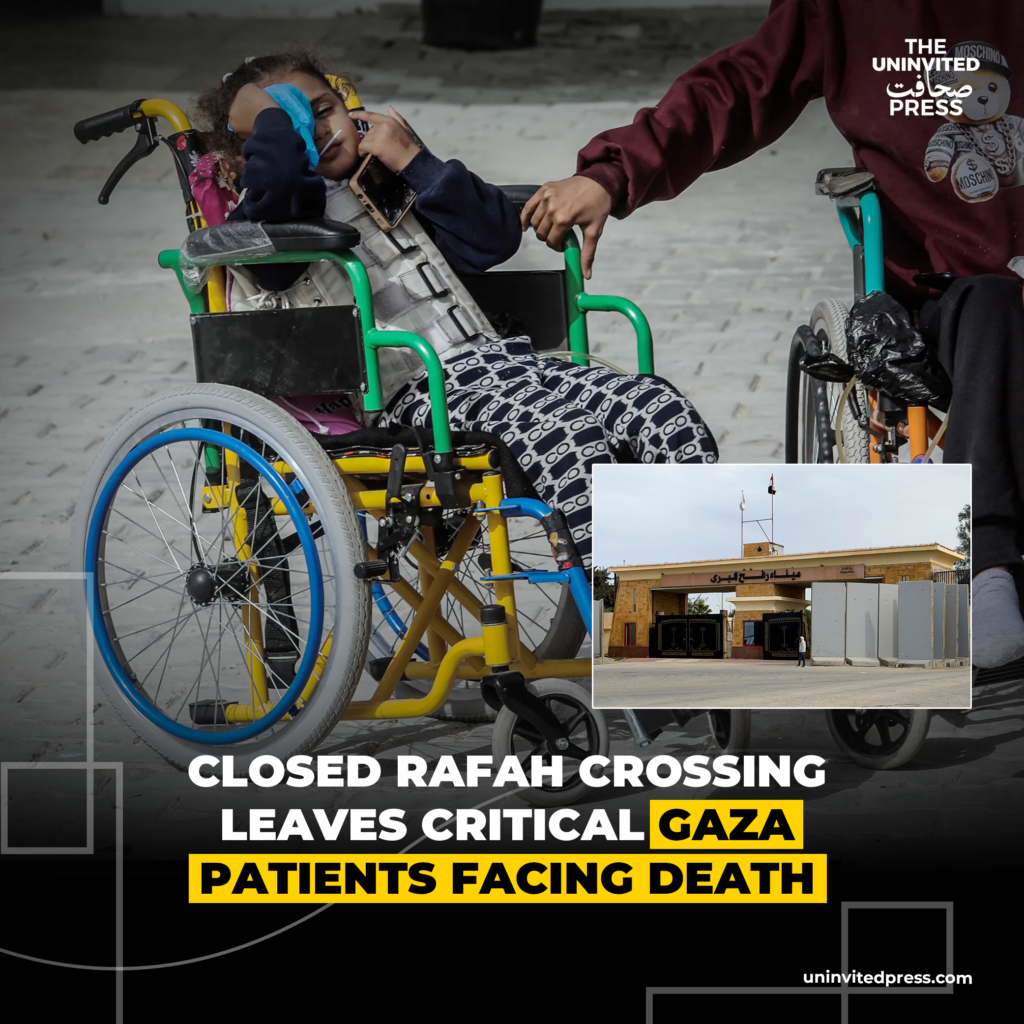
The closure of the Rafah border crossing between Gaza and Egypt has trapped tens of thousands of critically ill patients inside the besieged Gaza Strip, denying them life‑saving medical evacuations amid shortages and an overwhelmed healthcare system. International agencies warn the humanitarian crisis will worsen unless the crossing reopens.
Rafah Crossing Shutdown Traps Critically Ill Patients, Sparking Fears of Preventable Deaths:
The Rafah land crossing-Gaza’s main gateway to Egypt-has been closed again, leaving hundreds of critically ill patients stranded and facing possible death because they cannot travel abroad for urgent medical treatment. The crossing had briefly been reopened earlier this year under a fragile ceasefire arrangement, raising hopes among families of patients and the wounded. However, renewed conflict and tightening restrictions have forced a shutdown once more, extinguishing those hopess.
Patients and their families describe increasingly desperate conditions. Twelve‑year‑old Asmaa al‑Shawish, who suffers from Sanfilippo syndrome, was unable to leave Gaza for treatment despite years of referrals because the crossing was closed just before she could travel. Her health has deteriorated sharply, leaving her in constant pain and near death, according to her mother.
According to the Gaza Health Ministry, more than 20,000 patients and wounded individuals urgently need treatment abroad. Many have already died while waiting for the crossing to open fully, as local hospitals-crippled by years of conflict-lack the capability to provide specialized care. Essential medicines and supplies have nearly run out in many facilities.
The situation is exacerbated by critical shortages in medical supplies and the collapse of much of Gaza’s healthcare infrastructure. The World Health Organization (WHO) reported that essential items-from basic gauze and needles to pain medication and surgical supplies-are at dangerously low levels, further imperilling those in need of care.
Hamas officials have accused Israeli authorities of using security pretexts to justify the closure, calling it a violation of ceasefire commitments and an effort to tighten the blockade on the enclave. They argue that denying patients access to medical evacuation violates fundamental humanitarian rights.
Lifeline Severed: Rafah Crossing Closures Deepen Gaza's Humanitarian Crisis:
The Rafah border crossing has long been one of the few lifelines for Palestinians in Gaza, allowing movement to and from Egypt for medical evacuations, humanitarian aid, and family reunions. Since the escalation of violence and the breakdown of the ceasefire last month-partly linked to the wider regional tensions-the crossing has been intermittently closed, cutting off this vital access.
Temporary or partial reopenings in recent months allowed only limited numbers of patients to exit for treatment, often insufficient to meet the overwhelming need, with reports indicating only a handful of seriously ill people could leave even when Rafah was partially operational.
The blockade’s impact goes beyond medical travel-it has severely restricted the flow of humanitarian aid, fuel, and essential goods into Gaza. The combined effects have deepened shortages of food, water, and healthcare, compounding the humanitarian emergency in the territory.
International organisations and health agencies have repeatedly called for the crossing to be opened without restriction to allow mass evacuations for treatment and to facilitate the entry of much‑needed supplies. But obstacles-political, security‑related, and logistical-continue to prevent a sustained reopening.