

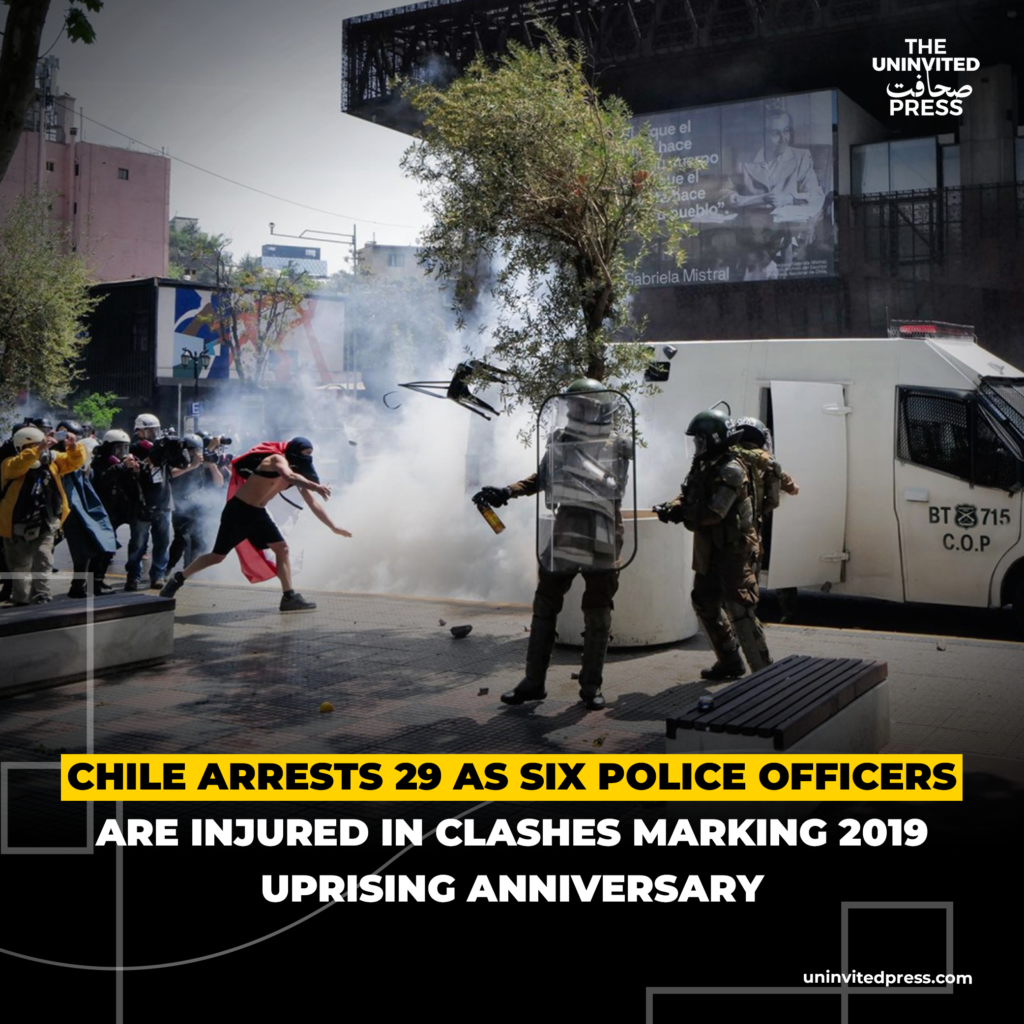
Unauthorised march in Santiago to commemorate the ‘estallido social’ turns violent when hooded groups attack officers with stones and Molotov cocktails; government condemns unrest.
Chilean police detained at least 29 people and reported six officers injured during clashes in central Santiago on Sunday as demonstrators marked the seventh anniversary of the 2019 social uprising, known as the estallido social.
The unauthorised gathering, organised by social and student groups, drew around 2,500 people to Plaza Baquedano (also called Plaza de la Dignidad by activists) before moving along the Alameda towards the presidential palace, La Moneda. Participants sought to reaffirm the social, economic, political and cultural demands that sparked the original protests seven years earlier.
Violence Erupts at Chile’s 2019 Uprising Anniversary March:
According to Carabineros Metropolitan Zone chief General Inspector Manuel Cifuentes, the march began relatively calmly but deteriorated around midday when groups of hooded individuals moved to the front and attacked officers with blunt objects, followed by Molotov cocktails and other incendiary devices. Police responded with water cannons and tear gas. Several metro stations along the route, including Baquedano, Universidad Católica, Santa Lucía and Universidad de Chile, were temporarily closed, and traffic diversions were put in place.
Among those arrested was one person accused of carrying and throwing an incendiary device at police, another of robbery with violence at a commercial premises, and a third of vandalising public security cameras on the Alameda. Public Security Minister Martín Arrau confirmed that six Carabineros officers were injured, some suffering eye injuries.
The Chilean government strongly condemned the violence. This was the first anniversary of the 2019 uprising under the administration of President José Antonio Kast, who has long described the original protests as an “outbreak of crime” rather than a legitimate social movement. Minister Arrau stated that society had learned “it was a bad idea to validate violence, because it brings later consequences of instability in our country.”
Chile’s 2019 Uprising Anniversary Revives Unresolved Grievances:
The 2019 protests began in mid-October over a modest rise in Santiago metro fares but rapidly expanded into nationwide demonstrations against inequality, the privatised pension system, education and healthcare costs, and the legacy of the 1980 constitution written under the Pinochet dictatorship. The unrest left around 30 people dead, thousands injured-including hundreds with serious eye trauma from police shotgun pellets-and triggered two failed attempts to rewrite the constitution. United Nations investigators and human rights organisations later documented excessive force, torture and other abuses by security forces during the crackdown.
Sunday’s commemorative march also carried contemporary grievances, including criticism of budget cuts under the current government. While the bulk of participants sought a peaceful remembrance of the victims and unfinished social agenda, the violence by a minority of masked attackers once again highlighted the persistent tensions surrounding public order, protest rights and unresolved demands that first erupted in 2019.