

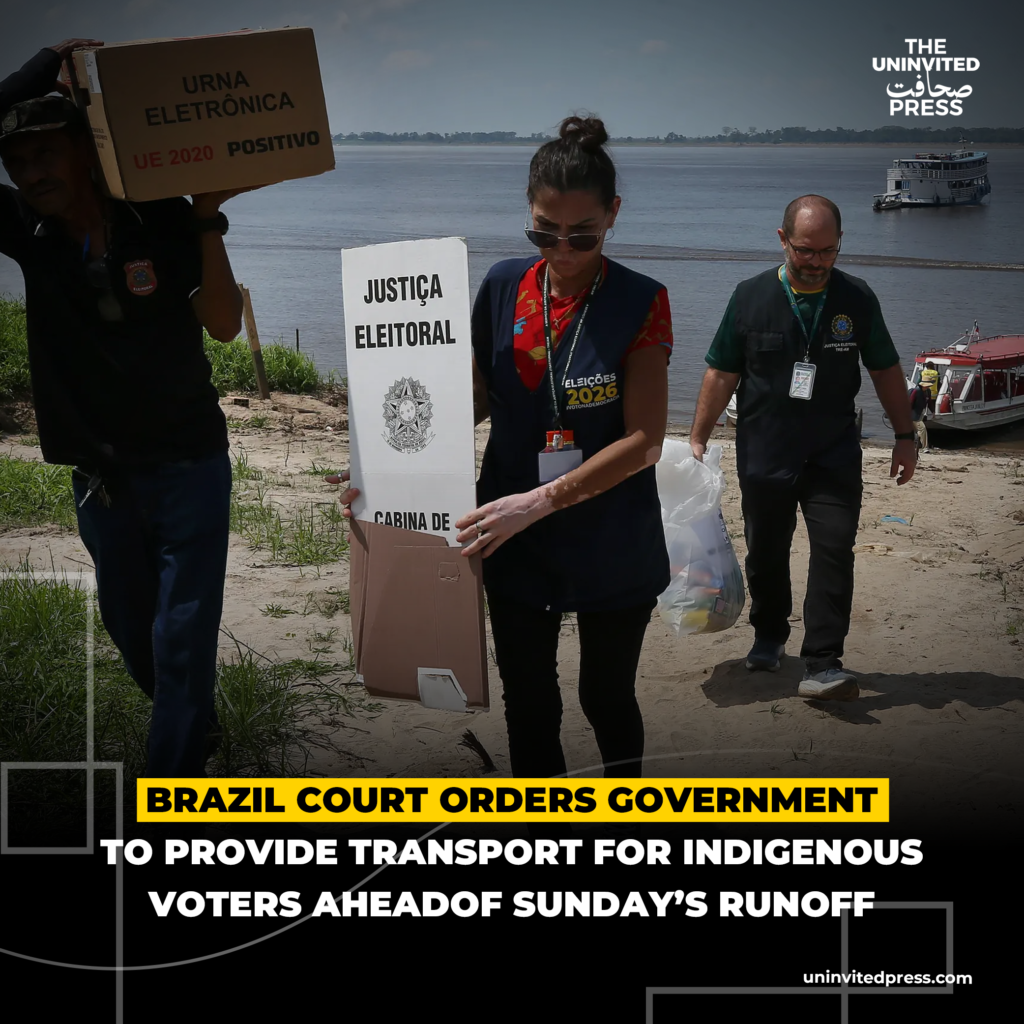
Federal ruling requires free river, land or air transport, food and language support nationwide, with daily fines for non-compliance.
A federal court in Brazil has ordered the government to guarantee free transportation, food and logistical support for Indigenous voters across the country so they can cast ballots in Sunday’s presidential runoff.
Judge Maria Carolina Valente do Carmo of the 5th Federal Civil Court in Pará issued the nationwide ruling on Thursday, giving the federal government 24 hours to implement the measures. Failure to comply without justification could result in a daily fine of one million reais (approximately $180,000).
Brazil Orders Free Transport for Indigenous Voters:
The decision requires the provision of free transport by river, land or air according to the needs of each community, along with adequate food for voters who must travel to polling stations. The government must also offer emergency financial and logistical support to municipalities for fuel, vehicles and boats, and coordinate with the National Foundation for Indigenous Peoples (Funai), the Indigenous Health Secretariat (Sesai), the Armed Forces and the Federal Police.
In addition, the court ordered the availability of interpreters, cultural facilitators and signage in Indigenous languages at polling stations where needed. Where public vehicles or boats cannot be provided directly, communities may be reimbursed for fuel costs related to transporting voters, subject to administrative verification.
Brazil Court Orders Measures to Help Indigenous Voters Reach Polls:
The ruling responds to a lawsuit filed by the Federal Public Prosecutor’s Office (MPF), which highlighted difficulties faced by Indigenous communities during the first round of voting on 4 October. Indigenous abstention reached about 26 percent, higher than the national average of around 20 percent. Reports from organisations including the Articulation of Indigenous Peoples of Brazil (Apib) pointed to problems in states such as Amazonas, Pará, Mato Grosso, Amapá and others, including lack of transport, fuel shortages and linguistic barriers.
Particular challenges were noted in remote Amazonian areas such as the Javari Valley, where some communities require multi-day boat journeys to reach polling stations, and local electoral authorities had previously denied transport requests. The court emphasised that geographic isolation combined with the absence of accessible transport can render a constitutionally recognised right impossible to exercise in practice.
The Indigenous electorate has grown significantly in recent years. The measures aim to ensure that remote and riverine communities can participate in the runoff between the leading candidates on 25 October without the logistical barriers that hindered many in the first round. Brazilian authorities have been directed to report urgently on the steps taken to comply with the order.