

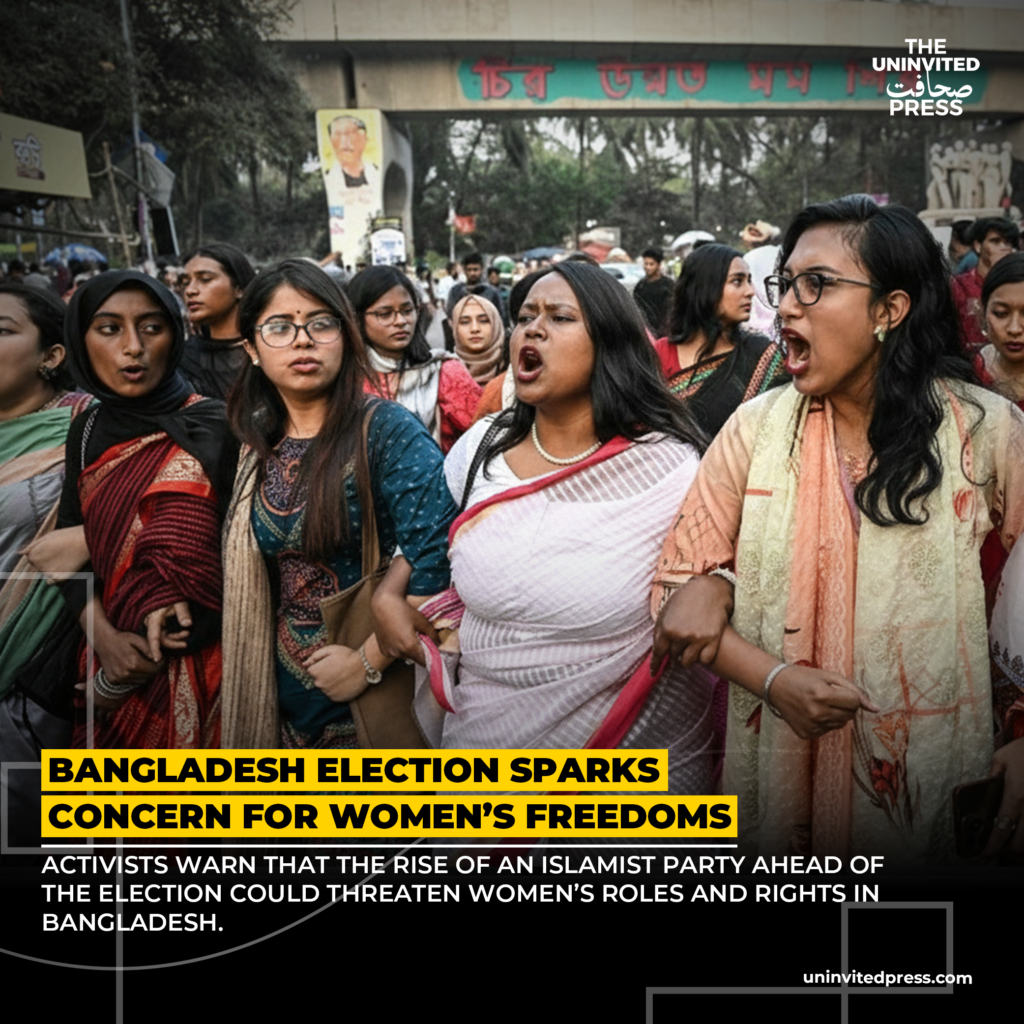
Bangladesh’s February 12 election fuels fears over women’s rights as Jamaat-e-Islami rises, threatening gender equality gains post-2024 uprising.
Bangladesh Votes: Democracy vs. Gender Rights:
With Bangladesh’s first free election in nearly two decades set for February 12, a surge in support for the Islamist party Jamaat-e-Islami has women’s rights groups on edge. Fears mount that the party’s conservative stance on gender roles could erode hard-fought gains, from workforce participation to leadership opportunities. In a country where women comprise half the voters and played a pivotal role in the 2024 uprising that ended Sheikh Hasina’s rule, this election tests the fragile balance between democratic renewal and rising religious conservatism. The outcome could reshape societal norms for generations, amplifying global concerns over minority and gender rights in South Asia’s volatile landscape.
Bangladesh Ballot: Revolution Meets Gender Battle:
The path to this election began with the student-led Monsoon Revolution in August 2024, which forced Prime Minister Sheikh Hasina to flee to India after weeks of protests over job quotas and corruption. The uprising claimed over 1,000 lives, leading to Hasina’s Awami League being banned from contests and her receiving a death sentence in absentia for crimes against humanity. An interim government under Nobel laureate Muhammad Yunus took charge, restoring Jamaat-e-Islami’s registration in June 2025 after a 2013 ban under Hasina for conflicting with the secular constitution.
By late 2025, JI had rebranded through welfare programs, including medical camps and aid for uprising victims’ families, appealing to disillusioned youth-42% of the electorate are first-time voters. In December 2025, JI allied with the youth-led National Citizen Party (NCP), though this prompted NCP resignations over JI’s history. JI’s February 4 manifesto pledged women’s empowerment but proposed reducing work hours to five for mothers, subsidized by the state-a move critics call a push toward domestic confinement.
Protests erupted in early February, with midnight marches in Dhaka where women chanted for equality. Reports surfaced of girls barred from sports in rural areas and increased harassment for “immodest” dress. As campaigning wrapped, polls indicated a close race between BNP and JI alliances, with JI potentially becoming a major opposition force.
Rising Islamism, Women and Minority Risks:
Jamaat-e-Islami traces its roots to 1941 in British India, founded by Sayyid Abul Ala Maududi, advocating for Sharia-based governance. In Bangladesh’s 1971 independence war from Pakistan, JI opposed separation and collaborated with Pakistani forces, leading to accusations of war crimes. Banned post-independence, it was reinstated in 1979 under military rule but faced crackdowns under Hasina, with leaders executed for 1971 atrocities.
Bangladesh, 91% Muslim, has a secular constitution restored in 2011, but oscillations between secularism and Islamism mark its politics. Women have advanced significantly: 44% workforce participation, highest in South Asia, and two female prime ministers. Yet, gender-based violence surged post-2024, with police noting increases in 2025. JI’s rise, polling at 29%, exploits anti-Hasina sentiment but alarms secularists fearing a shift to Islamic law, impacting minorities (Hindus 8%) who faced 51 attacks, including 10 killings, since 2024.