

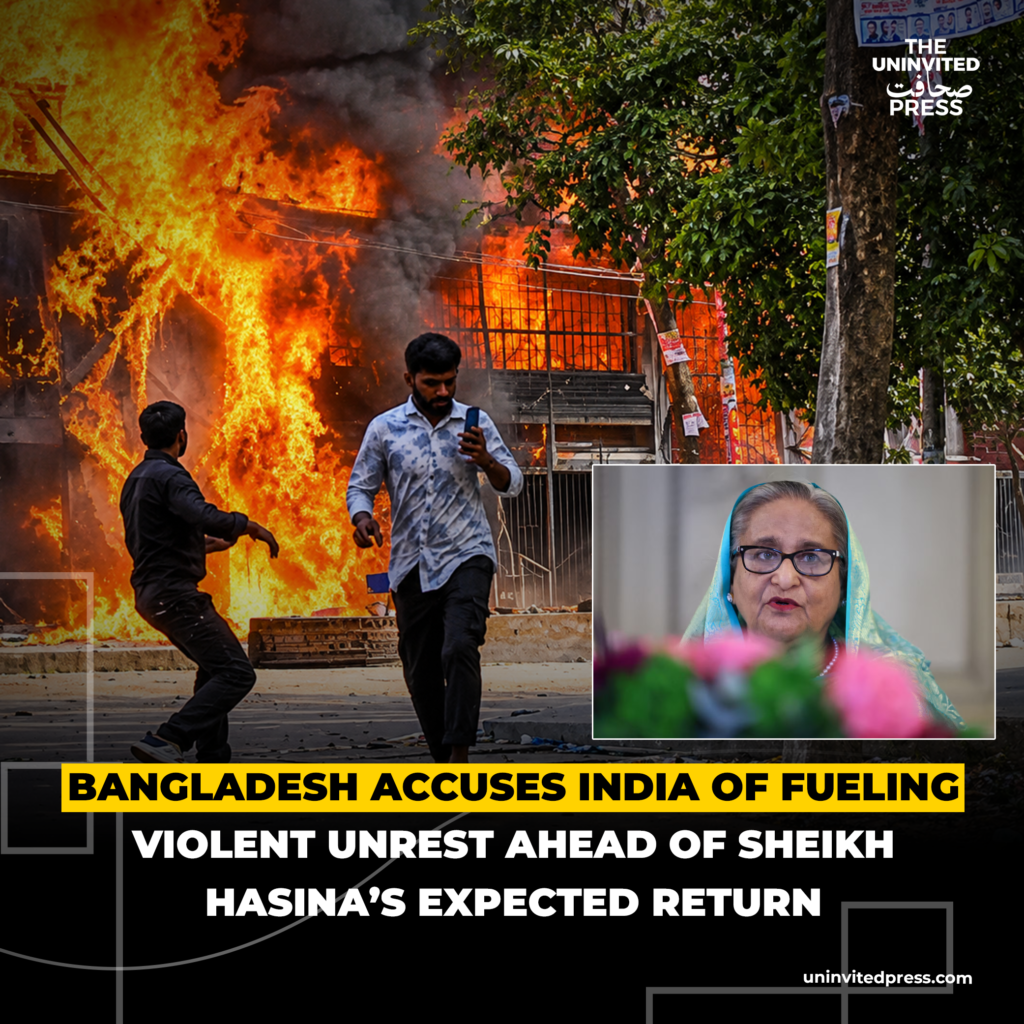
Paramilitary troops deployed amid arson, clashes and political tensions over ousted leader’s bid to come home from exile.
Bangladesh’s government has accused India of encouraging violent unrest linked to the banned Awami League as supporters of former Prime Minister Sheikh Hasina protest the rejection of her planned return from exile, escalating political tensions in the country and straining bilateral ties.
Prime Minister Tarique Rahman has pointed to “masters across the border” for allegedly directing the campaign of protests and disruption. In remarks to parliament and public events, he said Awami League figures who fled after Hasina’s ouster in 2024 “have not looked at the interests of Bangladesh and its people” and were conspiring against the nation to satisfy those external backers.
The comments came as paramilitary forces were deployed nationwide to contain a wave of violence that has included arson attacks on vehicles and homes, crude bomb blasts and clashes with security forces. At least four people have been killed in the recent unrest, according to local reports, including political activists and a bus worker who died when his vehicle was set on fire.
Bangladesh Unrest Grows Over Hasina’s Return:
Hasina, who has lived in self-imposed exile in India since fleeing Dhaka in August 2024 following a student-led uprising that toppled her government, requested a new passport and national identity card earlier this month to facilitate a return in December. The Bangladesh government rejected the request, describing her as a convicted criminal who can only return under the existing extradition treaty with India.
Hasina was tried in absentia and sentenced to death by Bangladesh’s International Crimes Tribunal on charges related to the deadly crackdown during the 2024 uprising. She has rejected the verdict and the proceedings. Her Awami League party, whose activities have been banned, responded by organising protests and calling for a nationwide shutdown, which authorities say led to widespread disruption.
Police have reported dozens of incidents across multiple districts, including the torching of homes belonging to ruling Bangladesh Nationalist Party (BNP) supporters, attacks on police vehicles and the setting ablaze of the ancestral home of Nobel laureate Muhammad Yunus, who headed the interim administration after Hasina’s departure. Hundreds of additional paramilitary troops, including units of the Border Guard Bangladesh, were mobilised to restore order.
India has declined to comment directly on Rahman’s remarks, with the Ministry of External Affairs stating it has no comments on Bangladesh’s internal developments while reiterating a desire for positive and constructive relations with Dhaka. New Delhi has long been a close ally of Hasina’s governments and provided her refuge after she fled on a military aircraft in 2024.
Bangladesh Faces Fresh Political Unrest Over Hasina’s Return:
Reports suggesting India had set conditions for any return or extradition-such as requiring the Bangladesh Army to oversee her transfer and guarantees of a fresh trial or appeal rights-were firmly denied by Bangladeshi officials. Dhaka has insisted that no such discussions took place and that Hasina’s return must proceed solely under the bilateral extradition treaty and domestic law.
The violence reflects deep political polarisation that has persisted since the 2024 uprising. Hasina’s long rule was marked by economic growth but also accusations of authoritarianism and repression. The current BNP-led government under Rahman, which came to power after elections that excluded the banned Awami League, faces challenges from both political opponents and economic pressures, including labour unrest in the garment sector.
Authorities have arrested dozens of suspected Awami League activists and warned that those involved in violence will face prosecution. Home ministry officials have accused overseas Awami League leaders of inciting the unrest from abroad. Supporters of Hasina argue that the protests are a legitimate response to the government’s refusal to allow her return and that the party continues to command significant grassroots support.
As of the latest reports, security forces remain on high alert and the investigation into the violence continues. The episode underscores the fragile state of Bangladesh’s post-uprising politics and the sensitive role India continues to play in the country’s internal dynamics.