

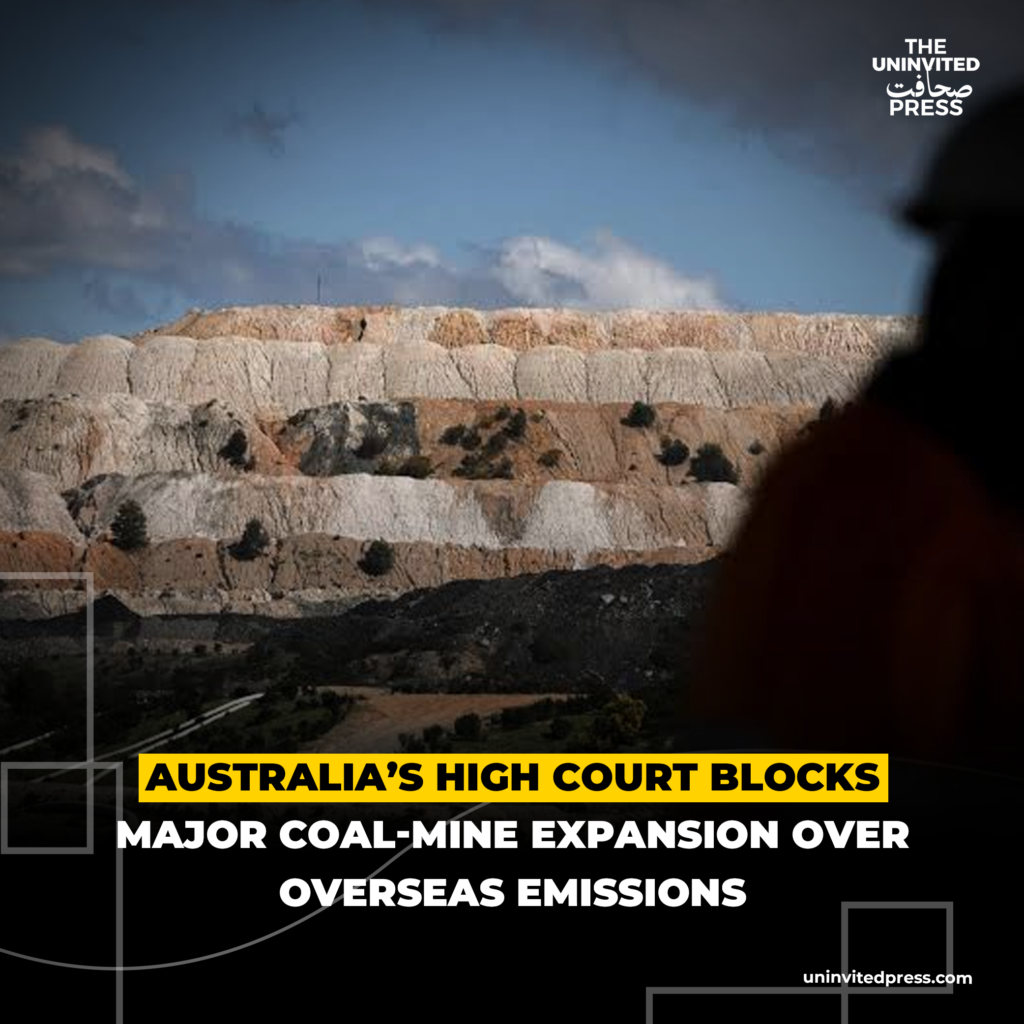
Landmark ruling finds planning authorities must consider climate impacts of coal burned abroad, in first climate case to reach the nation’s top court.
Australia’s High Court has blocked a major expansion of a coal mine in New South Wales, ruling that state planning authorities failed to properly consider the climate impacts of greenhouse gas emissions generated when the coal is burned overseas. The decision, delivered on Wednesday in a 3-2 majority judgment, marks the first time the country’s highest court has ruled on a climate change case and is being described by environmental advocates as a binding precedent for future fossil fuel projects.
The case centred on MACH Energy’s Mount Pleasant open-cut coal mine near Muswellbrook in the Hunter Valley. The company had sought approval to extend the mine’s life by more than 20 years until 2048 and roughly double its annual production to 21 million tonnes. The expansion would have allowed the extraction of an additional 406 million tonnes of coal. Approximately 98 percent of the project’s total projected greenhouse gas emissions were classified as Scope 3 emissions-those released when the exported coal is burned by overseas customers.
High Court Rules on Coal Mine Emissions Assessment:
In 2022, New South Wales’ Independent Planning Commission (IPC) granted development consent. A Hunter Valley community group, the Denman Aberdeen Muswellbrook Scone Healthy Environment Group (DAMSHEG), challenged the approval. After winning in the NSW Court of Appeal, the group defended the decision in the High Court when MACH Energy appealed.
A majority of the High Court found the IPC had failed to comply with a mandatory legal obligation under state planning law to consider imposing conditions ensuring that greenhouse gas emissions are “minimised to the greatest extent practicable.” Justice James Edelman noted that the Commission focused only on the 2 percent of emissions produced domestically and did not address whether conditions should be applied to the far larger Scope 3 component. “By focusing only upon 2% of the project’s emissions, the Commission failed in its reasons to consider whether conditions should be imposed,” he wrote.
Justice Michelle Gordon emphasised that the impact of emissions is the same regardless of how they are categorised for accounting purposes, rejecting the argument that overseas emissions fall outside Australia’s responsibility. Two judges dissented, finding that the Commission had adequately considered the issue by noting that importing countries had commitments under the Paris Agreement.
Australian Court Blocks Coal Expansion Over Climate Impacts:
Wendy Wales, a retired science teacher and president of the community group, welcomed the outcome. “Today the High Court has said what we have always known: we cannot dig up coal, ship it overseas, watch it drive climate change, and then pretend the consequences have nothing to do with us and won’t be felt by us,” she said. Lawyer Anita O’Hart, who represented the group, described the ruling as “one of the most significant domestic climate law decisions in the world,” confirming that planning authorities cannot ignore the chain of causation linking project emissions to local climate harm such as increased bushfire risk, drought, flooding and extreme heat.
MACH Energy said it was disappointed but accepted the decision and would continue to pursue options for the long-term continuity of the Mount Pleasant operation. The NSW government indicated it would engage closely with the company and noted that the ruling does not prevent the expansion from being reconsidered under existing frameworks.
Environmental groups say the judgment will affect other coal proposals currently in the NSW planning pipeline and could influence decision-making more broadly across Australia. Industry representatives have warned that requiring consideration of Scope 3 emissions may complicate approvals and investment. As one of the world’s largest coal exporters, Australia has long treated emissions from burned exports as the responsibility of importing nations. The High Court has now clarified that, at least under NSW planning law, those emissions cannot simply be disregarded when assessing local environmental impacts.