

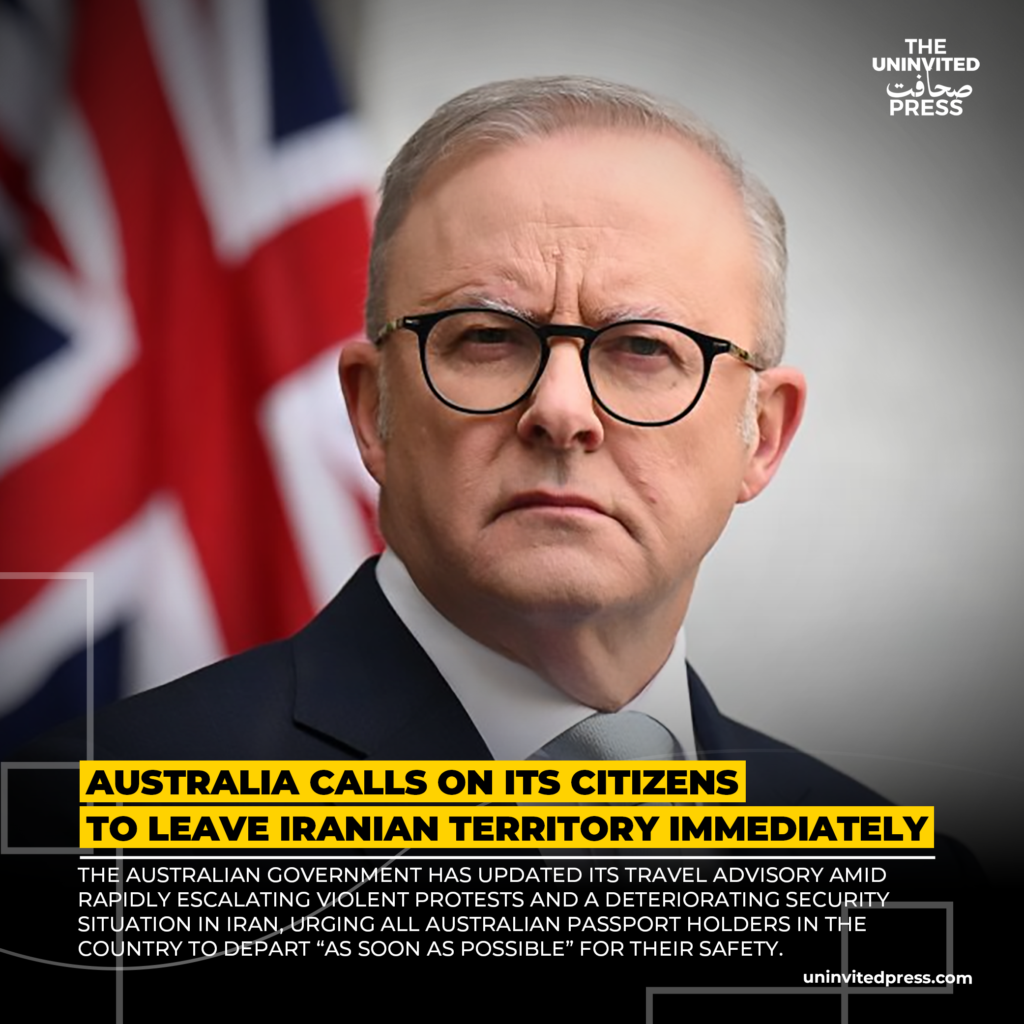
Canberra issues stark warning amid escalating violence, with reports of at least 28 killed in nationwide unrest.
INCIDENT:
The Australian government has escalated its travel advisory for Iran, urging all citizens to depart immediately due to ongoing violent protests that have turned deadly across the country. The directive highlights a rapidly deteriorating security situation, with demonstrations spreading to dozens of cities and risking further chaos. This move underscores the perils facing foreigners in Iran, where arbitrary detentions and limited consular support amplify the dangers, potentially stranding Australians in a volatile environment.
FULL STORY:
On January 7, 2026, Australia’s Department of Foreign Affairs and Trade (DFAT) issued an urgent update to its Smart Traveller advisory for Iran, elevating the warning to its highest level: “Do not travel.” The notice explicitly advised any Australians currently in Iran to “leave as soon as possible,” citing the “ongoing violent nationwide protests that may further escalate without notice.” This came amid reports of severe responses from Iranian security forces, including live fire on demonstrators.
The protests erupted in late December 2025, initially sparked by soaring inflation, currency devaluation, and economic hardships exacerbated by international sanctions. By January 8, 2026, demonstrations had spread to at least 45 cities across 13 provinces, according to Amnesty International and other monitoring groups. Human rights organizations, including the Norway-based Iran Human Rights (IHR) and the U.S.-based Human Rights Activists News Agency (HRANA), reported that security forces had killed at least 28 protesters and bystanders, including children, since the unrest began. Injuries numbered in the hundreds, with widespread arrests.
Iranian authorities imposed an internet blackout starting January 8, 2026, as confirmed by global monitoring firms like Net-Blocks and the Open Observatory of Network Interference (OONI). This measure, a tactic seen in previous uprisings, aimed to curb the spread of information and coordination among protesters. Videos circulating on social media before the shutdown showed crowds chanting anti-government slogans, burning effigies, and clashing with riot police in cities like Tehran, Isfahan, and Tabriz.
Australian officials noted the particular risks to dual nationals, who could face arbitrary detention. The advisory warned that the security situation remains “volatile,” with potential for further escalation. Commercial flights out of Iran were still operating as of January 9, 2026, but DFAT cautioned that options could dwindle rapidly.
CONTEXT & BACKGROUND:
Iran’s latest wave of protests fits a pattern of civil unrest driven by economic grievances and demands for political change. The country’s economy has been battered by U.S.-led sanctions reimposed in 2018 under former President Donald Trump, and tightened further since his reelection in 2024. Inflation hovered around 40% in 2025, with the rial plummeting to record lows against the U.S. dollar-trading at around 140,000 tomans by late December 2025, per reports from Reuters and Bloomberg.
This economic strain echoes the 2019 fuel price protests, which killed over 1,500 according to Amnesty International, and the 2022 demonstrations following the death of Mahsa Amini in custody, which claimed hundreds of lives. The current unrest began with shopkeepers striking over market instability in Tehran on December 31, 2025, quickly morphing into broader anti-regime calls for the ouster of the Islamic Republic’s leadership.
For Australia, relations with Iran have been strained. The Australian Embassy in Tehran suspended operations in June 2025 amid a diplomatic row over detained Australians, leaving citizens reliant on limited support from allied embassies like Canada’s. Historically, Australia has maintained a “Do not travel” advisory for Iran since 2019, citing risks of terrorism, unrest, and arbitrary arrest. The January 2026 update marks the first explicit “leave immediately” directive in recent years, reflecting the acute intensity of the current crisis.
The significance extends beyond bilateral ties. With Iran backing proxy groups in regional conflicts, such as in Yemen and Syria, domestic instability could ripple into broader Middle East tensions. For Australians, the human impact is stark: at least two citizens were reported detained in Iranian prisons as of October 2024, per an SBS News investigation, highlighting the real threat of wrongful imprisonment.