

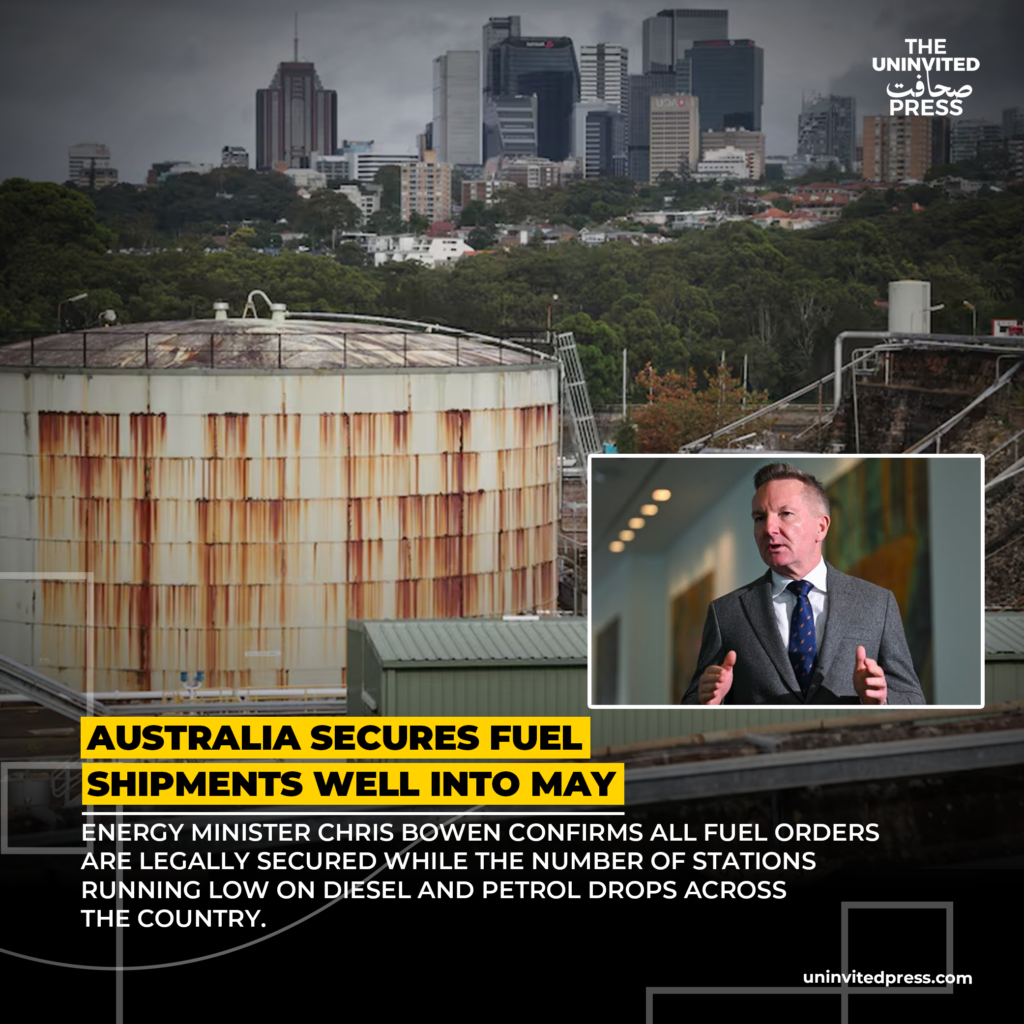
Energy Minister Chris Bowen confirms contracted imports will ease shortages as number of service stations running low on diesel and petrol continues to decline.
Australian Energy Minister Chris Bowen has assured the public that fuel shipments secured by importers and refiners will maintain supply stability into May, even as the country grapples with localised shortages triggered by heightened global tensions and surging domestic demand.
Speaking on Friday, Bowen stated that more than 50 ships-with some reports citing up to 55-carrying approximately 3.7 billion litres of fuel are currently en route to Australia, with arrivals expected throughout April. He emphasised that all contracted orders remain on track and have been “legally secured,” providing a buffer beyond the immediate Easter period.
The update comes as the number of service stations experiencing outages has dropped in recent days. As of early April, around 312 stations nationwide were reported out of diesel-representing roughly 3.4 to 4 percent of Australia’s approximately 8,000 outlets-with notable improvements in New South Wales, Victoria and Queensland. Outages for petrol have also eased, though diesel remains the primary concern in regional and rural areas.
Global challenges and national response:
The strain on Australia’s fuel supply stems largely from the ongoing conflict in the Middle East, which has disrupted global shipping routes and prompted the cancellation or deferral of six shipments earlier in the crisis. Those have since been replaced with alternative cargoes from other sources, and at least three additional spot cargoes have been ordered.
Australia relies heavily on imports for refined fuels, with domestic refineries operating at high capacity but unable to meet full demand alone. Current national reserves stand at approximately 39 days of petrol, 29-30 days of diesel, and 30 days of jet fuel. The government has released portions of the strategic fuel reserve-more than 500 million litres in some reports-prioritising regional distribution, and has temporarily relaxed fuel quality standards to allow higher sulphur content for 60 days to increase available supply.
Bowen noted that while international spot cargoes remain available, they are becoming more expensive and riskier to secure. In response, the government has introduced new legislative powers to underwrite purchases and direct fuel where it is most needed, particularly to rural communities facing acute shortages.
Effects on regions and community behavior:
Localised fuel shortages have hit hardest in regional Australia, affecting farmers, freight operators and remote communities. Panic buying in some areas has exacerbated the situation, prompting Bowen to urge motorists to avoid topping up unnecessarily and to fill up only when required.
Suppliers such as Viva Energy have reported diversifying sources across five continents, including new cargoes from the United States and South America, to bolster resilience. Refineries continue to operate at full stretch to push supply into the distribution network.