

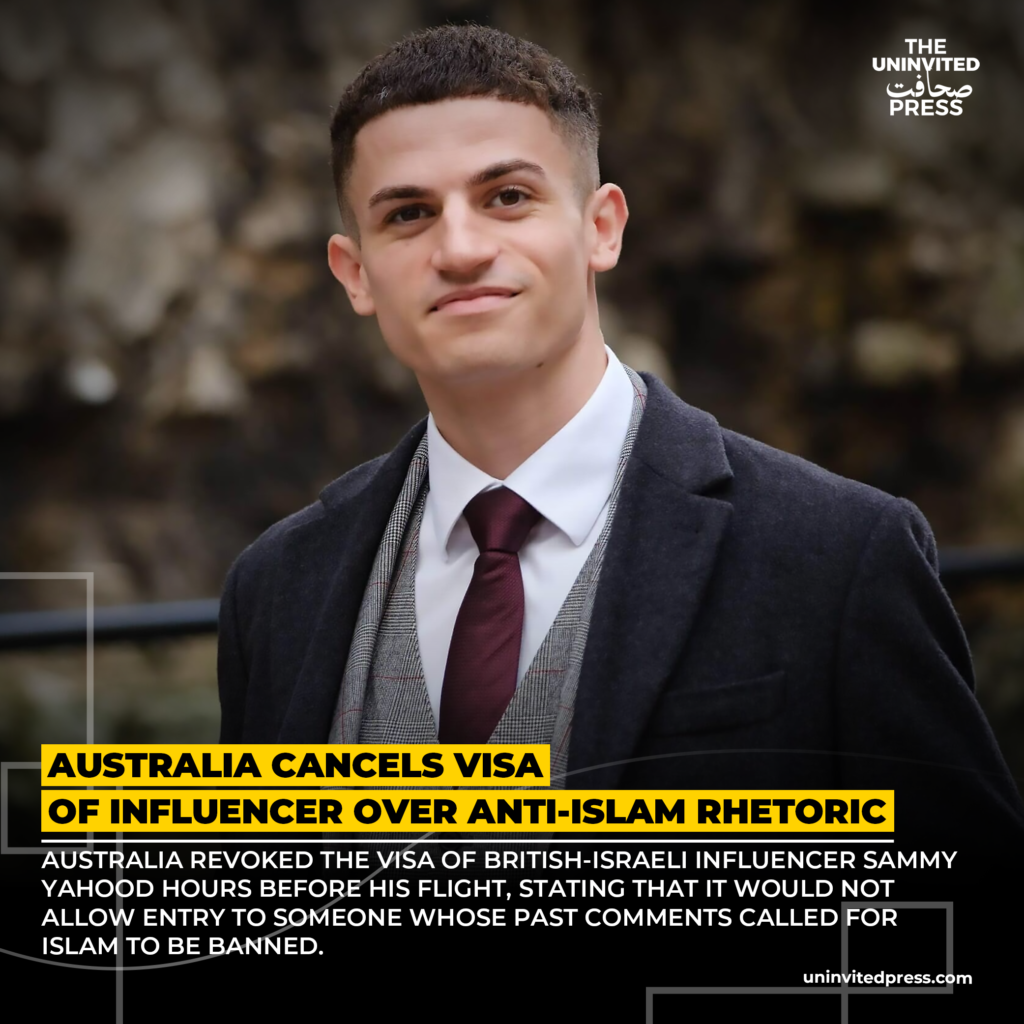
Government slams door on anti-Islam activist hours before flight, citing calls to ban the faith as unacceptable.
Australia Bars Influencer Over Hate Speech:
Australia’s government has abruptly canceled the visa of British-Israeli influencer Sammy Yahood, blocking his entry just three hours before his departure from Israel. The move, driven by his inflammatory comments labeling Islam a “disgusting ideology” and advocating its outright ban, underscores Canberra’s tough new stance on hate speech following a deadly mass shooting. As tensions rise in the wake of the Bondi Beach tragedy, this decision highlights the delicate balance between free expression and preventing division in a multicultural society.
Visa Revocation and Immediate Fallout: The Hours Before Departure:
On January 26, when Sammy Yahood, poised to board a flight from Israel, received notice that his Australian visa had been revoked. He was set to launch his “Peace Through Strength” campaign, hosting self-defense workshops and speaking at synagogues in Sydney and Melbourne organized by the Australian Jewish Association (AJA). Just hours earlier, Yahood had doubled down on his views in an X post, declaring Islam an “aggressor” that “does not tolerate non-believers, apostates, women’s rights, children’s rights, or gay rights.”
By the next day, Yahood confirmed the ban on social media, posting from Abu Dhabi where he praised the UAE for welcoming him while accusing Australia’s Labor government of “tyranny.” He managed to fly to the Gulf state but was barred from his connecting flight to Melbourne. In a follow-up post, he emphasized: “This is a story about government overreaching, We cannot allow it.”
The cancellation marks the latest in a series of high-profile visa denials by Australia, reflecting heightened scrutiny amid rising communal tensions.
How Yahood’s Ban Reflects Australia’s New Zero-Tolerance Era on Hate Speech?
Yahood’s rise as an influencer stems from his London upbringing in a privileged Jewish community, where he volunteered teaching self-defense before making Aliyah (immigrating to Israel) in recent years. He positions himself as a defender of Jewish identity, often framing his criticism of Islam as a call for “peace through strength.” His online content includes videos urging physical readiness against threats and pointed attacks on what he calls Islam’s “colonial death cult.”
This incident comes against the backdrop of Australia’s deadliest mass shooting in decades: the April 2025 attack at a Jewish festival in Sydney’s Bondi Beach, which killed 15 people and prompted national outrage. In response, Parliament passed the strongest federal hate speech laws in the country’s history just one week before Yahood’s ban. These expand the Migration Act’s character test, allowing visa rejections for “hate, vilification, or extremist conduct.”
Australia has a history of barring controversial figures. In 2019, far-right commentator Milo Yiannopoulos was denied entry after calling Islam “barbaric.” More recently, Israeli activists like Hillel Fuld and politician Simcha Rothman faced similar fates over “Islamophobic rhetoric” and fears of spreading division. The government has also targeted pro-Palestinian voices, such as canceling Khaled Beydoun’s visa in 2024 for endorsing violence.
This case tests Australia’s commitment to multiculturalism amid global debates on free speech versus hate incitement. With antisemitism and Islamophobia both surging post-Bondi, the government aims to prevent imported rhetoric from fueling local unrest.