

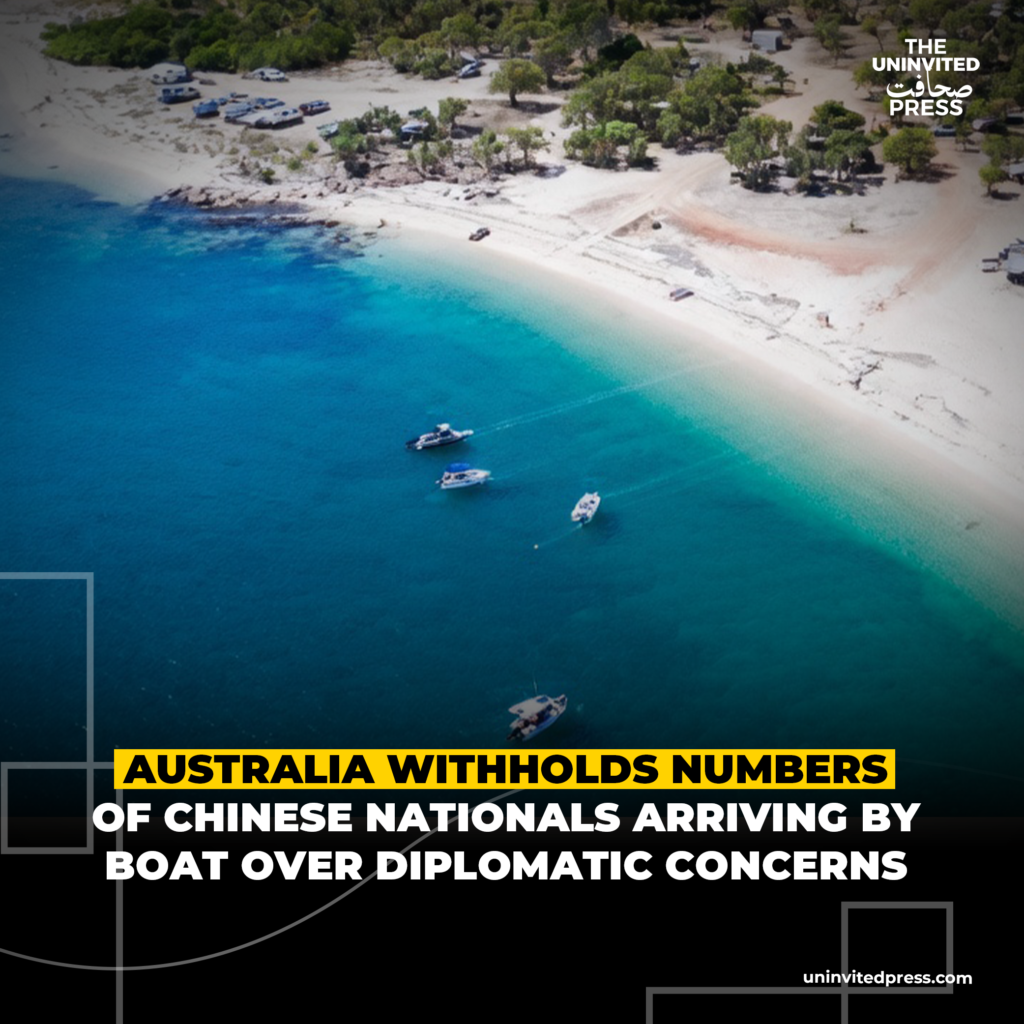
Australia has refused to disclose how many Chinese nationals have arrived by boat since 2024, citing risks to diplomatic relations. Indonesian police report a surge in smuggling attempts as an alternative migration route emerges.
Australia Withholds Data on Chinese Boat Arrivals Over Diplomatic Concerns:
The Australian government has declined to disclose how many Chinese nationals have reached or attempted to reach Australia by boat since January 2024, stating that releasing the figures could harm diplomatic ties and compromise border operations.
The Department of Home Affairs rejected a Freedom of Information request from Guardian Australia, arguing that details on interceptions, detentions, or deportations “could reasonably be expected to damage Australia’s relations with foreign governments.” The decision comes as Indonesian authorities document a rising number of Chinese nationals organising boat journeys from remote Indonesian islands, using Australia as an alternative migration route amid crackdowns elsewhere.
This withholding of data has raised questions about transparency in border management at a time when specific incidents of Chinese boat arrivals in remote northern Australia have already sparked political debate.
Rising Chinese Boat Arrivals to Australia Spark Border and Smuggling Concerns:
Guardian Australia has sought internal review of the FOI refusal. Operation Sovereign Borders policy remains unchanged: unauthorised boat arrivals face turnbacks, offshore processing, or removal and cannot settle in Australia. No public total released by Australian authorities.
Indonesian police in East Nusa Tenggara have intercepted several groups. In mid-2025, four Chinese nationals were arrested in Kupang after buying a speedboat for US$3,500 and attempting departure. In January 2026, three more were stopped at Oliana Beach in Tablolong with a boat. On 24 February 2026, Rote Ndao police found seven foreign nationals-including four Chinese-on Masidae Beach; the group had reached Australian waters on 19 February before being intercepted and returned.
In West Jakarta, immigration authorities dismantled a syndicate in January 2026 that falsified documents for Chinese clients heading to Australia. Police in Rote Ndao subsequently met with China’s deputy consul general to discuss preventing people-smuggling networks targeting Chinese citizens.
Australian media have independently documented specific landings. In December 2025, six Chinese nationals were detained after walking into the remote Indigenous community of Kalumburu in Western Australia’s Kimberley. Earlier incidents in 2025 included groups in Arnhem Land and the Northern Territory coast. These cases align with the broader trend reported by Indonesian authorities but represent only the publicly known fraction.
Chinese Irregular Migration Sparks Diplomatic and Border Challenges for Australia:
Chinese nationals have increasingly sought irregular migration paths since 2021, driven by China’s economic slowdown and tightening political controls. Over 37,000 were arrested on the US southern border in 2023 alone along the Darién Gap route. With enforcement stepped up under successive US administrations, alternative destinations such as Australia have gained attention.
Australia’s response is governed by Operation Sovereign Borders, the bipartisan policy in place since 2013 that mandates turnbacks or offshore processing for boat arrivals and explicitly bars resettlement. Successive governments-Labor and Coalition alike-have maintained that unauthorised maritime arrivals will not settle in Australia. The policy has drastically reduced boat arrivals overall, with official figures showing near-zero successful ventures in recent years. However, the government’s refusal to release nationality-specific data on Chinese arrivals marks a departure from routine transparency on broader irregular migration statistics.
The decision to withhold figures explicitly references risks to “bilateral relationships” and future cooperation from foreign governments. While the department did not name China, the context of the FOI request and concurrent diplomatic engagements-such as the Indonesian police meeting with Chinese consular officials-points to sensitivities around Beijing. Australia-China relations have been strained over issues including trade, strategic ports, and regional security, making any public data on Chinese irregular migration potentially delicate.