

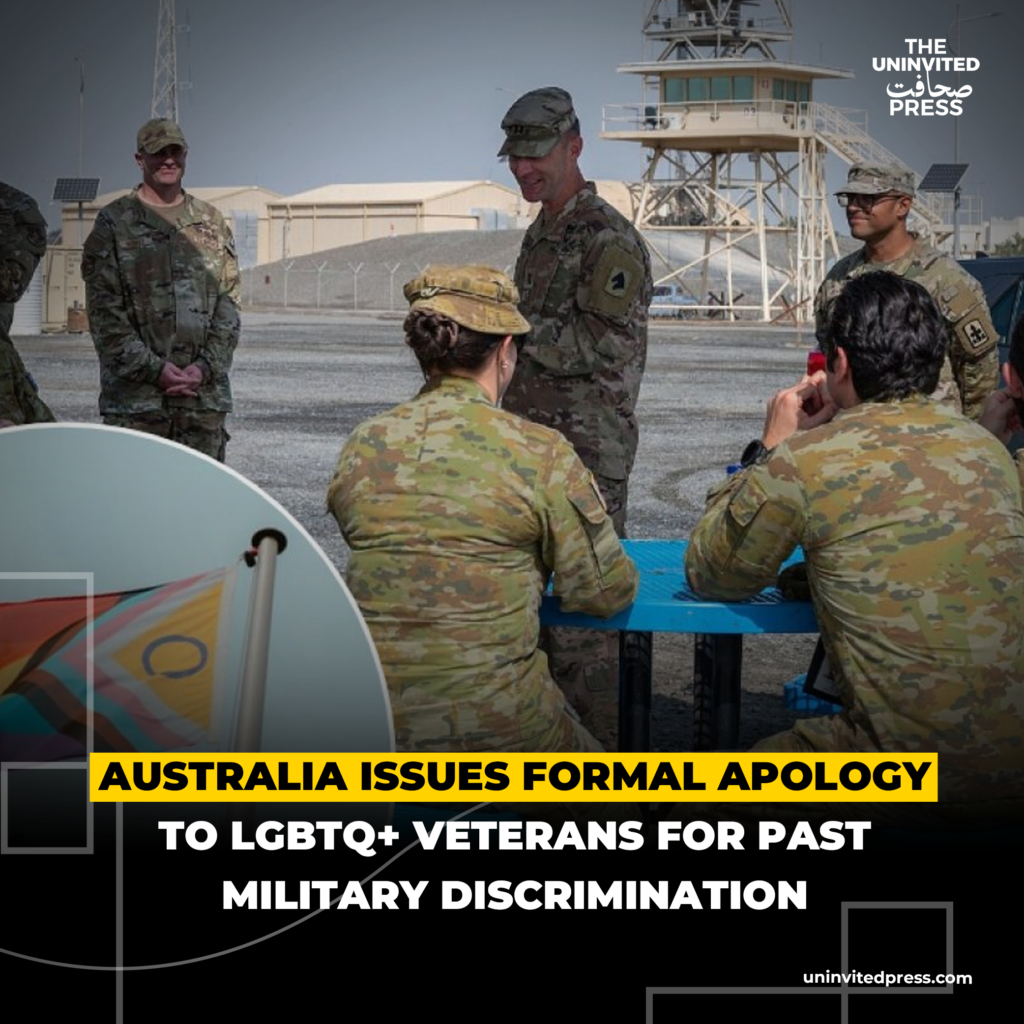
Defence Minister acknowledges ‘shameful chapter’ of surveillance, interrogations and forced discharges as government seeks to right historical wrongs.
Australia’s government has formally apologised to current and former LGBTQIA+ members of the Australian Defence Force for the harm caused by decades of discriminatory policies that targeted personnel solely because of their sexual orientation.
Deputy Prime Minister and Defence Minister Richard Marles delivered the apology in the House of Representatives on Wednesday, marking 34 years since the ban on lesbian, gay and bisexual people serving openly was lifted in 1992.
“You and your families offered this nation everything that service asks. In return our nation offered condemnation, derision, and suspicion,” Marles said. “This country did not keep faith with you. But today, it says sorry.”
Australia Apologises for Historic Ban on LGBTQ+ Military Personnel:
Until 1992, Australian Defence Force policy explicitly stated that homosexual behaviour was “not accepted or condoned.” Personnel who admitted to or were found to have engaged in same-sex relationships faced intrusive surveillance, investigations, interrogations and the threat of discharge. Many were forced to resign or received dishonourable discharges. Consensual same-sex activity could also be prosecuted under military law. Veterans have long described the period as one of “witch hunts,” in which colleagues were pressured to inform on one another and careers were abruptly ended.
Marles described the policies as a “shameful chapter” in the history of the Defence Force. “We asked these Australians to defend a fair go. Then we refused them one. None of this made our nation safer,” he said. He acknowledged that even after the formal ban was lifted, institutional culture and attitudes took far longer to change.
The apology follows legislation passed by parliament in September that allows historical convictions for homosexual service offences to be extinguished from service records. Applications under the scheme opened recently, and families of deceased veterans may apply on their behalf. The government has framed both the legal change and the formal apology as steps toward recognising the lasting damage inflicted on those who served.
Australia Apologises to LGBTQ+ Veterans:
Advocates and affected veterans have long campaigned for official recognition of the injustice. Many left the military under a cloud of stigma, some never explaining the true reason for their departure to family or friends. Others struggled for years to feel welcome within the broader veterans’ community.
Australia maintained a ban on transgender personnel until 2010. The apology focused primarily on the policies that targeted sexual orientation prior to 1992, while broader efforts to improve inclusion for LGBTQIA+ service members continue.
Officials stressed that an apology cannot undo the past, but that it must be accompanied by concrete action. In his address, Marles affirmed that those who served under the old regime always belonged in the Australian Defence Force and that their contributions are valued.
The statement represents one of the more comprehensive official reckonings by a Western military with its history of institutional discrimination against LGBTQ+ personnel. For many veterans, the public acknowledgment-delivered in parliament and broadcast widely-marks a long-overdue validation of their service and the personal cost they paid for simply being who they were.