

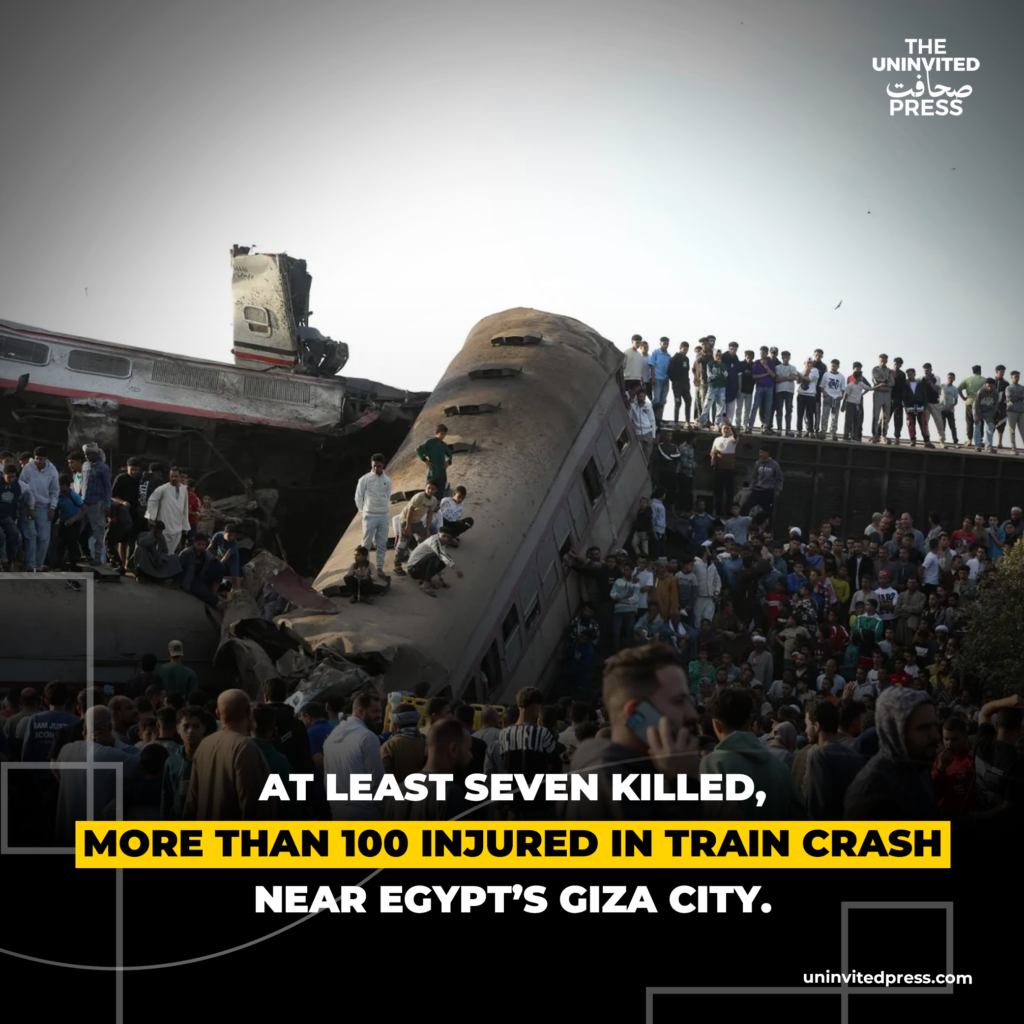
Collision between two passenger trains in al-Ayyat district leaves carriages overturned as emergency teams scramble and president orders investigation.
At least seven people were killed and more than 100 others injured when two passenger trains collided south of Cairo on Sunday, Egyptian authorities said, in the latest in a long series of rail accidents that have plagued the country’s ageing network.
The crash occurred in the al-Ayyat district of Giza governorate, roughly 50 to 76 kilometres (30 to 47 miles) south of the capital, between the Kafr Ammar and al-Raqqa stations. A train travelling from Giza to the Fayoum oasis struck the rear of a stationary service heading from Cairo to Aswan. Several carriages derailed and overturned, some tumbling down an embankment, according to the Egyptian Railway Authority and the health ministry.
Images and videos from the scene showed twisted and overturned carriages, crowds of local residents and emergency workers gathered around the wreckage, and rescue teams searching through the debris for survivors. One carriage appeared to have split open. Witnesses described scenes of chaos, with passengers trapped inside and bodies being pulled from the wreckage.
Egypt Train Collision Kills 7, Injures Over 100:
Egypt’s health ministry reported that the death toll stood at seven, including the driver of the Giza-Fayoum train. More than 100 people were injured-figures from official statements ranged between 112 and 125-with injuries including broken bones, head trauma, fractures of the pelvis and vertebrae, chest injuries, and cuts. Dozens of ambulances, reported as more than 70, transported the wounded to hospitals in the area, including facilities in al-Ayyat, al-Wasta and Atfih. Many of the less seriously injured were later discharged.
President Abdel Fattah el-Sisi ordered a prompt investigation into the circumstances of the accident and said those found negligent would be held accountable. Egypt’s public prosecutor’s office dispatched investigators to the site and said technical reasons for the crash were being examined. Early assessments indicated that the Cairo-Aswan train had stopped on the tracks when it was hit from behind by the following service travelling in the same direction.
Emergency crews and heavy lifting equipment, including cranes, were sent to clear the wreckage so that services on the vital Cairo-Upper Egypt line could resume. Trains operating between Giza and southern Egypt were suspended while the recovery operation continued.
Local residents were among the first to reach the site and help pull people from the wreckage before official teams fully arrived. One witness living nearby told reporters he saw roughly 80 injured people taken away by ambulance and that some passengers trapped inside a carriage were already dead when rescuers reached them. Another described people “piled on top of each other” inside an overturned carriage and said he saw a young man carrying his dead father from the train.
Egypt’s Rail Safety Concerns Resurface After Deadly Crash:
The crash site lies close to the location of Egypt’s deadliest rail disaster. In February 2002, a fire aboard a packed passenger train travelling from Cairo to Luxor killed more than 370 people in the same general area of al-Ayyat. Train accidents remain a recurring problem in Egypt, often attributed to ageing infrastructure, signal failures, human error and inadequate safety systems despite successive government pledges to modernise the network.
Rail remains one of the most affordable and widely used forms of long-distance transport for ordinary Egyptians, particularly those travelling between the capital and the densely populated Nile Valley and Upper Egypt. Sunday’s collision once again highlighted the human cost of persistent safety shortcomings on the country’s railways.
As recovery work continued into the evening and hospitals treated the injured, authorities said the final casualty figures were still being confirmed and that investigations into the precise cause of the collision were ongoing.